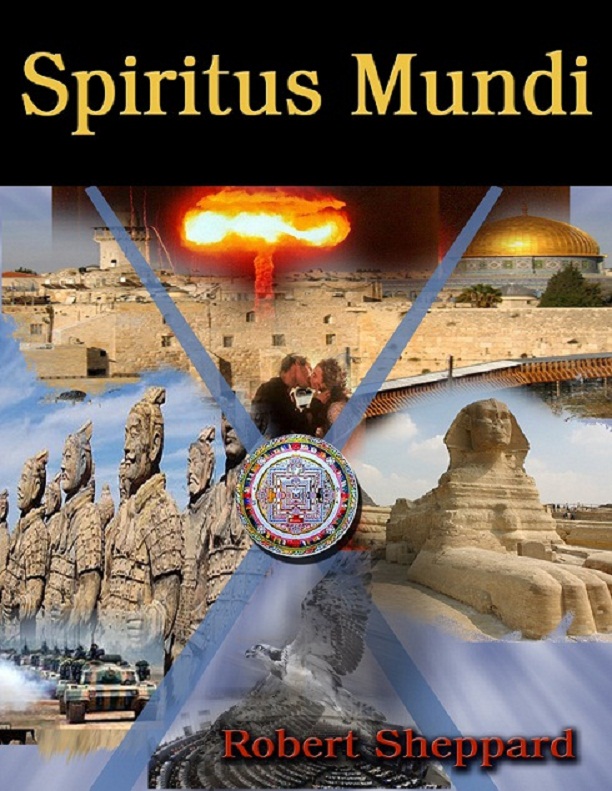
SPIRITUS MUNDI BY ROBERT SHEPPARD NOMINATED FOR PRESTIGIOUS PUSHCART 2014 AWARD– GET YOUR FREE COPY OF SPIRITUS MUNDI NOW DURING THE PUSHCART PRIZE FREE GIVEAWAY CELEBRATION FROM THANKSGIVING TO CHRISTMAS

SPIRITUS MUNDI BY ROBERT SHEPPARD NOMINATED FOR PRESTIGIOUS PUSHCART 2014 AWARD– GET YOUR FREE COPY OF SPIRITUS MUNDI NOW DURING THE PUSHCART PRIZE FREE GIVEAWAY CELEBRATION FROM THANKSGIVING TO CHRISTMAS

World Literature Forum is  honored to announce that Spiritus Mundi, Novel by Robert Sheppard has been included in the nominations for the presitigious Pushcart Prize, including several of the “Poems from Spiritus Mundi,” which appear as an embedded and integral part of the novel.

In celebration of the Pushcart Prize Nomination  for Spiritus Mundi a Pushcart Prize  Giveaway Celebration has been declared from Thanksgiving to Christmas in which Spiritus Mundi, Book I will be made available free on Smashwords and affiliated outlets, including Barnes & Noble and many others.

TO GET YOUR FREE e-COPY OF PUSHCART PRIZE NOMINEE ROBERT SHEPPARD’S SPIRITUS MUNDI NOW FOLLOW THIS SMASHWORDS LINK TO DOWNLOAD:

Spiritus Mundi Book I, The Novel (5.0 Stars on Smashwords) https://www.smashwords.com/books/view/303856

Spiritus Mundi Book I is also discounted on Amazon during the Pushcart Prize Giveaway Celebration period, and Spiritus Mundi Book II, The Romance is discounted $1.00 off the retail price to $3.99 on Smashwords and Amazon.

The Pushcart Prize is an American literary prize by Pushcart Press that honors the best “poetry, short fiction, essays or literary whatnot”published in the small presses over the previous year. Magazine and small book press editors are invited to nominate up to six works they have featured. Anthologies of the selected works have been published annually since 1976.

The founding editors are Anaïs Nin, Buckminster Fuller, Charles Newman, Daniel Halpern, Gordon Lish, Harry Smith, Hugh Fox, Ishmael Reed, Joyce Carol Oates, Len Fulton, Leonard Randolph, Leslie Fiedler, Nona Balakian, Paul Bowles, Paul Engle, Ralph Ellison, Reynolds Price, Rhoda Schwartz, Richard Morris, Ted Wilentz, Tom Montag, and William Phillips.

Among the writers who previously received early recognition in Pushcart Prize anthologies were: Kathy Acker, Steven Barthelme, Rick Bass, Charles Baxter, Bruce Boston, Raymond Carver, Joshua Clover, Junot Diaz, Andre Dubus, William H. Gass, Seán Mac Falls, William Monahan, Paul Muldoon, Joyce Carol Oates, Tim O’Brien, Lance Olsen,Peter Orner, Kevin Prufer, Kay Ryan, Mona Simpson, Ana Menéndez, and Wells Tower.

Included in the Pushcart 2014 Nominations were several of well-known author Robert Sheppard’s “Poems from Spiritus Mundi” including “Moby Dick” and “Zeno’s Paradox” which were published in and nominated for the Pushcart Prize by Poetry Pacific and available here and on their website:

https://robertalexandersheppard.wordpress.com/2013/04/11/poetry-pacific-3-poems-by-robert-sheppard/

INTRODUCING PUSHCART PRIZE  NOMINEE ROBERT SHEPPARD’S EPIC NOVEL SPIRITUS MUNDI

Author’s E-mail:   rsheppard99_2000@yahoo.com

ON SPIRITUS MUNDI

“Read Robert Sheppard’s sprawling, supple novel, Spiritus Mundi, an epic story of global intrigue and sexual and spiritual revelation. Compelling characters, wisdom, insight, and beautiful depictions of locations all over the world will power you through the book. You’ll exit wishing the story lines would go on and on.” May 13, 2012

Robert McDowell, Editor, Writer, Marketer, Editorial Cra, The Nature of Words

______________________________________________________

“Robert Sheppard’s novel, “Spiritus Mundi,” has everything. “Spiritus Mundi” is Latin, meaning “spirit” or “soul of the world.” According to the Norton Anthology of English Literature, the phrase refers to “the spirit or soul of the universe” with which all individual souls are connected through the “Great Memory.” This amazing novel is all inclusive and unceasingly riveting. If you are interested in politics, philosophy, human relationships, sex, intrigue, betrayal, poetry and even philosophy — buy and read “Spiritus Mundi”!”November 18, 2012

Raymond P. Keen, School Psychologist, Department of Defense Dependents Schools (DODDS)

—————————————————————-

“Robert Sheppard’s new novel “Spiritus Mundi” is a new twist on a well-loved genre. Robert leaves no stone unturned in this compelling page turner you’ll experience mystery, suspense, thrills, and excitement. Robert touches on sexuality and spirituality in such a way that the reader is compelled to ask themselves “what would you do if faced with these trials?” Robert is a master at taking the reader out of their own lives and into the world he created. If you’re looking for a “can’t put down” read pick up Spiritus Mundi!” May 20, 2012

Nicole Breanne, Content Coordinator, Ranker.com _____________________________________________________

“Longing for a thrilling experience of the sexual and spiritual world? Expecting a thorough summoning of your inner heart? Aspiring to find an extraordinary voice to enlighten your understanding heart? Then you can’t miss this extraordinary novel, Spiritus Mundi by Robert Sheppard. The author will spirit you into a exciting world filled with fantasy, myth, conflicts and wisdom from a fresh perspective. Don’t hesitate, just turn to the 1st page and start out enjoying this marvellous journey.”November 17, 2012

Alina Mu Liu, Official Interpreter, Editor & Translator, HM Courts & Tribunal Service, London UK & the United Nations

—————————————————————————— “Robert Sheppard’s Spiritus Mundi is a literary novel for those with an extensive vocabulary, and who believe how you tell a story is as important as what occurs in it. It is as current as today’s headlines.

Jaime Martinez-Tolentino, Writer” November 19, 2012

————————————————————————–

“Robert Sheppard’s exciting new novel, Spiritus Mundi, is an unforgettable read and epic journey of high adventure and self-discovery across the scarred landscape of the modern world and into the mysteries beyond. Its compelling saga reveals the sexual and spiritual lives of struggling global protesters and idealists overcoming despair, nuclear terrorism, espionage and a threatened World War III to bring the world together from the brink of destruction with a revolutionary United Nations Parliamentary Assembly and spiritual rebirth. This modern epic is a must read and compelling vision of the future for all Citizens of the Modern World and a beacon of hope pointing us all towards a better world struggling against all odds to be born.” May 19, 2012

Lara Biyuts, Reviewer and Blogger at Goodreads.com and Revue Blanche

________________________________________________________

“Robert Sheppard’s “Spiritus Mundi” is a book of major importance and depth. A must read for any thinking, compassionate human being living in these perilous times. I highly recommend this powerful testament of the current course of our so-called life on his planet. April 25, 2012

Doug Draime Writer, Freelance

___________________________________________________

“This new novel ‘Spiritus Mundi’ brings together history, politics, future society, and blends with a plausible World War Three scenario. I have read it and find it over the top fascinating. I am very glad to see Robert share his creativity with the world through this work of fiction, and know it will be a huge hit.” April 28, 2012

Jim Rogers, Owner and Director, AXL

______________________________________________

“Robert Sheppard is an exceptional thinker! His work should be read and made the subject of critical study.”May 26, 2012

Georgia Banks-Martin, Editor, New Mirage Journal

——————————————————————————

“This novel rocks the reader with its supple strength. You want to say “No, No,” and you end up saying, “Maybe.” Political science fiction at its highest, most memorable level.”November 17, 2012

Carl Macki, Owner, Carl Macki Social Media

——————————————————————————

“Robert Sheppard’s Novel Spiritus Mundi confronts politics and philosophies of the world. He’s examined multiple layers of personality in his characters; male, female, Chinese, Arab, English, and American melding them into a story of possible outcomes. How else can I convey the intelligent presentation of fiction woven with sensitivity to our world’s governments, religious influences and sectarian principles? We must not forget the influence of a largely secular world. Robert tirelessly checked, rechecked and triple checked his resources in order to bring a fiction of occurrence, and psychological impact as set forth in his novel Spiritus Mundi.”November 18, 2012

Glenda Fralin, Author, Organization NWG

__________________________________________________________

“Robert was one of my best guests. His novel is as wide ranging as are his interests and expertise. He can explain his various ideas with great clarity and he does this with compassion. Novel is worthwhile reading.”November 18, 2012

Dr. Robert Rose, Radio Show Host, http://www.blogtalkradio.com/icdrrose

________________________________________________________________

Related Links and Websites:  Spiritus Mundi, Novel by Robert Sheppard

For Introduction and Overview of the Novel:  https://spiritusmundinovel.wordpress.com/

For Updates on the Upcoming Movie Version of the Novel, Spiritus Mundi & Casting of Actors and Actresses for Leading Roles See: https://robertalexandersheppard.wordpress.com/

To Read Abut the Occupy Wall Street Movement in Spiritus Mundi: http://occupywallstreetnovel.wordpress.com/

For Author’s Blog:  https://robertalexandersheppard.wordpress.com/

To Read a Sample Chapter from Spiritus Mundi: https://spiritusmundisamplechapters.wordpress.com/

To Read Fantasy, Myth and Magical Realism Excerpts from Spiritus Mundi: https://spiritusmundifantasymythandmagicalrealism.wordpress.com/

To Read Sexual Excerpts from Spiritus Mundi: The Varieties of Sexul Experience:  https://spiritusmundivarietiesofsexualexperience.wordpress.com/

To Read Spy, Espionage and Counter-terrorism Thriller Excerpts from Spiritus Mundi:   http://spiritusmundispyespionagecounterterrorism.wordpress.com/

To Read Geopolitical and World War Three Excerpts from Spiritus Mundi: https://spiritusmundigeopoliticalworldwar3.wordpress.com/

To Read Spiritual and Religious Excerpts from Spiritus Mundi: https://spiritusmundionspiritualityandreligion.wordpress.com/

To Read about the Global Campaign for a United Nations Parliamentary Assembly in Spiritus Mundihttps://spiritusmundiunitednationsparliamentaryassembly.wordpress.com/

To Read Poetry from Spiritus Mundihttps://spiritusmundipoetry.wordpress.com/

For Discussions on World Literature and Literary Criticism in Spiritus Mundi:   http://worldliteratureandliterarycriticism.wordpress.com/

For Discussions of World History and World Civilization in Spiritus Mundi:  https://worldhistoryandcivilizationspiritusmundi.wordpress.com/

To Read the Blog of Eva Strong from Spiritus  Mundi: https://evasblogfromspiritusmundi.wordpress.com/

To Read the Blog of Andreas Sarkozy from Spiritus Mundi: http://andreasblogfromspiritusmundi.wordpress.com/

To Read the Blog of Yoriko Oe from Spiritus Mundi: http://yorikosblogfromspiritusmundi.wordpress.com/

To Read the Blog of Robert Sartorius from Spiritus Mundi: http://sartoriusblogfromspiritusmundi.wordpress.com/

I write to introduce to your attention  my double novel Spiritus Mundi, consisting of Spiritus Mundi, the Novel—Book I, and Spiritus Mundi, the Romance—Book II. Book I’s espionage-terror-political-religious thriller-action criss-crosses the globe from Beijing to New York London to Washington, Mexico City and Jerusalem presenting a vast panorama of the contemporary international world, including compelling action from the Occupy Wall Street Movement to espionage and a threatened World War Three, deep and realistic characters and surreal adventures, while Book II dialates the setting and scope into a fantasy (though still rooted in the real) adventure where the protagonists embark on a quest to the realms of Middle Earth and its Crystal Bead Game and through a wormhole to the Council of the Immortals in the Amphitheater in the center of the Milky Way Galaxy in search of the crucial Silmaril Crystal, and to plead for the continuance of the human race in the face of threatened extinction from a nuclear World War III, all followed by a triple-somersault thriller ending in which a common garden-variety terrorist attack is first uncovered by MI6 and the CIA  as the opening gambit a Greatpower Game of States threatening World War III and then, incredibly, as the nexus of a Time Travel conspiracy involving an attempt by fascist forces of the 23rd Century to alter a benign World History by a time-travelling raid on their past and our present to provoke that World War III, foiled by the heroic efforts of the democratic 23rd Century world government, the Senate of the United States of Earth, to hunt down the fascist interlopers before their history is irrevocably altered for evil.

When activist Robert Sartorius, leading a global campaign  to create a European Parliament-style world-wide United Nations Parliamentary Assembly presses  the proposal in New York on his old friend the UN Secretary-General and is rebuffed due to the hostile pressure of the conservative American administration, his Committee  resolves to fight back by launching a celebrity-driven Bono-Geldof-Band Aid/Live 8-style “People Power” media campaign and telethon, allied to the Occupy Wall Street movement and spearheaded by  rock superstars Isis and Osiris and former UN Secretary General Boutros Boutros-Ghali to mobilize global public support and pressure.  The Blogs of Sartorius, activist Eva Strong and Committee Chairman Andreas Sarkozy reveal the campaign’s working struggle, their tangled love affairs, a loss of faith, attempted suicide, reconciliation of father and son after divorce,  and recovery of personal love and faith.

Things fall apart as the idealists’ global crusade is infiltrated by a cell of jihadist terrorists using it as a cover, then counter-infiltrated by CIA agent Jack McKinsey and British MI6 agent Etienne Dearlove. A cat-and-mouse game of espionage and intrigue ensues pitting them against the Chinese MSS espionage network allied with the Iranian Quds Force crossing  Beijing, London, Moscow, Washington and Jerusalem unleashing an uncontrollable series of events which sees the American Olympic Track and Field Team bombed on an airplane in London, uncovers a secret conspiracy of China, Russia and Iran to jointly seize the oil reserves of the Middle-East, and witnesses  Presidents Clinton and Carter taken hostage with Sartorius, McKinsey, Eva and other activists at a Jerusalem telethon rally cut short by the explosion of a concealed atomic device in a loaned Chinese Terracotta Warrior, then flown by capturing terrorists to Qom, Iran as “human shields” to deter a retaliatory nuclear attack.

In Book II, Spiritus Mundi, the Romance they encounter Iran’s Supreme Leader in Qom as the world teeters on the brink of nuclear confrontation and World War III, while mysterious events unfold leading Sartorius and McKinsey from their captivity in the underground nuclear facilities of Qom into a hidden neo-mythic dimension that takes them to a vast ocean and land at the center of the world, Middle Earth, Inner Shambhala, and to involvement in a mysterious Castalian “Crystal Bead Game” linked to the destiny of the human race on earth. They then embark on a quest for the Silmaril, or Missing Seed Crystal to the central island of Omphalos in the Great Central Sea in the middle of the globe, aided by Goethe, the Chinese Monkey King, Captain Nemo, the African God-Hero Ogun, and a Sufi mystic they traverse a ‘wormhole’ at the center of the earth guarded by ‘The Mothers’ and the fallen angel tribe of the Grigori (Genesis 6:1-4) which leads the way to critical meeting of the “Council of the Immortals” at the Black Hole in the center of the Milky Way Galaxy to determine the final fate of the human species. The heroes battle and overcome the treacherous opposition of Mephisto and his satanic subaltern Mundus through their Underworld and Otherworld adventures and successfully plead the cause of the continuation of the human species before the Immortals, returning with the critical Silmaril Crystal. resolving the Crystal Bead Game and thereby inspiring through the Archangel Gabriel a dream in the mind of Iran’s Supreme Leader which brings a new Revelation causing him to release the hostages and an end the crisis. China and Russia stand down from aiding Iran in seizing the Mid-East oil reserves, but in a treacherous blow the Chinese instead utilize their forward-positioned armies to attack their former ally Russia and seize Siberia with its large oil and gas reserves instead. President Barret Osama, America’s newly-elected first black President then invites Russia, Japan and  South Korea to join NATO and together they succeed in expelling the Chinese from Siberia and usher in a new Eurasian and global balance of power and a New World Order.

Rock Superstar Osiris meanwhile, after undertaking a narcissistic Messianic mission in the wake of the Jerusalem atomic blast is dramatically assassinated on live world-wide television on Jerusalem’s Via Dolorosa by a disillusioned follower. His wife and rock-star partner Isis then leads a spiritual movement to reconcile and unite the clashing religions and catalyze a common global spiritual Renaissance through a Global Progressive Spiritual Alliance which seeks to construct an Inter-faith Temple on the ruins of the atomic blast in Jerusalem. In counter-reaction to the cataclysmic events the world finally implements Sartorius’ crusade for a United Nations Parliamentary Assembly, but not before Sartorius has himself has died, Moses-like of a heart attack while helping to foil a metaconspiracy mediated by Time Travel in which a fascist agent from the 23rd Century who has time-transited back to our time to alter a benign history by causing WWIII and thus preventing the evolution of a democratic world government, the United States of Earth, which follows him through time and nabs him just in the “nick of time” to prevent Aramgeddon.  The book ends with the opening ceremony of the UN Parliamentary Assembly which is attended in Sartorius’ name by his widow Eva Strong, whom Sartorius had fallen in love with and married in the course of the novel, and by their son Euphy, newborn after Sartorius’ death. They are joined in cinematic climax at the ceremony by newly chosen UN Secretary-General Clinton, President Osama and UN Parliamentary Assembly Committee Chairman Andreas Sarkozy who have just received the Nobel Peace Prize for their work in creation of the world’s first world parliamentary assembly within the United Nations, bringing together the representative voices of the peoples of the world in face-to-face assembly and dialogue for the first time in world history.

Highlights:

All the Highlights of the novel cannot be contained in such a short Introduction, but a few of them would include:

1.  Spiritus Mundi is the first novel in world history to portray the creation of a United Nations Parliamentary Assemblyon the working model, inter alia, of the European Parliament;

2.   Spiritus Mundi is a prophetic geo-political WWIII novel of the near future forseeing a conflict and conspiratorial surprise attack by a resurgent “Axis” of China, Russia and Iran seeking by a decisive blow in jointly seizing the Middle-East oil fields to radically alter the global balance of power vis-a-vis the West in the world and Eurasia. Like Clancy’s The Bear and the Dragon, it forsees the inclusion of Russia in NATO, and goes far beyond in forseeing the inclusion of South Korea and Japan, following a joint Chinese-Russian occupation of a collapsing North Korea and the Axis strike at the Middle-Eastern oil fields;

3. Spiritus Mundi is an exciting espionage thriller involving the American CIA. British MI6, the Chinese MSS, or Ministry of State Security and the Russian SVR contending in a deul of intrigue and espionage;

4. Spiritus Mundi is a Spellbinding Terrorism/Counterterrorism novel involving a global plot to conceal an atomic bomb in a Chinese Teracotta Warrior to be detonated in Jerusalem;

5. Features the romantic and sexual searching and encounters of dozens of idealist activists, rock-stars, CIA and MI6 agents, public-relations spinmeisters and billionaires with a detour into the bi-sexual and gay scenes of Beijing, New York, California, London and Tokyo:

6.   Establishes and grounds the new genre of the Global Novel written in Global English, the international language of the world,

7. Spiritus Mundi is a novel of Spiritual Searching featuring the religious searching of Sufi mystic Mohammad ala Rushdie, as well as the loss of faith, depression, attempted suicide and recovery of faith in life of protagonist Sartorius. Follows bogus religious cult leaders and the Messiah-Complex megalomanic-narcissistic mission of rock superstar Osiris that leads to his dramatic assassination on worldwide television in Jerusalem, followed by the religious conversion of his wife and rock-star parner Isis;

8.   Features the search for love and sexual fulfillment of Eva Strong, a deeply and realistically portrayed divorced single mother involved in the United Nations campaign, who reveals her tortured heart and soul in her Blog throughout several disastrous sexual affairs and ultimately through her final attainment of love and marriage to Sartorius;

9.   Features Sartorius’ experience of a bitter divorce, alienation and reconciliation with his son, his loss of faith and attempted suicide, his battle against drugs and alcoholism, his surreal and sexual adventures in Mexico City, and his subsequent redeeming love and marriage to Eva Strong;

10.   Contains the in–depth literary conversations of Sartorius and his best friend, Literature Nobel Laureate Günther Gross, as they conduct  worldwide interviews and research for at book they are jointly writing on the emergence of the new institution of World Literature, building on Goethe’s original concept of “Weltliteratur” and its foundations and contributions from all the world’s traditions and cultures;

11.   Predicts the emergence of the institution and quest of “The Great Global Novel” as a successor to the prior quest after “The Great American Novel” in the newer age of the globalization of literature in Global English and generally;

12.   Features the cross-cultural experiences and search for roots, sexual and spiritual fulfillment and authenticity of Asian-American character Jennie Zheng, and  Pari Kasiwar of India;

13.         For the first time incorporates in the dramatic narrative flow of action the mythic traditions of all the cultures and literatures of the world, including such figures as Goethe, The Chinese Monkey King, the African God-Hero Ogun, surreal adventures in the ‘Theatro Magico’ in Mexico City bringing to life figures from the Mayan-Aztec Popul Vuh, Hanuman from the Indian classic the Ramayana, and many more;

14. Book Two, Spiritus Mundi, the Romance is a fantastic Fantasy, Myth and Magical Realism Rollercoaster Ride:   The more mythic Book Two utilizes a Wellsian motif of Time Travel to explore the making of history and its attempted unmaking (a la Terminator) by a hositile raid from the future on the past, our present, and the foiling of the fascist attempt by an alliance of men and women of goodwill and courage from past, present and future generations united in a Commonwealth of Human Destiny; Like Thomas Pynchon’s Against the Day and Welles’ Journey to the Center of the Earth it involves a journey to an interior realm of the “Middle Earth;” it also contains a futuristic travel through a wormhole to the center of our Milky Way Galaxy for a meeting with the “Council of the Immortals” where the fate of the human race will be decided;

15.  Is a fantastic read on a roller-coaster ride of high adventure and self-exploration!

C   Copyright 2011 Robert Sheppard   All Rights Reserved

NEW BOOK RELEASE: SPIRITUS MUNDI BY ROBERT SHEPPARD NOW AVAILABLE ON AMAZON!

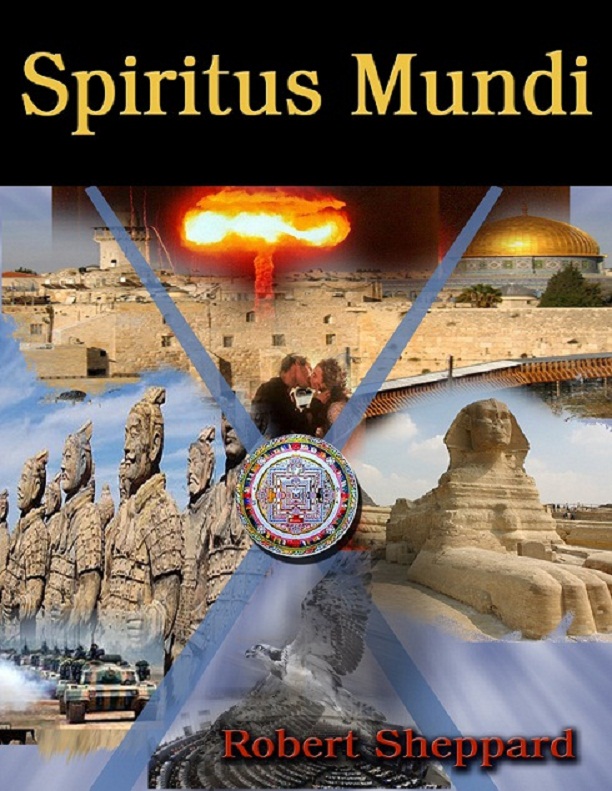
Spiritus Mundi Book Cover.80.3

PUSHCART PRIZE NOMINEE ROBERT SHEPPARD’S SPIRITUS MUNDI NOW AVAILABLE ON AMAZON! —–INVITATION TO LISTEN TO MAY 17 BLOGTALKRADIO INTERVIEW WITH AUTHOR 10:00 AM PST _______________________________________________________________________

We are pleased to announce the launch of SPIRITUS MUNDI on AMAZON , including both Spiritus Mundi, Book I: The Novel (5.0-Star Amazon Rating Average), and Spiritus Mundi, Book II:The Romance (5.0-Star Amazon Rating Average). You can browse and sample both onlline for free now, then purchase immediaetly by clicking on the following Amazon sites:

Spiritus Mundi, Book I: The Novel: http://www.amazon.com/dp/B00CIGJFGO

Spiritus Mundi, Book II: The Romance http://www.amazon.com/dp/B00CGM8BZG

CHECK OUT SPIRITUS MUNDI’S 5.O-STAR GOODREADS RATING AVERAGE & REVIEWS ON GOODREADS:

Book I (5.0-Stars on Goodreads) http://www.goodreads.com/book/show/17857619-spiritus-mundi-book-i

Book II (5.0-Stars on Goodreads) http://www.goodreads.com/book/show/17857704-spiritus-mundi-book-ii-the-romance

CHECK OUT A FULL SUMMARY OF SPIRITUS MUNDI ON SHELFARI before purchasing at:

http://www.shelfari.com/books/36123188/Spiritus-Mundi—Book-I-The-Novel http://www.shelfari.com/books/36123187/Spiritus-Mundi—Book-II-The-Romance

Spiritus Mundi is also available on SMASHWORDS in ALL FORMATS:

Book I (5.0 Stars on Smashwords) https://www.smashwords.com/books/view/303856 Book II (5.0 Stars on Smashwords) https://www.smashwords.com/books/view/303798

Spiritus Mundi is also now available at the following sites:

Spiritus Mundi: Book I: The Novel https://www.smashwords.com/books/view/303856 http://www.barnesandnoble.com/w/spiritus-mundi-robert-sheppard/1115113181?ean=2940044432598&itm=1&usri=2940044432598 http://www.kobobooks.com/ebook/Spiritus-Mundi-Book-The-Novel/book-vYffC7MUUEyN0wJTQSpgFQ/page1.html https://itunes.apple.com/us/book/spiritus-mundi/id634577546?mt=11 http://www.diesel-ebooks.com/item/SW00000303856/Sheppard-Robert-Spiritus-Mundi-Book-I-The-Novel/1.html

Spiritus Mundi – Book II: The Romance https://www.smashwords.com/books/view/303798 http://www.barnesandnoble.com/w/spiritus-mundi-robert-sheppard/1115113152?ean=2940044433182&itm=1&usri=2940044433182 http://www.kobobooks.com/ebook/Spiritus-Mundi-Book-II-The/book-PlMhvFBI5USTGkLFnO1TQA/page1.html https://itunes.apple.com/us/book/spiritus-mundi-book-ii-romance/id634586781?mt=11 http://www.diesel-ebooks.com/item/SW00000303798/Sheppard-Robert-Spiritus-Mundi-Book-II-The-Romance/1.html

CELEBRATING SPIRITUS MUNDI’S AMAZON RELEASE DAY WITH MAY 17 BLOGTALKRADIO AUTHOR INTERVIEW WITH DR. ROBERT ROSE 10:00 AM PST __________________________________________________________________________

We also invite you to listen in to the  BlogTalkRadio Interview with Dr. Robert Rose interviewing Robert Sheppard on the topic of “World Consciousness and the Emergencer of World Literature” pre-recorded May 17, 10:00 AM, PST:

How to Tune In: ============ You can tune in by clicking on the following BlogTalkRadio link:

http://www.blogtalkradio.com/icdrrose/2013/05/17/robert-sheppard-global-consciousness

or you can listen in anytime to the recorded Podcasts of the May 17 Interview, or past Interviews:

http://www.blogtalkradio.com/icdrrose http://www.blogtalkradio.com/icdrrose/2012/08/01/robert-sheppard–spiritus-mundi-a-novel

Spiritus Mundi, Novel by Robert Sheppard: Table of Contents

Spiritus Mundi

Contents

Book One Spiritus Mundi: The Novel Chapters 1-33

  1. Departure (Beijing)
  2. A Failing Quest (New York)
  3. War Council & Counteroffensive (Geneva)
  4. New Beginnings (London)
  5. Republic of Letters (Berlin)
  6. Fathers and Sons (Washington,D.C.)
  7. Ulysses: Blogo Ergo Sum (Beijing)
  8. Frequently Asked Questions (London)
  9. In the Middle Kingdom (Beijing)

10. Past and Present (London-South Africa)

11. Telemachus (Washington, D.C.)

12. The Everlasting Nay (Beijing)

13. My Brother’s Keeper (London)

14. In the Global Village (Beijing-Tokyo)

15. Deceits and Revelations (London)

16. Be Ready for Anything (Beijing)

17. The Obscure Object of Desire (London-Pyongyang)

18. Sufferings (Beijing)

19. Of the Yearnings of the Caged Spirit (London)

20. Cyclops (Washington, D.C.)

21. The Engines of Illusion (Beijing)

22. On Her Majesty’s Secret Service (London)

23. The Temptation of the Sirens (Beijing)

24. Truth or Consequences (London)

25. Lazarus Laughed (Beijing)

26. Neptune’s Fury & The Perils of the Sea (The Maldive Islands)

Naval Diaries and Ship’s Logs of Admiral Sir George Rose Sartorius (1780-1875)

27. Penelope (London)

28. The Volcano’s Underworld (Mexico City)

Teatro Magico

29. The Everlasting Yea (London)

30. Paradise Regained (Little Gidding)

31. To the South of Eden (Kenya-to Midrand-Johannesburg South Africa)

32. In a Glass Darkly (London)

33. Spiritus Mundi

Book Two Spiritus Mundi: The Romance Chapters 1-21

  1. Gerusalemme Liberata & Orlando Furioso (Jerusalem)
  2. In a Glass Darkly (London)
  3. Great Expectations (Jerusalem)
  4. The Parable of the Cave (Qom, Iran)
  5. The Xth Day of the Crisis (London)
  6. The Supreme Leader & The Three Messiahs (Qom)
  7. Going for the Jugular (London)
  8. The Night Journey, Goethe & The Monkey King (Qom)
  9. The Central Sea, The Crystal Bead Game & The Quest

10. The Island of Omphalos & The Mothers

11. The Council of the Immortals & The Trial By Ordeal

12. Nemesis

13. Armageddon (London)

14. The Fever Breaks

15. High Noon & Showdown at the OK Corral (Washington, D.C.)

16. Ecce Homo (Jerusalem)

17. Deliverance (London/Lhasa)

18. For Every Action…. (Moscow/Beijing)

19. The Burial of the Dead (London/Little Gidding)

20. Spiritus Mundi (London/Jerusalem)

21. In My End is My Beginning

—-The Convening of the First Meeting of the

United Nations Parliamentary Assembly (New York)

Appendix 1: A United Nations Parliamentary Assembly: Frequently Asked Questions

Appendix 2: Spiritus Mundi: Index of Principal Characters

C  Copyright Robert Sheppard 2011 All Rights Reserved

Posted in Uncategorized | Tagged , , , , , , , , , , , , , , , , , , , , , , , , , , , , , , , , , , , , , , , , , , , , , , , , , , , , , , , , | Leave a comment

A UNITED NATIONS PARLIAMENTARY ASSEMBLY: AN IDEA WHOSE TIME HAS COME

A UNITED NATIONS PARLIAMENTARY ASSEMBLY: AN IDEA WHOSE TIME HAS COME
UN Parliamentary Assembly.03

The great problems of our times – such as the World Economic Crisis,  war and peace, Global Warming and climate change, international terrorism, epidemic diseases such as AIDS -– cannot be solved by individual nations acting alone. It is more and more obvious in our Era of Globalization that the most fundamental problems affecting the lives of individuals can only be addressed by global action on a worldwide basis, and that the mechanisms of the past for doing so, such as informal intergovernmental cooperation as in the G-20 and such treaty conventions as the glacially-paced failed Climate Change conferences of Copenhagen, South Africa and Warsaw are ineffective, slow, unwieldly and so divorced from the people as to suffer fatal democratic deficits.

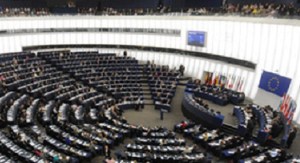
At the same time our international institutions have been slowly evolving more effective models for international and global governance, most successfully in the case of the European Parliament of the European Uniion (EU), which brings together the elected representatives of 27 European Union member states in a permanent parliamentary assembly representing not simply the member states and their governments, but the independent elected representatives of all segments of European public opinion, whether in government or in opposition. The pioneering model of the European Parliament has now been copied across the world with analogous parliamentary assemblies now in sucessful operation, such as the Pan-African Parliament of the African Union (AU), the Arab Parliament of the Arab League and the Latin-American Parliament (Parlatino). Now that the concept of an international parliamentary assembly has been proven on the ground passing the test of time and reality, the time is now ripe for the creation of such an institution on a global scale as a new organ of the United Nations beside the existing General Assembly and Security Council to enable the United Nations and our system of global governance to be strengthened to an extent necessary to solve our globalized problems in a globalized world, and to bring  the United Nations and its related international institutions into closer communication, responsiveness and accountability to the peoples of the world, not just governments in power, and by so doing address the democratic deficit in our system of global governance.

An ergetic coalition under the leadership of former United Nations Secretary-General Boutros Boutros-Ghali is now working hard and effectively to bring about the creation of a United Nations Parliamentary Assembly, spearheaded by the Campaign for a United Nations Parliamentary Assembly whose website is accessible at:

Campaign for a United Nations Parliamentary Assembly:  http://en.unpacampaign.org/about/unpa/index.php
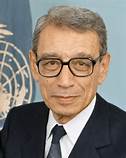
Former United Nations Secretary-General Boutros Boutros-Ghali, leader of the Campaign for a United Nations Parliamentary Assembly (UNPA)

The European Parliament has endorsed the creation of such a UN Parliamentary Assembly and it is supported by hundreds of Members of European Parliament and similar support groups across the world. The fact that it is supported by the former UN Secretary-General and the European Parliament and Pan-African Parliament proves both that it is a highly practical, tested and workable idea whose time has come.
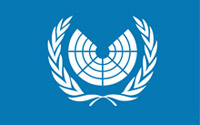
The Proposed Logo of the United Nations Parliamentary Assembly featuring the "benches" at which the elected representatives would sit.
The Proposed Logo of the United Nations Parliamentary Assembly featuring the “benches” at which the elected representatives would sit.

A United Nations Parliamentary Assembly (UNPA) for the first time would give citizen representatives, not only states, a direct and influential role in global policy. The assembly would not replace existing UN bodies but would be an additional means to integrate parliamentarians more effectively into the shaping of globalization. In tabling this initiative it is also important to clarify what a United Nations Parliamentary Assembly would not be. It would not be a world government. It would not in any way attempt to make law on a global scale or in any way limit the sovereignty of existing national governments. The existing United Nations General Assembly and the Security Council would continue to exist side-by-side with the new UNPA and would continue their existing work, just as the national governments of the EU along with the European Council continue to function alongside the European Parliament. The creation of a United Nations Parliamentary Assembly, at least initially would not increase or decrease the sovereignty of UN member states nor alter the powers of the existing UN organs, the Generally Assembly and Security Council. Instead, it would add the voice of the peoples of the world to the existing institutions and increase their accountability to those peoples, from whom they derive all their existing powers.

Direct citizen representation could help the world develop a greater understanding of itself as a global community. At the highest levels of the United Nations, a UNPA could function as a world conscience and watchdog, and a catalyst for further reforms. Over time, the UNPA could evolve from a consultative body to a world parliament with genuine rights of information, participation and control.

As a transitional step until global direct elections become practical, the UN Parliamentary Assembly could consist of delegates from national and possibly regional parliaments, reflecting their political diversity. The UNPA would therefore include members of minority parties whose opinions are often not represented in the United Nations. Unlike current UN ambassadors, UNPA representatives would not be subject to the authority, direction or control of national governments. These parliamentarians would be free to ask probing questions, raise sensitive issues, and table innovative proposals for consideration by the Security Council, the General Assembly, the Bretton Woods financial institutions and other UN bodies, just as the European Parliament successfully functions within the European Union.

Contrary to popular belief, creation of a United Nations Parliamentary Assembly would be procedurally quite easy as all that is required is a majority vote of the UN General Assembly, and its creation is not subject to any veto power under the United Nations Charter. A consultative Parliamentary Assembly at the UN could be established as a subsidiary body by a simple vote in the General Assembly under Article 22, without changing the UN Charter. The historical record demonstrates, as with the Land Mines Treaty and the International Criminal Court, that if a few countries urged on by civil society take the lead, significant transformation at the international level is indeed possible. “We the People” of the World can bring about this fundamental democratic change through an energetic “People Power” campaign pressuring our national governments to vote “Yes” on the proposal in the UN General Assembly.

If the creation of a United Nations Parliamentary Assembly is so drastically needed to address the core problems of our age and it is so procedurally easy to accomplish it, you may ask, why hasn’t it been done already? One reason is that the proposal has often been misunderstood when raised, both from those who have hoped or feared too much from the proposal and those who have expected too little. Many people dismiss the idea as an unworkable utopian dream by mistakenly thinking that the UNPA would hope to bring about a “One World Government” replacing or subordinating existing nation-states in one swoop. But this is a “red herring” and “straw-man” argument irrelevant to reality. The United Nations Parliamentary Assembly would not reduce the sovereignty or freedom of action of any national governemnt and is neither utopian nor a threat. Its work would be essentially similar and of restricted scope to that of the European Parliament within the EU, which no one sees as a threat.

A second reason for resistance to the idea is the natural disinclination of existing governments, regimes and powerholders to any limitation of their personal powers. But the idea of democracy on the national or international level is precisely that power holders MUST be made accountable to their peoples and that applies to the international arena as well as the national arena. Clemenceau famously said that “war is too important to be left to the generals.” and a fortiori government and global governance in an age of globalization is far too important to the lives of the people to be left to the nation-states, the diplomats, heads-of-state, regimes, generals and power holders of the world, and you and I and the peoples of the world must insist that they finally be made accountable to the people and their interests above and beyond the “power game” interests of those functionaries and politicians who purport to act in the people’s name but place priority on the exercise of their own power. That is what democracy, national and international, is all about.

We urge all the “People of the World” to support Secretary-General Boutros Boutros-Ghali and the Campaign for a United Nations Parliamentary Assembly, and encourage you to access their website to learn more and contribute your support. We also urge all Americans to write to President Obama and Secretary of State Kerry to introduce and support the proposal for its creation in the UN General Assembly. Leadership in its creation would be the crowning acheivement of this outgoing administration and and merit the awarding of a further edition of the Nobel Peace Prize for all concerned.

The novel Spiritus Mundi by Robert Sheppard is the first novel in World Literature to expressly illustrate and urge the creation of a United Nations Parliamentary Assembly for global democracy.  Below is the an FAQ, or “Frequently Asked Questions” concerning the concept of a United Nations Parliamentary Assembly which appears as an embedded part of the novel.  The novel may also be accessed at:

Spiritus Mundi Book Cover.80.3

PUSHCART PRIZE NOMINEE ROBERT SHEPPARD’S NOVEL SPIRITUS MUNDI _______________________________________________________________________

We are pleased to announce the launch of SPIRITUS MUNDI on AMAZON , including both Spiritus Mundi, Book I: The Novel (5.0-Star Amazon Rating Average), and Spiritus Mundi, Book II:The Romance (5.0-Star Amazon Rating Average). You can browse and sample both onlline for free now, then purchase immediaetly by clicking on the following Amazon sites:

Spiritus Mundi, Book I: The Novel: http://www.amazon.com/dp/B00CIGJFGO

Spiritus Mundi, Book II: The Romance http://www.amazon.com/dp/B00CGM8BZG

CHECK OUT SPIRITUS MUNDI’S 5.O-STAR GOODREADS RATING AVERAGE & REVIEWS ON GOODREADS:

Book I (5.0-Stars on Goodreads) http://www.goodreads.com/book/show/17857619-spiritus-mundi-book-i

Book II (5.0-Stars on Goodreads) http://www.goodreads.com/book/show/17857704-spiritus-mundi-book-ii-the-romance

CHECK OUT A FULL SUMMARY OF SPIRITUS MUNDI ON SHELFARI before purchasing at:

http://www.shelfari.com/books/36123188/Spiritus-Mundi—Book-I-The-Novel http://www.shelfari.com/books/36123187/Spiritus-Mundi—Book-II-The-Romance

Spiritus Mundi is also available on SMASHWORDS in ALL FORMATS:

Book I (5.0 Stars on Smashwords) https://www.smashwords.com/books/view/303856 Book II (5.0 Stars on Smashwords) https://www.smashwords.com/books/view/303798

Spiritus Mundi is also now available at the following sites:

Spiritus Mundi: Book I: The Novel https://www.smashwords.com/books/view/303856 http://www.barnesandnoble.com/w/spiritus-mundi-robert-sheppard/1115113181?ean=2940044432598&itm=1&usri=2940044432598 http://www.kobobooks.com/ebook/Spiritus-Mundi-Book-The-Novel/book-vYffC7MUUEyN0wJTQSpgFQ/page1.html https://itunes.apple.com/us/book/spiritus-mundi/id634577546?mt=11 http://www.diesel-ebooks.com/item/SW00000303856/Sheppard-Robert-Spiritus-Mundi-Book-I-The-Novel/1.html

Spiritus Mundi – Book II: The Romance https://www.smashwords.com/books/view/303798 http://www.barnesandnoble.com/w/spiritus-mundi-robert-sheppard/1115113152?ean=2940044433182&itm=1&usri=2940044433182 http://www.kobobooks.com/ebook/Spiritus-Mundi-Book-II-The/book-PlMhvFBI5USTGkLFnO1TQA/page1.html https://itunes.apple.com/us/book/spiritus-mundi-book-ii-romance/id634586781?mt=11 http://www.diesel-ebooks.com/item/SW00000303798/Sheppard-Robert-Spiritus-Mundi-Book-II-The-Romance/1.html

APPENDIX 1:      FROM SPIRITUS MUNDI NOVEL BY ROBERT SHEPPARD

A UNITED NATIONS PARLIAMENTARY ASSEMBLY: FREQUENTLY ASKED QUESTIONS (FAQ)

Contents

General questions………………………………………………………………………………………………….. ….1

1.1. What is a parliamentary assembly?…………………………………………………………………. 1

1.2. What is so important about a UNPA?………………………………………………………………..1

1.3. Since publication of the strategy paper, what new aspects did come up?……………….1

1.4. What is the Global Marshall Plan and what has it to do with the UNPA project?……..1

1.5. Don’t we have enough bodies and bureaucracy already at the international level?….2

1.6. What are the preconditions of a world parliament? Isn’t the idea simply an utopia?…2

1.7. Following the principle of subsidiarity, government should be brought as near to the people as possible and people should enjoy maximum freedom within the law to run their

own lives. Would a global assembly really help to advance such freedom in any significant

way?………………………………………………………………………………………………………………… …3

1.8. Before we can elect an assembly for the world, the world should be willing to become

a governable entity. Instead of moving in that direction, it is becoming more fragmented

and polarized. Isn’t this obstructing the idea to set up a UNPA?…………………………………. 3

1.9. Doesn’t the Inter Parliamentary Union already fulfill the function of a UNPA?…………3

1.10. . What makes you think this would really work?—–Are there any successful real world experiences to draw upon?………………………………………………………. …………….…4

1.11. What’s the history of the idea of a world parliament going back to WWI and earlier, and why hasn’t it been realized since that time? ……………………………………………………………………………………………………………………. 4

1.12. Wouldn’t international cooperation become even more complicated and ineffective if

a UNPA would have a say?………………………………………………………………………………….. 4

1.13. Not all UN politics are to the good of the people why then concentrate on the UN

at all?……………………………………………………………………………………………………………….. 5

Creation of a UNPA………………………………………………………………………………………………… 9

2.1. . Wouldn’t a UNPA be too hard to establish?  Is a reform of the UN Charter needed to establish a UNPA? Wouldn’t some big country just veto it?………………………………………. 9

2.2. Where will the UNPA be located?……………………………………………………………………. 9

2.3. Which are the steps to be taken for the creation of this new body?……………………….. 10

2.4. How much does a UNPA cost and where would the money come from?……………….. 10

2.5. Couldn’t civil society organize its own world parliament? Why draw upon national parliaments?…………………………………………………………………………………………………………. 11

Design of a UNPA………………………………………………………………………………………………………….12

3.1. How many members will each country have?……………………………………………………. 7

3.2. If such a planetary assembly would be popularly elected, a third of the seats would go

to China and India. What voice would people from smaller countries have?…………………. 7

3.3. How can one have free elections for the UNPA in countries that do not allow free

elections for their citizens at all?……………………………………………………………………………. 7

3.4. Are there other models than that recommended by CUNPPA? ………………………………..8

3.5. How can the ordinary citizen participate in the work of a UNPA?………………………….. 8

3.6. Why should the maximum number of delegates range between 700 and 900?……….. 8

Rights and functions………………………………………………………………………………………………………….. 8

4.1. What would a United Nations Parliamentary Assembly do?—–What would the main functions of a UNPA be?………………………………………………………………………………………. 8

4.2. Would delegations of the UNPA have the right to participate in international governmental conferences? …………………………………………………………………………………. 9

4.3. Can you give some examples where parliamentary control of international action

would have been crucial?…………………………………………………………………………………….. 9

4.4. What is the ultimate aim of establishing a UNPA?……………………………………………. 10

Campaign for a UNPA…………………………………………………………………………………………………… 10

5.1.What can I do to support the campaign?…………………………………………………………. 10

5.2. Which governments support the UNPA proposal?……………………………………………. 10

5.3. Which parliaments support the UNPA proposal?……………………………………………… 11

5.4. Who else is supporting the idea?…………………………………………………………………… 11

5.5 What Testimonials and Statements of Support has the Campaign for a United Nations Parliamentary Assembly received from Parliaments, NGO’s and notable individuals?

5.6. What are the views inside the IPU about the CUNPPA campaign? ……………………….11

5.7. What if the United States or another veto power does not support the proposal?….. 12

United Nations Parliamentary Assembly FAQ

General questions

1.1    What is a parliamentary assembly?

An international parliamentary assembly is a consultative body attached to an international

organization. It is usually composed of parliamentarians appointed by the parliaments of the organization’s member states. Examples of existing parliamentary assemblies include: The

Pan African Parliament, the NATO Parliamentary Assembly, The Parliamentary Assembly of the Council of Europe, the Parliamentary Assembly of the OSCE, the Parliamentary Assembly of the Black Sea Economic Cooperation and the Parliamentary Assembly of the Francophonie. A Parliamentary Assembly may also be constituted by direct international elections, as in the case of the European Parliament of the European Union, to date the most highly evolved example and model of a Parliamentary Assembly. Existing models may evolve into the future to assume the greater powers of a true constitutional Parliament.  However, as yet no parliamentary assembly exists on the global level. For a fuller discussion of the concept of a United Nations Parliamentary Assembly see:

http://en.wikipedia.org/wiki/United_Nations_Parliamentary_Assembly

1.2   What is so important about a UNPA?

Currently, the governance of the international system is a process exclusively betweengovernments. An international representation of citizens or parliamentary control of international governmental action and international organizations as such, does not exist. A United Nations Parliamentary Assembly would address this democracy deficit or “democratic deficit” by introducing the voice of the citizens into the United Nations and international politics. The membership of the assembly would reflect the composition of national parliaments and thus would also include members of opposition parties who are not participating in government. Furthermore, in contrast to government diplomats, members of the UNPA would be free from instructions, free to take a global perspective and to represent the world community as such. In addition, a UNPA would be an important link between the citizens and the United Nations who step by step could be vested with information, participation and control rights and therefore would act as body for international parliamentary oversight. It could serve as a parliamentary umbrella for international cooperation. By addressing issues concerning global governance and United Nations reform, it could become a political catalyst for the further development of the international system and eventually could be transformed into a principal organ of a reformed United Nations.

Furthermore a Parliamentary Assembly is increasingly necessary as a matter of efficiency to provide a permanent and continuous forum in international treaty negotiations such as the Climate Change conferences in Bali, Copenhagen and Durban, and to make them more democratic. The experience of the Climate Change, WTO and other specialized international conferences is that it is simply not workable to merely convene a treaty Conference every two, five or eight years for two weeks to deal with these subjects. There needs to be a permanent assembly with specialized committees working continuously on debate, consensus building and treaty drafting on these matters with continuous dialogue and feedback between governments and civil society to avoid the too sporadic, short and demonstration disrupted plenary conferences which are now far too slow and obsolete.

1.3   Since publication of the strategy paper, what new aspects have come up?

The strategy paper of the Committee for a United Nations Parliamentary Assembly (CUNPPA) on the establishment of a United Nations Parliamentary Assembly (UNPA) was released in September 2004 and published as paperback book in May 2005. The discussion on the recommendations included in the paper is an open ended process. At some point, the Committee will publish a follow up paper reviewing its strategy and considering enhancements and changes.

Important aspects which came up with regard to the basic concept are the inclusion of a delegation of the European Parliament into a UNPA (being a directly elected parliament), the possible inclusion of representatives of indigenous peoples, means to guarantee gender equality in the UNPA and the question whether and how local decision makers may be included as well.

1.4. What is the Global Marshall Plan and what has it to do with the UNPA

project?

The Global Marshall Plan (GMP) has developed out of a nongovernmental initiative. It aims at a better design of globalization and global economic processes: a so called worldwide“ eco-social market economy.“ The focus lies on an improved global structural framework, sustainable development, the eradication of poverty, environmental protection and equity, altogether thought to be resulting in a new global economic miracle. The Global Marshall

Plan includes the following five core goals:

1)     implementation of the globally agreed upon UN Millennium Goals by 2015;

2)  raising of an additional 100 billion US$ a year required to achieve the Millennium Goals, to enhance worldwide development;

3)     fair and competitively, neutral raising of these necessary resources, also by burdening global financial and other transactions;

4)     gradual establishment of a worldwide eco-social market economy with an improved global policy framework through the interlinking of established rules and agreed upon

standards for economic, environmental and social issues (WTO, ILO and UNEP standards);

5)      new forms of appropriation of funds directed to the grassroots level, while at the same time fighting corruption.

In the view of the Committee for a United Nations Parliamentary Assembly the connection of the Global Marshall Plan and the United Nations Parliamentary Assembly proposal is twofold.

Firstly, the dual aims of enhancing economic and political opportunities for the people are deeply interwoven. Democracy embraces both fair economic and fair political participation in a given society. They are two sides of the same coin which cannot do without each other in the long run. On a global scale, the effort to establish a UNPA therefore covers the political side whilethe GMP covers the economic one.

On an operational level a UNPA as independent and democratically legitimate body could have a the function of guaranteeing accountability of the GMP’s use of money. Administering sums as large as 100 billion US$ a year makes effective control and oversight necessary. This could be provided by an international parliamentary body such as the UNPA.

Links: http://globalmarshallplan.org/

1.5. Don’t we have enough bodies and bureaucracy already at the international level?

It’s true that the UN system embraces a multitude of programmes, funds, specialized agencies, institutes and other entities (see chart: http://www.un.org/aboutun/chart.html). While there certainly are opportunities for more efficiency and streamlining, one has to keep in mind that the UN system is designed to take care of the wellbeing of 7 billion people on the international level. Given the growing tasks transferred to the UN by its member states, the UN Secretariat as the core of the system, for example, is very modest in size and budget.

In fact, it cannot fulfill its functions properly because it is not financed and staffed well enough. It has a total staff of about 7,500 and a budget of about 1. 4 billion US Dollars.The New York City Fire Department’s staff alone, for example, is more than two times larger. The combined expenditures of the complete UN system, including, for example, peacekeeping operations, was at 12.3 billion US Dollars in 2001 – less than 2 US Dollars per world inhabitant and year (figures: http://www.globalpolicy.org/finance/tables/tabsyst.htm). The City of New York, in comparison, currently has an annual budget of 52.9 billion US Dollars and thus spends about 6,500 US Dollar per inhabitant and year.

1.6. What are the preconditions of a world parliament? Isn’t the idea simply a utopia?

The idea of a world parliament directly elected by the world’s population with legislative powers embedded into an effective system of global governance—–a true and comprehensive World Parliament in a legally constituted and fully functioning constitutional World Government certainly still is an unrealistic utopia today and the Committee does not advocate or go so far at the present time, which would most likely be unworkable. Instead it advocates a first, but limited step in that direction, creation of a United Nations Parliamentary Assembly of an advisory nature based on already proven models such as the European Parliament of the European Union. In practice the idea of a unified government of the world, or a “United States of Earth” would face insurmountable difficulties because of the extreme social and economic disparities and political differences in development and interests in the world which exist today.

Starting from a broad notion of democracy, encompassing both political and social participation, the concept of international democracy cannot be reduced to merely establishing a new body. This approach could even corrupt the actual intention. The concept rather includes comprehensive questions of human development as well, such as how to create fair economic opportunities for everyone, thus taking on the challenge to reduce extreme poverty and to bridge the wealth divide, or GINI Coeffecient, within as well as between countries. The basic precondition for a world parliament therefore is a minimum of common economic and social welfare in the world which does not yet exist.

On the side of political participation, there are similar problems. The direct, democraticelection of delegates to a world parliament in undemocratic states, for example, is simply not possible. Thus, the creation of a fully democratic world parliament, in addition, depends on the development of stable democratic systems at the level of nation states as well.

These issues in mind, however, the Committee for a United Nations Parliamentary Assembly believes that first steps are possible and urgently needed. This is why it advocates the establishment of a United Nations Parliamentary Assembly.

1.7. Following the principle of subsidiarity, government should be brought as near to the people as possible and people should enjoy maximum freedom within the law to run their own lives. Would a global assembly really help to advance such freedom in any significant way?

Yes. A United Nations Parliamentary Assembly (UNPA) would help to solve global problems which by their nature cannot be dealt with effectively on a local level but affect people’s daily lives. By bringing the voice of the people into the UN system and international relations, a UNPA would contribute to a better understanding and awareness of such global problems. Creating fair economic and social opportunities for the people, for example, is not only a matter of national, regional or local concern. It is also a matter of economic and financial relations in the world. A UNPA therefore is very much in accordance with the principle of subsidiarity since its aim is to enhance the possibility for the citizens to influence the international environment which has an impact on their day to day lives. Subsidiarity means that problems should be dealt with on the level as near to the citizens as possible capable of managing such problems. In case of global problems no such lower level is available. Thus, citizens need an international body to represent them more directly.

1.8. Before we can elect an assembly for the world, the world should be willing to become a governable entity. Instead of moving in that direction, it is becoming more fragmented and polarized. Isn’t this obstructing the idea of setting up a UNPA?

No. On the contrary, we believe that a United Nations Parliamentary Assembly would contribute to bridging national differences. Since a UNPA would be composed of amembership which roughly reflects the political composition of the respective national parliaments and of delegates who in principle are not answerable to or controlled by their home governments but rather more directly to their peoples, these would tend to group according to political orientation rather than divide according to national origin. In this way, delegates would recognize political agreement with fellow parliamentarians from other countries and the need for international solutions would become more apparent. A similar development on the regional level has taken place, for example, in the European Parliament.

1.9. Doesn’t the Inter Parliamentary Union already fulfill the function of a UNPA?

No. The Inter Parliamentary Union (IPU) is a fraternity of members of existing parliaments meeting only on a sporadic and intermittent basis. It does not directly represent the people at the United Nations. It is an umbrella organization and fraternity of a few members of existing parliaments with no connection or input into the United Nations principal organs. The IPU’s goal is to share insights and experiences as members of existing national parliaments and perhaps indirectly channel the views of national parliaments into the UN decision making process, but not to be a continuous deliberative body addressing global problems and needed solutions as its principal activity. Its members are fully absorbed in their work at the national parliament level and have only a small amount of time and effort left over for international efforts. Moreover, its interest is not to democratically control the UN and its decision making by serving as a direct channel for communicating the desires and interests of the underlying peoples, which is the natural role of a genuine parliament. Nor is the IPU at the moment prepared to take on the role of an international legislative organ, which participates in making international laws and regulations through the treaty-making process and otherwise. In a recent paper of 2006, for example, the IPU largely reiterates the Declaration of the First Conference of Presiding Officers of Parliaments of 2000 that the “parliamentary dimension [to international cooperation] must be provided by parliaments first of all at the national level”.

1.10. What makes you think this would really work?—–Are there any successful real world experiences to draw upon?

When imagining the possible development of a United Nations Parliamentary Assembly one can draw first upon the very strong leading example of the European Parliament (EP) as the principal international parliamentary organ of the European Union. Developing out of the Parliamentary Assembly of the European Coal and Steel Community, founded in 1952, the consultative function of the early European Parliament, set up in 1962, was widened to include the right to be heard in legislative processes. Since 1975, the EP has been allowed to co-decide with regard to the budget. At the beginning, the EP consisted of representatives of national parliaments. In 1979, direct election of EP parliamentarians in the EC Member States was introduced. Politically strengthened in that way, the EP rejected the draft budget of the Commission for the first time. Today, the European Parliament has the same rights as the European Council with regard to three quarters of all legislative projects in the European Union. Additionally, successful international parliamentary assemblies have been implemented  including the Pan-African Parliament of the African Union, the Arab Parliament of the Arab League,  and the Latin American Parliament (Parlatino). Parliamentary Assemblies also exist in other international organizations such as the Inter-Parliamentary Union, the Parliamentary Assembly of the Council of Europe, the NATO Parliamentary Assembly, the WEU Parliamentary Assembly, and the MERCOSUR Parliament.

1.11. What’s the history of the idea of a world parliament going back to WWI and earlier, and why hasn’t it been realized since that time?

The idea of a world parliament was introduced initially before the First World War. However, at that time, no international or regional organization existed. The paramount thrust of many proponents of an international organization was to introduce some institution which would control national state behaviour at the international level. Thus, they saw as an international organization first the League of Nations, after the Second World War the UN by itself as a kind of parliament which would control states behaviour. That this would not work as long as there was no democratic control within the organization was for a long time not recognized, especially during the time of the Cold War where the UN also took on the role of a mediator. Therefore, the legitimacy deficit of the UN was only widely criticized after the end of the Iron Curtain era, i. e. the 1990s.

Moreover, there was another, even more important reason why a UN Parliament was never realized. For governments, it was already a huge concession to set up an international organization after the First World War. They were not prepared to give up their sovereignty to an organization which the idea of a parliament would entail when it is implemented, i. e. when it is entrusted with genuine democratic rights of control and lawmaking.

Nevertheless, one government, namely, Germany, tried to introduce a World Parliament as part of the new League of Nations after the First World War. However, Germany could not impose itself since it had lost the war and bargained from a position of weakness. Major decision makers at that time, especially the US President Wilson, the instigator of the League of Nations, were against the idea. This was also the case after the Second World War and continues until today. However, meanwhile, the UN comes under more and more pressure because it demands national democratization, but is not democratically organized itself.

1.12. Wouldn’t international cooperation become even more complicated and ineffective if a UNPA would have a say?

Yes and no. On the one hand, it is true that a Parliamentary Assembly at the United Nations would be another player in the diplomatic scenery which governments and their executives in international organizations would have to take into account to a certain degree, just as the EU Parliament has become.  On the other hand, being composed of elected parliamentarians, the assembly would be closer to the citizens and as such it would lend more credibility and legitimacy to international decisions in which it is involved. In this way, the parliamentary assembly actually would contribute to an increased efficiency and efficacy of international actions.

1.13. Not all UN politics are to the good of the people—-why then concentrate on the UN at all?

The United Nations was set up after the Second World War in order to avoid wars in the future and to reduce narrow nationalist thinking through cooperation of states. This is also reflected in the UN Charter which describes as the task of the UN “to maintain international peace and security, to develop friendly relations among nations based on respect for the principle of equal rights and self-determination of peoples and to achieve international cooperation in solving international problems of an economic, social cultural or humanitarian character, and in promoting and encouraging respect for human rights and for fundamental freedoms for all without distinction as to race, sex, language or religion” (Art. 1of the UN Charter). In pursuing these goals, the UN has achieved a lot throughout the years, be it with regard to the whole system of human rights, the decolonization process, development, etc.

Of course, not all UN politics may be to the good of all affected by them. The reason for this is that particular political decisions beyond the framework just described are left to the states which have to decide about them in the UN organs. Thus states within the United Nations may be fixated upon the narrow advantage of the governing elites of those states rather than the underlying interests of even their own peoples, let alone the underlying international and global interests of the people of the world as a whole. States are represented by governments not by direct representatives of the people and in addition often have pure national interests and not the common good of the world as their highest priority, for example in the prioritizing of immediate national political concerns over the long-term avoidance of global climate change. Moreover, the UN is made up of thousands of bureaucrats and people in complex organizations and structures always in need some leadership and control in order to be reminded of public goals and not only to cling to their personal interests.

Thus, what the UN needs is an enhanced control and guidance mechanism and not its abolition. It needs most an independent organ which controls governments’ UN decision making, weighing it against the common good of all humankind, and similarly evaluates the actions of those implementing the decisions—mainly, the UN Secretariat and governments. The UN has achieved many good things for humanity. More to the point, however, is the simple fact that there is no viable alternative to the United Nations—-it is the only organization capable of acting effectively on a global scale in respect to the global problems which urgently need solving. Without it, the world would be poorer, colonized, crueler, and less supervised. Thus, it is better to maintain and improve the UN and to rectify its deficiencies and wrongdoings.

Creation of a UNPA

2.1.  Wouldn’t a UNPA be too hard to establish?  Wouldn’t a complicated reform of the UN charter be needed to establish a UNPA? Wouldn’t some big country just veto it?

No!  Perhaps surprisingly, United Nations Parliamentary Assembly with consultative functions vis-à-vis the UN General Assembly can be established relatively simply by a simple majority vote of the UN General Assembly according to Art. 22 UN Charter which says: “The General Assembly may establish such subsidiary organs as it deems necessary for the performance of its functions.“ No veto right applies, because the Security Council need not be involved in the decision making.

Besides, a UNPA could also be established by a standalone international treaty and a cooperation agreement with the UN. A reform of the UN Charter, however, would be necessary should the UNPA once be transformed into a more fully functioning principle organ of the world organization at a later step.

2.2. Where will the UNPA be located?

It is too early to determine the eventual seat of a UNPA administration. The Committee for a United Nations Parliamentary Assembly does not make recommendations in this respect at this time. To save costs and take advantage of existing infrastructure, however, plenary sessions could be held free of charge in the hall of the UN General Assembly in New York, for example, or at other venues all over the world. A rotation system whereby the assembly would shift its location in successive meetings to the various continents or regions, perhaps in coordination with regional parliamentary assemblies such as the Pan-African Parliament or Parlatino, would involve the opportunity to impart the work of the UNPA to a larger public in the respective regions. Perhaps a system of alternating meetings between New York and on a revolving circuit of each successive continent might be desirable. If a government or regional international organization is ready to place appropriate premises at the UNPA’s disposal, at zero cost and for an indefinite duration, this could be an argument to settle the administrative headquarters there.

2.3. Which are the steps to be taken for the creation of this new body?

Politically, the most important step is to secure considerable support by national parliaments and governments, by the concerted efforts of their underlying peoples. Eventually, the proposal needs to be scrutinized and debated in detail by like-minded governments, ideally in cooperation with parliaments and civil society. Depending on the results, these deliberations then would lead to the introduction of an a Proposal into the respective committee of the United Nations General Assembly or, in the alternative, to a special-purpose treaty negotiation process.

2.4. How much does a UNPA cost and where would the money come from?

First calculations of the Committee for a Democratic UN as to how much the setting up of a UNPA would cost resulted in a first rough total estimate of 100 to 120 million Euro per year. This would include the establishment and maintaining of a permanent UNPA Secretariat, the administration, logistics and the carrying out of parliamentary work in a first, still limited step, during an initial contemplated annual session of two to six weeks per year. The figure was calculated based on the budget of the InterParliamentary Union (IPU) for the administration of its Secretariat and on the budget of the European Parliament for travelling, accommodation during sessions as well as for extra costs, costs for special travels in execution of the mandate and general reimbursements. It is based on the assumption that all UN member states which participate possess a constitutionally elected parliament. The actual financial need for the first step can only be quantified if it is clear how the UNPA is to be designed, for example composition, voting procedure, participating states and legal basis. The money could most likely come from UN Member States through incorporating it into the regular UN budget and financing process, as far as a UNPA established according to Article 22 UN Charter is concerned, which Article states: “The General Assembly may establish such subsidiary organs as it deems necessary for the performance of its functions,” otherwise arrangements might be made through a budget which has to be set up and financed separately. Alternatively in such a context it is sometimes suggested that voluntary contributions for a direct financing of the UNPA from governments, international organizations, individuals, corporations and other entities could be made possible, analogous to Article 116 of the Statute of the International Criminal Court. This could relieve the regular contributors. A necessary precondition in this respect would be that these contributions are in accordance with relevant criteria defined for this purpose which especially would have to guarantee the independence of the UNPA from donors influence. Furthermore, the UNPA could be recipient of means raised by innovative financial sources such as global taxation of airline travel, and taxation of international financial instruments and flows as reflected in the Tobin Tax proposal, should they once emerge from the process of longer-term historical evolution to be established.

2.5. Couldn’t civil society organize its own world parliament? Why draw upon national parliaments?

Certainly, civil society could organize its own global conferences to discuss issues of global concern. In fact, it is doing so. The World Social Forum, for example, is a successful implementation of this approach. Another example was the civil society components of the Millennium Forum which took place in 2000 or the efforts to create a regular NGO Global Conference synchronized to meet yearly just ahead of the annual United Nations General Assembly sessions.

A parliament, however, is something different. The term describes a type of representative deliberative assembly vested with a varying degree of political powers under  a respective express or implied constitution which holds the executive branch of government accountable and participates in action, lawmaking or policymaking. A self organized conference which has no legal links to the established political order and which is not officially elected by the populace obviously is not a “parliament“ or parliamentary assembly and certainly cannot undertake public action, develop authoritative policy or adopt any sort of treaty or legislation. Since civil society organizations and their representatives are not popularly elected, they lack a central precondition which characterizes parliaments and their membership, namely to speak with accepted authority for their peoples. The same applies to any self appointed “people’s assemblies“ or other “Do-it-Yourself” quick fixes. By its definition, therefore, a “world parliament“ or authoritative world parliamentary assembly in the any genuine meaning of the term as such cannot be organized on a do-it-yourself basis by NGO’s or civil society without integration into the governmental process of legal governance, and without which it would lack democratic legitimacy and authority, not to mention governmental resources. However, it is possible to draw upon national parliaments because these are regularly elected by the populace.

Links:

http://en.wikipedia.org/wiki/Parliament

http://en.wikipedia.org/wiki/World_social_forum

http://en.wikipedia.org/wiki/United_Nations_Parliamentary_Assembly

Design of a UNPA

3.1. How many members will each country have?

The Committee for a United Nations Parliamentary Assembly (CUNPA) recommends that the determination of the number of delegates per country in the UNPA should be left to the political negotiations of the governments during the preparatory process. The basis of the negotiations should be a commitment to a graduated division oriented primarily according to population size but including other modulating factors, corresponding, in principle, to existing parliamentary assemblies. Besides purely population size, other criteria could play a role, such as the equality principle (one member one vote) or the financial contributions to the UN system. However, the calculation should and can be made in such a way that huge countries, such as China or India, are not overrepresented or overdominant and small countries have guarantees of some minimal weight and influence. A graduation constitutes a perfect means for achieving this and, practically speaking, reflects the modern usage in existing parliaments and international institutions which are not 100% proportional as to population alone but balance other factors. Furthermore, CUNPPA recommends an upper limit for the total number of delegates between 700 and 900.

3.2. If such a planetary assembly would be popularly elected, a third of the seats would go to China and India. What voice would people from smaller countries have?

Not necessarily. A third of the seats would only go to China and India if such an assembly would only take the population size into account and if it would be directly mirrored in the distribution of seats. However, the composition of none of the existing regional parliamentary assemblies purely mirrors the population size of their member states. The Committee for United Nations Parliamentary Assembly also does not recommend such a pure, one-factor only approach. As in the case of the voting power of Germany, the largest nation in population within the European Union, most likely a commonly negotiated framework necessary to gain acceptance by all the parties would lead to significant dilution of the “one-man-one-vote” principal, however legitimate that may or may not be, and would be modified to include a larger proportionate representation of smaller nations to provide at least some minimum national voice and influence, plus reflecting the necessary compromise of abstract principles with the practical and power-based considerations of “Realpolitik.” Existing regional assemblies all work with a graduation of seats and/or votes which workably allows avoidance of an over or under representation of member states. Moreover, besides population size, other criteria, such as the equality principle (one member, one vote) or an equity in representation derived from the greater financial contributions to the UN system and others, are being discussed as additional criteria to calculate the distribution of seats and/or votes. See also question 3.1. and para. 3943 of the strategy paper.

3.3. How can one have free elections for the UNPA in countries that do not allow free elections for their citizens at all?

In undemocratic countries which do not allow for free, equal and secret elections at all, realistically speaking, it will not be possible to have pure democratically legitimate delegates for the United Nations Parliamentary Assembly in the short term. Pseudo-parliamentarians coming from such undemocratic states actually would probably be subject to the clandestine control and instructions of their home government or monopoly party. CUNPPA has dealt with this problem in its strategy paper, para. 32. There are legitimate objections that the participation of such “pseudo-parliamentarians” could undermine the democratic legitimacy and moral authority of the assembly altogether. This opinion contradicts the fact that the affected states are already represented in the United Nations with equal rights according to international law. In view of this, excluding these states from a participation in a Parliamentary Assembly at the United Nations could hardly be explained.

Furthermore, to draw the line between the criteria for an inclusion and those against would hardly be possible in a convincing way. An exclusive membership excluding large numbers of states would undermine the global perspective and would make its effectiveness and legitimacy implausible. Having said this, it certainly is important that the clear majority of the membership is democratically legitimate, and that processes are instituted for further evolution to make it progressively more and more so. Since the majority of the UN Member States as a result of favourable historical evolution in recent decades are to a greater extent democratic than ever before, this prospect would not be infeasible.

3.4. Are there other models than that recommended by the Committee for a United Nations Parliamentary Assembly?

In a question as complex as the establishment of a United Nations Parliamentary Assembly, it would be pretty extraordinary if there were not many different opinions on various aspects and possible models. These are the most important differences between the recommendations of CUNPPA and other proposals:

CUNPPA recommendation                                                      Other proposals

Mode of establishment

In a first step subsidiary body to                                              Standalone

international treaty by

likeminded

states

General Assembly according to

Art. 22 UN Charter or

transformation of InterParliamentary

Union and subsequent cooperation agreement

between UN and IPU

Participation

Open to all

UN Member

States

Open

Only to democracies

Attached to

United Nations, later

including

financial institutions

No attachment

Election

At first step indirect election through national parliaments, later direct election optional or phased in.

Direct election or Indirect

Furthermore, there are initiatives promoting a self-organized People’s Assembly.  For this see question 2.5.  “Couldn’t civil society organize its own world parliament? Why draw upon national parliaments?“

3.5. How can the ordinary citizen participate in the work of a UNPA?

One of the reasons to establish a United Nations Parliamentary Assembly (UNPA) is to provide for a closer link between the United Nations and its affairs and the citizens in the UN member states. Citizens would be able to contact their own delegate to the UNPA responsible for their constituency and in this way would have a direct contact person to raise issues which may affect them and are of international concern or directly linked to the UN or its affiliated organizations. Delegates would be able to provide information and to take up issues for further consideration in the UNPA.

3.6. Why should the maximum number of delegates range between 700 and 900?

The Parliamentary Assembly at the United Nations should not exceed a certain number ofdelegates in order that its efficiency and functionality is maintained. This means that if the Assembly is too big the members will most probably be unable to effectively communicate, interact, bargain, reach effective understandings and compromises, develop interpersonal relationships, understandings and bonds of trust, and develop leadership and the purposive collective consensus and will necessary to make their work effective. The Committee for a United Nations Parliamentary Assembly thus estimates that the upper limit for this is at about 900 delegates. These seats then would be distributed to the participating states. An example for this procedure is the European Parliament. Representing about 450 million citizens of the European Union, it has a maximum number of MEPs fixed at 750, with a minimum threshold of five per member state and no member state being allocated more than 99 seats.

Rights and functions

4.1. What would a United Nations Parliamentary Assembly do?—–What would the main functions of a UNPA be?

The populations and civil societies of the UN member states have to be better and more directly included into the activities and decision making processes of the United Nations and its international organizations. This can be achieved by setting up a parliamentary assembly. Possible functions a United Nations Parliamentary Assembly could be vested with have been named in CUNPPA’s strategy paper (para. 5). The functions of a United Nations Parliamentary Assembly would minimally include:

  1. Submission of its own opinions/resolutions to the General Assembly, ECOSOC, the Secretary General, the Security Council, and to the organs and other institutions of the UN system;
  2. Consultation with the General Assembly, ECOSOC and by organs of other institutions of the UN system with regard to important questions;
  3. The right to address questions to the Secretary General, the Presidents of the General Assembly, of ECOSOC and of the Security Council as well as to the heads of other institutions of the UN system and demand appropriate answers;
  4. Rights of information and participation in relation to the activities of the institutions of the UN system including the still independent Economic and Financial Institutions;
  5. Readings of draft resolutions of the General Assembly, of ECOSOC  and perhaps the Security Council with the right to submit suggestions for amendments;
  6. The right to submit to the General Assembly and to ECOSOC draft resolutions for further negotiation and adoption;
  7. Co-decision with regard to the adoption of the UN budget;
  8. Co-decision with regard to the election of the UN Secretary General;
  9. The right to be integrated into all treaty negotiations and conventions which are conducted under the auspices of the United Nations to establish or modify international institutions or for other purposes;
  10. The right also to be integrated into multilateral treaty negotiations or conventions at the international level not under the auspices of the UN;
  11. The right to submit, in accordance with Article 65 of its Statute, legal questions to the International Court of Justice.

Furthermore, a UNPA must have the right to establish inquiry committees which may summon functionaries of the UN institutions and conduct investigations with full powers to fulfill their task. In line with a comprehensive reform of the United Nations in the future, the UNPA could be transformed into a UN main body and become part of a global legislature.

4.2. Would delegations of the UNPA have the right to participate in international governmental conferences?

Wide parts of the populations of the various nations and of the population of humanity on earth globally do not feel sufficiently represented by their government in International institutions and negotiation processes. An indication of this are the continuing protests of civil society alongside international government conferences such as the WTO, COP, G8 or G20, which they feel are not only democratically illegitimate but in increasing ascendency in controlling the conditions of their daily lives. The Committee for a United Nations Parliamentary Assembly therefore strongly recommends that the United Nations Parliamentary Assembly should have the right to fully participate in multilateral treaty negotiations processes and to this end should have the right to send official representatives or delegations and make proposals. For instance a delegation from a UNPA would be seated at such conferences as the Copenhagen/Durban Climate Change Conference or at plenary meetings of the WTO.

4.3. Can you give some examples where parliamentary control of international action would have been crucial?

A government-independent Parliamentary body a United Nations Parliamentary Assembly could have assumed a role to scrutinize international action, or inaction, in the case of the genocide in Rwanda 1994, to name an important example. While there in fact has been a subsequent inquiry commissioned by the UN Secretary General on the failings of the international community in face of the genocide, a UNPA would have been able to address the inadequate response by the United Nations during the events themselves. Since a UNPA would include delegates of oppositional parties from the parliaments of the UN member states, it would offer them an international platform to voice concerns which governments  would not address. Alerting the world community of large scale human rights abuses therefore is an area where a UNPA could play an important political role.

Another area where a UNPA could assert oversight functions and conduct important analysis is with regard to the UN’s sanctions regime. The United Nations Oil for Food programme, for example, was only thoroughly scrutinized by an international inquiry committee set up for this purpose by the UN Secretary General after the US General Accounting Office discovered severe irregularities in its operations. This underlines the need that there be a permanent independent body which is able to provide continuous oversight and public feedback in respect of the UN’s programmes. A UNPA would be well suited for this purpose. In contrast to inquiries by national authorities or by ad hoc bodies set up by the UN Secretary-General, a UNPA inquiry committee would be representing an international viewpoint and would be democratically legitimate and speak with authority through its parliamentary membership.

Links:

http://en.wikipedia.org/wiki/Oil_for_food

http://en.wikipedia.org/wiki/Rwandan_Genocide

4.4. What is the ultimate aim of establishing a UNPA?

The creation of a United Nations Parliamentary Assembly will be an ongoing long term process which will continue even after it is once established as consultative body in the first phase. Connected with globalization, this process will be closely interlinked with the continuing evolvement of an ever closer world community and a growing need for effective global governance. A UNPA is the embryonic starting point for the creation of a world parliament in the longterm future in order to guarantee the involvement of the citizens in international affairs as closely as possible and to support a sense of the global common good and democratic legitimacy and oversight as globalization requires more and more powers to be transferred to international bodies to deal with the ever more internationalized problems of a globalized world. See also:  http://en.wikipedia.org/wiki/United_Nations_Parliamentary_Assembly

Campaign for a UNPA

5.1. What can I do to support the campaign?

As an individual citizen you can do one or more of the following:

  1. Sign the international appeal for the establishment of a United Nations Parliamentary Assembly published as ofApril 2007;
  2. Write an email to your friends and colleagues and invite them to sign the appeal as well;
  3. Subscribe to our newsletter in order to be up to date on current developments;
  4. Write politely to the member of parliament of your constituency and ask him/her to support the proposal to establish a United Nations Parliamentary Assembly.  Should you get an answer, share it with us!
  5. Help us with a donation to the Committee for a UNPA. Any amount counts!
  6. Become supporting member of the Committee for a United Nations Parliamentary Assembly;
  7. Volunteer your professional skills. The campaign is largely based on volunteer collaboration. We need translators, web programmers, graphic designers, lobby assistants, research assistants and volunteers with other skills which are necessary to build an international campaign of this kind;
  8. If you are member of a civil society organization or a political party, campaign for its support of the establishment of a UNPA;
  9. Write a carefully drafted letter to the editor of your newspaper if an article invites a comment touching upon the UNPA proposal. Maybe it will be published!

5.2. Which governments support the UNPA proposal?

On 7 July 2009 Pope Benedict XVI published his first social encyclical called “Caritas in Veritate, charity in truth.  In this writing, the Pope contemplated the nature and consequences of globalization, the global economic crisis and the world order. Benedict XVI stressed the importance of a reform of the United Nations Organization and of international economic and financial institutions. “There is urgent need of a true world political authority,” the Pope proclaimed. According to a study published today by the Committee for a Democratic U.N. (KDUN) in Germany, “it is possible to derive from catholic social doctrine the creation of a democratic world legislative which, in particular, has the task to exercise oversight over the executive world authority.”

“The establishment of an effective political world authority has been continuously advocated by the Holy See since Pope Pius XII in the 1950s and was now again reiterated by Benedict XVI.

The Committee for a United Nations Parliamentary Assembly is trying to establish a dialogue with open-minded governments on the proposal to establish a United Nations Parliamentary Assembly. Despite widespread support at many levels, as yet, no government officially sponsors the approach officially in diplomatic negotiations. Historically, a similar proposal was put forward by one of the first democratic governments of Germany in 1919, after the First World War. Its draft for the statutes of the League of Nations included a “world parliament“ elected by the parliaments of the member states. Naturally, as defeated country at that time, Germany’s position had no effectiveness at that time.

5.3. Which parliaments support the UNPA proposal?

In 1993 the European Parliament has been the first directly elected parliament to endorse the establishment of a United Nations Parliamentary Assembly in an official resolution adopted by its plenary. It has reiterated its position in resolutions from 2003 and 2005 and up to the present. In January 2006 the Parliamentary Assembly of the Council of Europe has also adopted a resolution containing such support. As at October 2006, no similar resolutions have been adopted on national level. However, a majority of the members of the National Council of Switzerland have endorsed the UNPA proposal in an open letter addressed to then UN Secretary General Kofi Annan in February 2005. In 1993 the Standing Committee on External Affairs and International Trade of the House of Commons of the Canadian Parliament did support the UNPA proposal. Because of subsequent elections, the plenary never dealt with the issue, however. It is the goal of the Committee for a Democratic UN’s campaign to build more parliamentary support for the proposal. These and other relevant resolutions and documents are available on the websites of various wholly independent, unrelated  and distinct organizations sharing parallel goals to this Committee such as:

http://en.unpacampaign.org/index.php http://www.unokomitee    http://www.kdun.org     http://www.unpacampaign.org

de/en/documents/projects/unpa.php

5.4. Who else from NGO’s, Civil Society, Academia and individually is supporting the idea?

The Campaign’s Appeal for the Establishment of a Parliamentary Assembly at the United Nations is supported by thousands individuals from 137 countries and 217 non-governmental organizations from 57 countries, among them 17 international networks.

Notable supporters include former United Nations Secretary-General Boutros Boutros-Ghali, former Czech President Vaclav Havel and Nobel Prize winners Günter Grass. The Pope’s endorsement of the general concept in his first social encyclical called “Caritas in Veritate”, Charity in Truth has been noted above.

The two Campaign’s statements together are as of 2010 supported by 699 members of parliament from 94 countries and 155 former parliamentarians from 40 countries. The sitting MPs represent estimated 111.8 million people from their constituencies.

The individual supporters include hundreds of distinguished personalities, in particular 226 professors from 50 countries, 6 Nobel laureates, 11 Right Livelihood laureates, 8 former foreign ministers, 3 former prime ministers and people from all walks of life.

Besides parliamentary support, several organizations and conferences have supported the proposal of a United Nations Parliamentary Assembly. To name the most important: The Socialist International, the Liberal International, the World Federalist Movement Institute for Global Policy and the United Nations Millennium Forum 2000. Furthermore, the idea of a United Nations Parliamentary Assembly is being supported by hundreds of distinguished individuals from more than 70 countries, among them parliamentarians, leading scholars, former government members, civil society leaders, human rights activists, authors, Nobel laureates and others. See the list of initial supporters of the international appeal for a Parliamentary Assembly at the UN and the continuous updates to be published on the sister websites http://en.unpacampaign.org/index.php and . http://www.kdun.org/en/index.php .

5.5 What Testimonials and Statements of Support has the Campaign for a United Nations Parliamentary Assembly received from Parliaments, NGO’s and notable individuals?

Testimonials and statements of support include the following, amoung thousands of others:

“The European Parliament calls for the establishment of a United Nations Parliamentary Assembly (UNPA) within the UN system, which would increase the democratic profile and internal democratic process of the organization and allow world civil society to be directly associated in the decision-making process”

European Parliament, June 2005

Former United Nations Secretary-General Boutros Butros-Ghali Calls for Establishment of a United Nations    Parliamentary Assembly (16 May 2007)

“States and societies everywhere in the world increasingly confront forces far beyond the control of any one state or even group of states. Some of these forces are irresistible, such as the globalization of economic activity and communications. In the process, problems which can only be solved effectively at the global level, are multiplying and requirements of political governance are extending beyond state borders accordingly. Increasing decision-making at the global level is inevitable. In this process, however, democracy within the state will diminish in importance if the process of democratization does not move forward at the international level. Therefore, we need to promote the democratization of globalization, before globalization destroys the foundations of national and international democracy. The establishment of a Parliamentary Assembly at the United Nations has become an indispensable step to achieve democratic control of globalization. Complementary to international democracy among states, which no less has to be developed, it would foster global democracy beyond states, giving the citizens a genuine voice in world affairs. As the Campaign’s appeal rightly implies, a United Nations Parliamentary Assembly could also become a catalyst for a comprehensive reform of the international system. In particular, I would like to point out, it should become a force to provide democratic oversight over the World Bank, the IMF and the WTO. We cannot just dream, or wait for someone else to bring our dream about. We must act now. In this sense, I strongly encourage you in your struggle for a United Nations Parliamentary Assembly. Once established, this new body will be a decisive contribution to strengthen democracy at all levels.”

“…the Latin-American Parliament declares … its support to efforts towards the creation and establishment of a Parliamentary Assembly of the United Nations Organization (UNO) with the purpose of strengthening the effectiveness, transparency, representativeness, plurality and legitimacy of the international system”

24th Ordinary Assembly of the Latin-American Parliament, Panamá, December 2008

On 7 July 2009 Pope Benedict XVI published his first social encyclical called “Caritas in Veritate”, charity in truth. In this writing, the Pope contemplated the nature and consequences of globalization, the global economic crisis and the world order. Benedict XVI stressed the importance of a reform of the United Nations Organization and of international economic and financial institutions. “There is urgent need of a true world political authority,” the Pope proclaimed. According to a study published today by the Committee for a Democratic U.N. (KDUN) in Germany, “it is possible to derive from this Catholic social doctrine the creation of a democratic world legislative which, in particular, has the task to exercise oversight over the executive world authority.” The establishment of an effective political world authority has been continuously advocated by the Holy See since Pope Pius XII in the 1950s and was now again reiterated by Benedict XVI.

Pope Benedict XVI, in his first social encyclical called “Caritas in Veritate”, Charity in Truth

“The method of representation at the UN should be considerably modified. The present method of selection by government appointment does not leave any real freedom to the appointee. Furthermore, selection by governments cannot give the peoples of the world the feeling of being fairly and proportionately represented. The moral authority of the UN would be considerable enhanced if the delegates were elected directly by the people. Were they responsible to an electorate, they would have much more freedom to follow their consciences”

Open letter of Albert Einstein to the UN General Assembly, October 1947

Former WTO Director-General Mike Moore Endorses Creation of a UN Parliamentary Assembly

In a comment published today, the former Director General of the World Trade Organization (WTO) and former Prime Minister of New Zealand, Mike Moore, has spoken out for the creation of a United Nations Parliamentary Assembly (UNPA). “The global architecture is in need of refurbishing. It is necessary to build democratic principles into global governance,” said Moore who was also Member of Parliament for the New Zealand Labour Party for over 20 years.

“A parliament at the U.N. would symbolize the notion of humanity as a community of world citizens.”

Günter Grass, Nobel Prize Laureate in Literature (1999)

“The United Nations would probably have to rest on two pillars: one constituted by an assembly of equal executive representatives of individual countries, resembling the present plenary, and the other consisting of a group elected directly by the globe’s population in which the number of delegates representing individual nations would, thus, roughly correspond to the size of the nations.”

Václav Havel President of the Czech Republic (1993-2003) at the Millennium Summit of the United Nations, New York, September 2000

“The call for a Parliamentary Assembly at the United Nations has my support”

Emma Thompson, Actress, Academy Award recipient

“I support the call for a United Nations Parliamentary Assembly, and believe that a more democratic United Nations as envisaged by this campaign will strengthen the accountability and legitimacy of the UN”

Ken Livingstone, 2000-2008 Mayor of London

“A UN Parliament would be an epiphany. By contrast to the UN General Assembly which is driven by the narrow interest of government representatives only, a UN Parliament would truly reflect the world’s public opinion.”

Akbar Alami, Member of the Islamic Consultative Assembly

PACE: Parliamentary Assembly of the Council of Europe (PACE) Calls for UN Parliamentary Assembly

In a resolution on the reform of the United Nations which was adopted today(1 Oct 2009), the Parliamentary Assembly of the Council of Europe (PACE) has called for “the incorporation of a democratic element in the United Nations system.” While the assembly reiterates its “unabated support” to the UN and multilateralism, it also stresses that “the United Nations is in urgent need of a far-reaching reform in order to make it more transparent, accountable and capable of facing the global challenges of today’s world.” The resolution states that the assembly regrets that although numerous reform proposals have been advanced over the last years in the UN none of them aimed at “improving the democratic character of the United Nations.” This could be done, according to PACE, through “the introduction of a parliamentary element in the structure of the UN General Assembly.”

“A long-term Green goal is overcoming the international democracy deficit. This includes greater democratization of the UN and other international institutions. Among these reforms, Greens support the creation of a United Nations Parliamentary Assembly (UNPA) as a parliamentary body within the UN system.”

Global Greens Second Congress, São Paulo, May 2008

“The Pan-African Parliament … notes that in a first preliminary step the United Nations Parliamentary Assembly could be composed of national parliamentarians, but that eventually it should be directly elected by universal adult suffrage in the UN member states. … Stresses that a United Nations Parliamentary Assembly eventually should have participation and oversight rights, in particular, to send fully participating parliamentary delegations or representatives to international governmental fore and negotiations and to establish inquiry committees to assess matters related to the actions of the United Nations, its personnel and its special programmes”

Pan-African Parliament, October 2007

“The World Federation of United Nations Associations supports the establishment of a United Nations Parliamentary Assembly as a consultative body within the United Nations system as a voice of the citizens and calls upon the governments of the United Nations member states, parliamentarians and civil society representatives to jointly examine possible steps and options to create a United Nations Parliamentary Assembly”

38th Plenary Assembly of the World Federation of United Nations Associations, Buenos Aires, November 2006

“Whilst international organizations and negotiations will remain essentially the domain of intergovernmental co-operation, the democratic accountability of existing organizations should also be improved through the increased participation of national parliaments in global economic management. This calls for increasing the role of national parliaments in monitoring and mandating the work of their governments in international forums as well as for strengthening existing and creating new forums for inter-parliamentary co-operation in different international organizations.”

Report from the Helsinki Process on Globalization and Democracy, co-chaired by Foreign Ministers Jakaya M. Kikwete from Tanzania and Erkki Tuomioja from Finland, August 2005

“In the belief that the principles of separation of powers and democracy should be made beneficial on the international level … the Liberal International calls on the member states of the United Nations to enter into deliberations on the establishment of a Parliamentary Assembly at the United Nations.”

53rd Congress of the Liberal International, Sofia, May 2005

“A Parliamentary Assembly at the UN would encompass a number of advantages. Representation of the population and participation of civil society within the organization would promote the faith of citizens in the UN and increase its acceptance and legitimation. … peoples and minorities could introduce their concerns more efficiently within a Parliamentary Assembly at the UN, ultimately promoting the preservation of global diversity.”

Open letter of a majority of 101 members of the Swiss National Council to then UN-Secretary General Kofi Annan, February 2005

“Parliamentary oversight of the multilateral system at the global level should be progressively expanded. We propose the creation of a Parliamentary Group concerned with the coherence and consistency between global economic, social and environmental policies, which should develop an integrated oversight of major international organizations.”

World Commission on the Social Dimension of Globalization established by the International Labour Organization, April 2004

“Better-structured democratic control and accountability is needed if the world’s democratic deficit is to be addressed seriously. At some point, contemplation of a UN Parliamentary Assembly will be needed. … Such an Assembly should be more than just another UN institution. It would have to become a building block of a new, democratically legitimate, world order”

22nd Congress of the Socialist International, São Paulo, October 2003

“The Forum urges the United Nations to consider the creation of a UN parliamentary body related to the UN General Assembly. One proposal that should be considered is the creation of a consultative Parliamentary Assembly”

Millennium Forum of Civil Society, United Nations, May 2000

It has also been suggested that [an assembly of parliamentarians, consisting of representatives elected by existing national legislatures] could function as a constituent assembly for the development of a directly elected assembly of people. We encourage further debate about these proposals. When the time comes, we believe that starting with an assembly of parliamentarians as a constituent assembly for a more popular body is the right approach. But care would need to be taken to ensure that the assembly of parliamentarians is the starting point of a journey and does not become the terminal station.”

Report of the Commission on Global Governance, co-chaired by Swedish Prime Minister Ingvar Carlsson and former Foreign Minister of Guyana, Shridath Ramphal, 1995

“The feasibility of a parliamentary chamber or assembly complementing the present intergovernmental structure should be seriously explored, as it might enhance the political legitimacy of the organisations and strengthen accountability of organisations and governments”

High-Level Expert Group of the InterAction Council, chaired by Andries van Agt, former Prime Minister of the Netherlands, May 1994

“[The European Parliament] wishes consideration to be given to the possibility of setting up within the UN a parliamentary consultative assembly to enable the elected representatives of peoples to participate more fully in the work of UN bodies”

European Parliament, February 1994

“A World Parliamentary Assembly would enable national parliaments to become better acquainted with the work of the United Nations … The establishment of a second body in which the major nations would have an added weight would bring the United Nations closer to the one man, one vote ideal”

Twentieth Report of the Commission to Study the Organization of Peace, New York, November 1969

“There should be a study of a house directly elected by the people of the world to whom the nations are accountable”

Ernest Bevin, British Secretary of State for Foreign Affairs (1945-1951), Speech in the House of Commons, November 1945

An international Parliament elected by the Peoples should replace the assembly of delegates proposed in the Paris text [of the Statutes of the League of Nations]. This Parliament should have full prerogatives and legislative powers”

International Conference of League of Nations Societies, Berne, March 1919

  “I support the efforts of the Committee to establish a parliament at the UN because with this the world community would clearly commit itself to common democratic action.”

Sigmar Gabriel, Federal Minister for the Environment, Germany

5.6. What are the views inside the Inter Parliamentary Union about the CUNPPA campaign?

The Inter Parliamentary Union (IPU) at the moment consists of 148 member parliaments. The views held within the IPU therefore are not uniform. Consciousness of a legitimacy deficit of the UN and of a role of the IPU in overcoming this deficit is there. However, views diverge with regard to which way to follow. The official road map of the IPU is becoming and maintaining the “parliamentary dimension of the UN”. This amounts to a representation of national parliaments at the international level, rather than representing the people at the UN and democratically controlling the UN, i. e. being a watchdog of UN affairs and speaking for those represented within “we, the peoples”. However, there are also those members and individual parliamentarians who perceive the IPU as being capable and being predestined for being more a real UN Parliament, which includes democratic decision making and control, building on the large institutional knowledge which the IPU has acquired within more than 115 years. Yet, up to now, these voices are still in the minority within the IPU.

See also question 1.9. “Doesn’t the Inter Parliamentary Union already fulfill the function of a UNPA?”

5.7. What if the United States or another veto power does not support the proposal?

First of all, in order to set up a UNPA, support of the veto powers on the UN Security Council legally is not necessary. If a UNPA is established as a subsidiary organ of the General Assembly, its majority vote alone is sufficient (every state has one vote and no veto power). If a UNPA would come into existence through a rapprochement of the Inter Parliamentary Union (IPU) to the UN, this could be done through a more detailed cooperation agreement which would contain genuine parliamentary rights and duties for the IPU. In this case, the UN organ to which the UNPA should be linked, in this case the General Assembly, decides about the treaty either by Majority vote or, if it is judged to be an “important question” in accordance with Art. 18 (2) of the UN Charter, by a two thirds majority of the members present and voting. In the IPU itself, which naturally also would have to decide about such an agreement, the US is not a member anymore. And even if it were, the decision making organ of the IPU, the Governing Council, also decides by majority vote. Thus, US support, or the support of any Security Council veto-power legally is not necessary to set up a UNPA and it is important to realize that the establishment of a United Nations Parliamentary Assembly is not subject to any veto.

Nevertheless, political support of the veto powers would of course be highly desirable. The United States, in particular, throughout the last years under conservative administrations repeatedly criticized the UN for not being efficient, effective, and of being corrupt. The US even conducted its own investigations at Congressional and federal level into the corruption accusations towards the UN Oil for Food Programme, for example. This gap in the UN legal system is exactly what the Committee for a United Nations Parliamentary Assembly wants to fill: Since the UN members and the UN administration cannot control themselves effectively, we need an institution which is independent and is equipped with sufficient investigation and control powers and rights. This would be the main task of a UNPA. A UN Parliament should be able to set up inquiry committees, which can question UN officials and have access to documents. It would be able to rectify possible wrongdoings within a huge institution such as the UN. Furthermore, the US has stated its desire to increase democracy in the world, which necessarily also includes democracy within international organizations and institutions.

For a fuller discussion see:  http://en.wikipedia.org/wiki/United_Nations_Parliamentary_Assembly.

(Thanks and acknowledgement is given to the Committee for a United Nations Parliamenary Assembly and KDUN,  of which the author serves as a Senior Associate and whose FAQ contributed to this FAQ.)

Copyright Robert Sheppard 2013 All Rights Reserved

Posted in Uncategorized | Tagged , , , , , , , , , , , , , , , , , , , , , , , , , , , , , , , , , | 1 Comment

SPIRITUS MUNDI BY ROBERT SHEPPARD NOMINATED FOR PRESTIGIOUS PUSHCART 2014 AWARD– FREE GIVAWAY CELEBRATION WEEK OF DEC 1

SPIRITUS MUNDI BY ROBERT SHEPPARD NOMINATED FOR PRESTIGIOUS PUSHCART 2014 AWARD– GET YOUR FREE COPY OF SPIRITUS MUNDI NOW DURING THE PUSHCART PRIZE FREE GIVAWAY CELEBRATION FROM THANKSGIVING TO CHRISTMAS

World Literature Forum is  honored to announce that Spiritus Mundi, Novel by Robert Sheppard has been included in the nominations for the presitigious Pushcart Prize, including several of the “Poems from Spiritus Mundi,” which appear as an embedded and integral part of the novel.

In celebration of the Pushcart Prize Nomination  for Spiritus Mundi a Pushcart Prize  Giveaway Celebration has been declared from Thanksgiving to Christmas in which Spiritus Mundi, Book I will be made available free on Smashwords and affiliatedoutlets, including Barnes & Noble and many others.

TO GET YOUR FREE e-COPY OF PUSHCART PRIZE NOMINEE ROBERT SHEPPARD’S SPIRITUS MUNDI NOW FOLLOW THIS SMASHWORDS LINK TO DOWNLOAD:

Spiritus Mundi Book I, The Novel (5.0 Stars on Smashwords) https://www.smashwords.com/books/view/303856

Spiritus Mundi Book I is also discounted on Amazon during the Pushcart Prize Giveaway Celebration period, and Spiritus Mundi Book II, The Romance is discounted $1.00 off the retail price to $3.99 on Smashwords and Amazon.

The Pushcart Prize is an American literary prize by Pushcart Press that honors the best “poetry, short fiction, essays or literary whatnot”published in the small presses over the previous year. Magazine and small book press editors are invited to nominate up to six works they have featured. Anthologies of the selected works have been published annually since 1976.

The founding editors are Anaïs Nin, Buckminster Fuller, Charles Newman, Daniel Halpern, Gordon Lish, Harry Smith, Hugh Fox, Ishmael Reed, Joyce Carol Oates, Len Fulton, Leonard Randolph, Leslie Fiedler, Nona Balakian, Paul Bowles, Paul Engle, Ralph Ellison, Reynolds Price, Rhoda Schwartz, Richard Morris, Ted Wilentz, Tom Montag, and William Phillips.

Among the writers who previously received early recognition in Pushcart Prize anthologies were: Kathy Acker, Steven Barthelme, Rick Bass, Charles Baxter, Bruce Boston, Raymond Carver, Joshua Clover, Junot Diaz, Andre Dubus, William H. Gass, Seán Mac Falls, William Monahan, Paul Muldoon, Joyce Carol Oates, Tim O’Brien, Lance Olsen,Peter Orner, Kevin Prufer, Kay Ryan, Mona Simpson, Ana Menéndez, and Wells Tower.

Included in the Pushcart 2014 Nominations were several of well-known author Robert Sheppard’s “Poems from Spiritus Mundi” including “Moby Dick” and “Zeno’s Paradox” which were published in and nominated for the Pushcart Prize by Poetry Pacific and available here and on their website:

https://robertalexandersheppard.wordpress.com/2013/04/11/poetry-pacific-3-poems-by-robert-sheppard/

INTRODUCING PUSHCART PRIZE  NOMINEE ROBERT SHEPPARD’S EPIC NOVEL SPIRITUS MUNDI

Author’s E-mail:   rsheppard99_2000@yahoo.com

ON SPIRITUS MUNDI

“Read Robert Sheppard’s sprawling, supple novel, Spiritus Mundi, an epic story of global intrigue and sexual and spiritual revelation. Compelling characters, wisdom, insight, and beautiful depictions of locations all over the world will power you through the book. You’ll exit wishing the story lines would go on and on.” May 13, 2012

Robert McDowell, Editor, Writer, Marketer, Editorial Cra, The Nature of Words

______________________________________________________

“Robert Sheppard’s novel, “Spiritus Mundi,” has everything. “Spiritus Mundi” is Latin, meaning “spirit” or “soul of the world.” According to the Norton Anthology of English Literature, the phrase refers to “the spirit or soul of the universe” with which all individual souls are connected through the “Great Memory.” This amazing novel is all inclusive and unceasingly riveting. If you are interested in politics, philosophy, human relationships, sex, intrigue, betrayal, poetry and even philosophy — buy and read “Spiritus Mundi”!”November 18, 2012

Raymond P. Keen, School Psychologist, Department of Defense Dependents Schools (DODDS)

—————————————————————-

“Robert Sheppard’s new novel “Spiritus Mundi” is a new twist on a well-loved genre. Robert leaves no stone unturned in this compelling page turner you’ll experience mystery, suspense, thrills, and excitement. Robert touches on sexuality and spirituality in such a way that the reader is compelled to ask themselves “what would you do if faced with these trials?” Robert is a master at taking the reader out of their own lives and into the world he created. If you’re looking for a “can’t put down” read pick up Spiritus Mundi!” May 20, 2012

Nicole Breanne, Content Coordinator, Ranker.com _____________________________________________________

“Longing for a thrilling experience of the sexual and spiritual world? Expecting a thorough summoning of your inner heart? Aspiring to find an extraordinary voice to enlighten your understanding heart? Then you can’t miss this extraordinary novel, Spiritus Mundi by Robert Sheppard. The author will spirit you into a exciting world filled with fantasy, myth, conflicts and wisdom from a fresh perspective. Don’t hesitate, just turn to the 1st page and start out enjoying this marvellous journey.”November 17, 2012

Alina Mu Liu, Official Interpreter, Editor & Translator, HM Courts & Tribunal Service, London UK & the United Nations

—————————————————————————— “Robert Sheppard’s Spiritus Mundi is a literary novel for those with an extensive vocabulary, and who believe how you tell a story is as important as what occurs in it. It is as current as today’s headlines.

Jaime Martinez-Tolentino, Writer” November 19, 2012

————————————————————————–

“Robert Sheppard’s exciting new novel, Spiritus Mundi, is an unforgettable read and epic journey of high adventure and self-discovery across the scarred landscape of the modern world and into the mysteries beyond. Its compelling saga reveals the sexual and spiritual lives of struggling global protesters and idealists overcoming despair, nuclear terrorism, espionage and a threatened World War III to bring the world together from the brink of destruction with a revolutionary United Nations Parliamentary Assembly and spiritual rebirth. This modern epic is a must read and compelling vision of the future for all Citizens of the Modern World and a beacon of hope pointing us all towards a better world struggling against all odds to be born.” May 19, 2012

Lara Biyuts, Reviewer and Blogger at Goodreads.com and Revue Blanche

________________________________________________________

“Robert Sheppard’s “Spiritus Mundi” is a book of major importance and depth. A must read for any thinking, compassionate human being living in these perilous times. I highly recommend this powerful testament of the current course of our so-called life on his planet. April 25, 2012

Doug Draime Writer, Freelance

___________________________________________________

“This new novel ‘Spiritus Mundi’ brings together history, politics, future society, and blends with a plausible World War Three scenario. I have read it and find it over the top fascinating. I am very glad to see Robert share his creativity with the world through this work of fiction, and know it will be a huge hit.” April 28, 2012

Jim Rogers, Owner and Director, AXL

______________________________________________

“Robert Sheppard is an exceptional thinker! His work should be read and made the subject of critical study.”May 26, 2012

Georgia Banks-Martin, Editor, New Mirage Journal

——————————————————————————

“This novel rocks the reader with its supple strength. You want to say “No, No,” and you end up saying, “Maybe.” Political science fiction at its highest, most memorable level.”November 17, 2012

Carl Macki, Owner, Carl Macki Social Media

——————————————————————————

“Robert Sheppard’s Novel Spiritus Mundi confronts politics and philosophies of the world. He’s examined multiple layers of personality in his characters; male, female, Chinese, Arab, English, and American melding them into a story of possible outcomes. How else can I convey the intelligent presentation of fiction woven with sensitivity to our world’s governments, religious influences and sectarian principles? We must not forget the influence of a largely secular world. Robert tirelessly checked, rechecked and triple checked his resources in order to bring a fiction of occurrence, and psychological impact as set forth in his novel Spiritus Mundi.”November 18, 2012

Glenda Fralin, Author, Organization NWG

__________________________________________________________

“Robert was one of my best guests. His novel is as wide ranging as are his interests and expertise. He can explain his various ideas with great clarity and he does this with compassion. Novel is worthwhile reading.”November 18, 2012

Dr. Robert Rose, Radio Show Host, http://www.blogtalkradio.com/icdrrose

________________________________________________________________

Related Links and Websites:  Spiritus Mundi, Novel by Robert Sheppard

For Introduction and Overview of the Novel:  https://spiritusmundinovel.wordpress.com/

For Updates on the Upcoming Movie Version of the Novel, Spiritus Mundi & Casting of Actors and Actresses for Leading Roles See: https://robertalexandersheppard.wordpress.com/

To Read Abut the Occupy Wall Street Movement in Spiritus Mundi: http://occupywallstreetnovel.wordpress.com/

For Author’s Blog:  https://robertalexandersheppard.wordpress.com/

To Read a Sample Chapter from Spiritus Mundi: https://spiritusmundisamplechapters.wordpress.com/

To Read Fantasy, Myth and Magical Realism Excerpts from Spiritus Mundi: https://spiritusmundifantasymythandmagicalrealism.wordpress.com/

To Read Sexual Excerpts from Spiritus Mundi: The Varieties of Sexul Experience:  https://spiritusmundivarietiesofsexualexperience.wordpress.com/

To Read Spy, Espionage and Counter-terrorism Thriller Excerpts from Spiritus Mundi:   http://spiritusmundispyespionagecounterterrorism.wordpress.com/

To Read Geopolitical and World War Three Excerpts from Spiritus Mundi: https://spiritusmundigeopoliticalworldwar3.wordpress.com/

To Read Spiritual and Religious Excerpts from Spiritus Mundi: https://spiritusmundionspiritualityandreligion.wordpress.com/

To Read about the Global Campaign for a United Nations Parliamentary Assembly in Spiritus Mundihttps://spiritusmundiunitednationsparliamentaryassembly.wordpress.com/

To Read Poetry from Spiritus Mundihttps://spiritusmundipoetry.wordpress.com/

For Discussions on World Literature and Literary Criticism in Spiritus Mundi:   http://worldliteratureandliterarycriticism.wordpress.com/

For Discussions of World History and World Civilization in Spiritus Mundi:  https://worldhistoryandcivilizationspiritusmundi.wordpress.com/

To Read the Blog of Eva Strong from Spiritus  Mundi: https://evasblogfromspiritusmundi.wordpress.com/

To Read the Blog of Andreas Sarkozy from Spiritus Mundi: http://andreasblogfromspiritusmundi.wordpress.com/

To Read the Blog of Yoriko Oe from Spiritus Mundi: http://yorikosblogfromspiritusmundi.wordpress.com/

To Read the Blog of Robert Sartorius from Spiritus Mundi: http://sartoriusblogfromspiritusmundi.wordpress.com/

I write to introduce to your attention  my double novel Spiritus Mundi, consisting of Spiritus Mundi, the Novel—Book I, and Spiritus Mundi, the Romance—Book II. Book I’s espionage-terror-political-religious thriller-action criss-crosses the globe from Beijing to New York London to Washington, Mexico City and Jerusalem presenting a vast panorama of the contemporary international world, including compelling action from the Occupy Wall Street Movement to espionage and a threatened World War Three, deep and realistic characters and surreal adventures, while Book II dialates the setting and scope into a fantasy (though still rooted in the real) adventure where the protagonists embark on a quest to the realms of Middle Earth and its Crystal Bead Game and through a wormhole to the Council of the Immortals in the Amphitheater in the center of the Milky Way Galaxy in search of the crucial Silmaril Crystal, and to plead for the continuance of the human race in the face of threatened extinction from a nuclear World War III, all followed by a triple-somersault thriller ending in which a common garden-variety terrorist attack is first uncovered by MI6 and the CIA  as the opening gambit a Greatpower Game of States threatening World War III and then, incredibly, as the nexus of a Time Travel conspiracy involving an attempt by fascist forces of the 23rd Century to alter a benign World History by a time-travelling raid on their past and our present to provoke that World War III, foiled by the heroic efforts of the democratic 23rd Century world government, the Senate of the United States of Earth, to hunt down the fascist interlopers before their history is irrevocably altered for evil.

When activist Robert Sartorius, leading a global campaign  to create a European Parliament-style world-wide United Nations Parliamentary Assembly presses  the proposal in New York on his old friend the UN Secretary-General and is rebuffed due to the hostile pressure of the conservative American administration, his Committee  resolves to fight back by launching a celebrity-driven Bono-Geldof-Band Aid/Live 8-style “People Power” media campaign and telethon, allied to the Occupy Wall Street movement and spearheaded by  rock superstars Isis and Osiris and former UN Secretary General Boutros Boutros-Ghali to mobilize global public support and pressure.  The Blogs of Sartorius, activist Eva Strong and Committee Chairman Andreas Sarkozy reveal the campaign’s working struggle, their tangled love affairs, a loss of faith, attempted suicide, reconciliation of father and son after divorce,  and recovery of personal love and faith.

Things fall apart as the idealists’ global crusade is infiltrated by a cell of jihadist terrorists using it as a cover, then counter-infiltrated by CIA agent Jack McKinsey and British MI6 agent Etienne Dearlove. A cat-and-mouse game of espionage and intrigue ensues pitting them against the Chinese MSS espionage network allied with the Iranian Quds Force crossing  Beijing, London, Moscow, Washington and Jerusalem unleashing an uncontrollable series of events which sees the American Olympic Track and Field Team bombed on an airplane in London, uncovers a secret conspiracy of China, Russia and Iran to jointly seize the oil reserves of the Middle-East, and witnesses  Presidents Clinton and Carter taken hostage with Sartorius, McKinsey, Eva and other activists at a Jerusalem telethon rally cut short by the explosion of a concealed atomic device in a loaned Chinese Terracotta Warrior, then flown by capturing terrorists to Qom, Iran as “human shields” to deter a retaliatory nuclear attack.

In Book II, Spiritus Mundi, the Romance they encounter Iran’s Supreme Leader in Qom as the world teeters on the brink of nuclear confrontation and World War III, while mysterious events unfold leading Sartorius and McKinsey from their captivity in the underground nuclear facilities of Qom into a hidden neo-mythic dimension that takes them to a vast ocean and land at the center of the world, Middle Earth, Inner Shambhala, and to involvement in a mysterious Castalian “Crystal Bead Game” linked to the destiny of the human race on earth. They then embark on a quest for the Silmaril, or Missing Seed Crystal to the central island of Omphalos in the Great Central Sea in the middle of the globe, aided by Goethe, the Chinese Monkey King, Captain Nemo, the African God-Hero Ogun, and a Sufi mystic they traverse a ‘wormhole’ at the center of the earth guarded by ‘The Mothers’ and the fallen angel tribe of the Grigori (Genesis 6:1-4) which leads the way to critical meeting of the “Council of the Immortals” at the Black Hole in the center of the Milky Way Galaxy to determine the final fate of the human species. The heroes battle and overcome the treacherous opposition of Mephisto and his satanic subaltern Mundus through their Underworld and Otherworld adventures and successfully plead the cause of the continuation of the human species before the Immortals, returning with the critical Silmaril Crystal. resolving the Crystal Bead Game and thereby inspiring through the Archangel Gabriel a dream in the mind of Iran’s Supreme Leader which brings a new Revelation causing him to release the hostages and an end the crisis. China and Russia stand down from aiding Iran in seizing the Mid-East oil reserves, but in a treacherous blow the Chinese instead utilize their forward-positioned armies to attack their former ally Russia and seize Siberia with its large oil and gas reserves instead. President Barret Osama, America’s newly-elected first black President then invites Russia, Japan and  South Korea to join NATO and together they succeed in expelling the Chinese from Siberia and usher in a new Eurasian and global balance of power and a New World Order.

Rock Superstar Osiris meanwhile, after undertaking a narcissistic Messianic mission in the wake of the Jerusalem atomic blast is dramatically assassinated on live world-wide television on Jerusalem’s Via Dolorosa by a disillusioned follower. His wife and rock-star partner Isis then leads a spiritual movement to reconcile and unite the clashing religions and catalyze a common global spiritual Renaissance through a Global Progressive Spiritual Alliance which seeks to construct an Inter-faith Temple on the ruins of the atomic blast in Jerusalem. In counter-reaction to the cataclysmic events the world finally implements Sartorius’ crusade for a United Nations Parliamentary Assembly, but not before Sartorius has himself has died, Moses-like of a heart attack while helping to foil a metaconspiracy mediated by Time Travel in which a fascist agent from the 23rd Century who has time-transited back to our time to alter a benign history by causing WWIII and thus preventing the evolution of a democratic world government, the United States of Earth, which follows him through time and nabs him just in the “nick of time” to prevent Aramgeddon.  The book ends with the opening ceremony of the UN Parliamentary Assembly which is attended in Sartorius’ name by his widow Eva Strong, whom Sartorius had fallen in love with and married in the course of the novel, and by their son Euphy, newborn after Sartorius’ death. They are joined in cinematic climax at the ceremony by newly chosen UN Secretary-General Clinton, President Osama and UN Parliamentary Assembly Committee Chairman Andreas Sarkozy who have just received the Nobel Peace Prize for their work in creation of the world’s first world parliamentary assembly within the United Nations, bringing together the representative voices of the peoples of the world in face-to-face assembly and dialogue for the first time in world history.

Highlights:

All the Highlights of the novel cannot be contained in such a short Introduction, but a few of them would include:

1.  Spiritus Mundi is the first novel in world history to portray the creation of a United Nations Parliamentary Assemblyon the working model, inter alia, of the European Parliament;

2.   Spiritus Mundi is a prophetic geo-political WWIII novel of the near future forseeing a conflict and conspiratorial surprise attack by a resurgent “Axis” of China, Russia and Iran seeking by a decisive blow in jointly seizing the Middle-East oil fields to radically alter the global balance of power vis-a-vis the West in the world and Eurasia. Like Clancy’s The Bear and the Dragon, it forsees the inclusion of Russia in NATO, and goes far beyond in forseeing the inclusion of South Korea and Japan, following a joint Chinese-Russian occupation of a collapsing North Korea and the Axis strike at the Middle-Eastern oil fields;

3. Spiritus Mundi is an exciting espionage thriller involving the American CIA. British MI6, the Chinese MSS, or Ministry of State Security and the Russian SVR contending in a deul of intrigue and espionage;

4. Spiritus Mundi is a Spellbinding Terrorism/Counterterrorism novel involving a global plot to conceal an atomic bomb in a Chinese Teracotta Warrior to be detonated in Jerusalem;

5. Features the romantic and sexual searching and encounters of dozens of idealist activists, rock-stars, CIA and MI6 agents, public-relations spinmeisters and billionaires with a detour into the bi-sexual and gay scenes of Beijing, New York, California, London and Tokyo:

6.   Establishes and grounds the new genre of the Global Novel written in Global English, the international language of the world,

7. Spiritus Mundi is a novel of Spiritual Searching featuring the religious searching of Sufi mystic Mohammad ala Rushdie, as well as the loss of faith, depression, attempted suicide and recovery of faith in life of protagonist Sartorius. Follows bogus religious cult leaders and the Messiah-Complex megalomanic-narcissistic mission of rock superstar Osiris that leads to his dramatic assassination on worldwide television in Jerusalem, followed by the religious conversion of his wife and rock-star parner Isis;

8.   Features the search for love and sexual fulfillment of Eva Strong, a deeply and realistically portrayed divorced single mother involved in the United Nations campaign, who reveals her tortured heart and soul in her Blog throughout several disastrous sexual affairs and ultimately through her final attainment of love and marriage to Sartorius;

9.   Features Sartorius’ experience of a bitter divorce, alienation and reconciliation with his son, his loss of faith and attempted suicide, his battle against drugs and alcoholism, his surreal and sexual adventures in Mexico City, and his subsequent redeeming love and marriage to Eva Strong;

10.   Contains the in–depth literary conversations of Sartorius and his best friend, Literature Nobel Laureate Günther Gross, as they conduct  worldwide interviews and research for at book they are jointly writing on the emergence of the new institution of World Literature, building on Goethe’s original concept of “Weltliteratur” and its foundations and contributions from all the world’s traditions and cultures;

11.   Predicts the emergence of the institution and quest of “The Great Global Novel” as a successor to the prior quest after “The Great American Novel” in the newer age of the globalization of literature in Global English and generally;

12.   Features the cross-cultural experiences and search for roots, sexual and spiritual fulfillment and authenticity of Asian-American character Jennie Zheng, and  Pari Kasiwar of India;

13.         For the first time incorporates in the dramatic narrative flow of action the mythic traditions of all the cultures and literatures of the world, including such figures as Goethe, The Chinese Monkey King, the African God-Hero Ogun, surreal adventures in the ‘Theatro Magico’ in Mexico City bringing to life figures from the Mayan-Aztec Popul Vuh, Hanuman from the Indian classic the Ramayana, and many more;

14. Book Two, Spiritus Mundi, the Romance is a fantastic Fantasy, Myth and Magical Realism Rollercoaster Ride:   The more mythic Book Two utilizes a Wellsian motif of Time Travel to explore the making of history and its attempted unmaking (a la Terminator) by a hositile raid from the future on the past, our present, and the foiling of the fascist attempt by an alliance of men and women of goodwill and courage from past, present and future generations united in a Commonwealth of Human Destiny; Like Thomas Pynchon’s Against the Day and Welles’ Journey to the Center of the Earth it involves a journey to an interior realm of the “Middle Earth;” it also contains a futuristic travel through a wormhole to the center of our Milky Way Galaxy for a meeting with the “Council of the Immortals” where the fate of the human race will be decided;

15.  Is a fantastic read on a roller-coaster ride of high adventure and self-exploration!

C   Copyright 2011 Robert Sheppard   All Rights Reserved

NEW BOOK RELEASE: SPIRITUS MUNDI BY ROBERT SHEPPARD NOW AVAILABLE ON AMAZON!

Spiritus Mundi Book Cover.80.3

PUSHCART PRIZE NOMINEE ROBERT SHEPPARD’S SPIRITUS MUNDI NOW AVAILABLE ON AMAZON! —–INVITATION TO LISTEN TO MAY 17 BLOGTALKRADIO INTERVIEW WITH AUTHOR 10:00 AM PST _______________________________________________________________________

We are pleased to announce the launch of SPIRITUS MUNDI on AMAZON , including both Spiritus Mundi, Book I: The Novel (5.0-Star Amazon Rating Average), and Spiritus Mundi, Book II:The Romance (5.0-Star Amazon Rating Average). You can browse and sample both onlline for free now, then purchase immediaetly by clicking on the following Amazon sites:

Spiritus Mundi, Book I: The Novel: http://www.amazon.com/dp/B00CIGJFGO

Spiritus Mundi, Book II: The Romance http://www.amazon.com/dp/B00CGM8BZG

CHECK OUT SPIRITUS MUNDI’S 5.O-STAR GOODREADS RATING AVERAGE & REVIEWS ON GOODREADS:

Book I (5.0-Stars on Goodreads) http://www.goodreads.com/book/show/17857619-spiritus-mundi-book-i

Book II (5.0-Stars on Goodreads) http://www.goodreads.com/book/show/17857704-spiritus-mundi-book-ii-the-romance

CHECK OUT A FULL SUMMARY OF SPIRITUS MUNDI ON SHELFARI before purchasing at:

http://www.shelfari.com/books/36123188/Spiritus-Mundi—Book-I-The-Novel http://www.shelfari.com/books/36123187/Spiritus-Mundi—Book-II-The-Romance

Spiritus Mundi is also available on SMASHWORDS in ALL FORMATS:

Book I (5.0 Stars on Smashwords) https://www.smashwords.com/books/view/303856 Book II (5.0 Stars on Smashwords) https://www.smashwords.com/books/view/303798

Spiritus Mundi is also now available at the following sites:

Spiritus Mundi: Book I: The Novel https://www.smashwords.com/books/view/303856 http://www.barnesandnoble.com/w/spiritus-mundi-robert-sheppard/1115113181?ean=2940044432598&itm=1&usri=2940044432598 http://www.kobobooks.com/ebook/Spiritus-Mundi-Book-The-Novel/book-vYffC7MUUEyN0wJTQSpgFQ/page1.html https://itunes.apple.com/us/book/spiritus-mundi/id634577546?mt=11 http://www.diesel-ebooks.com/item/SW00000303856/Sheppard-Robert-Spiritus-Mundi-Book-I-The-Novel/1.html

Spiritus Mundi – Book II: The Romance https://www.smashwords.com/books/view/303798 http://www.barnesandnoble.com/w/spiritus-mundi-robert-sheppard/1115113152?ean=2940044433182&itm=1&usri=2940044433182 http://www.kobobooks.com/ebook/Spiritus-Mundi-Book-II-The/book-PlMhvFBI5USTGkLFnO1TQA/page1.html https://itunes.apple.com/us/book/spiritus-mundi-book-ii-romance/id634586781?mt=11 http://www.diesel-ebooks.com/item/SW00000303798/Sheppard-Robert-Spiritus-Mundi-Book-II-The-Romance/1.html

CELEBRATING SPIRITUS MUNDI’S AMAZON RELEASE DAY WITH MAY 17 BLOGTALKRADIO AUTHOR INTERVIEW WITH DR. ROBERT ROSE 10:00 AM PST __________________________________________________________________________

We also invite you to listen in to the  BlogTalkRadio Interview with Dr. Robert Rose interviewing Robert Sheppard on the topic of “World Consciousness and the Emergencer of World Literature” pre-recorded May 17, 10:00 AM, PST:

How to Tune In: ============ You can tune in by clicking on the following BlogTalkRadio link:

http://www.blogtalkradio.com/icdrrose/2013/05/17/robert-sheppard-global-consciousness

or you can listen in anytime to the recorded Podcasts of the May 17 Interview, or past Interviews:

http://www.blogtalkradio.com/icdrrose http://www.blogtalkradio.com/icdrrose/2012/08/01/robert-sheppard–spiritus-mundi-a-novel

Spiritus Mundi, Novel by Robert Sheppard: Table of Contents

Spiritus Mundi

Contents

Book One Spiritus Mundi: The Novel Chapters 1-33

  1. Departure (Beijing)
  2. A Failing Quest (New York)
  3. War Council & Counteroffensive (Geneva)
  4. New Beginnings (London)
  5. Republic of Letters (Berlin)
  6. Fathers and Sons (Washington,D.C.)
  7. Ulysses: Blogo Ergo Sum (Beijing)
  8. Frequently Asked Questions (London)
  9. In the Middle Kingdom (Beijing)

10. Past and Present (London-South Africa)

11. Telemachus (Washington, D.C.)

12. The Everlasting Nay (Beijing)

13. My Brother’s Keeper (London)

14. In the Global Village (Beijing-Tokyo)

15. Deceits and Revelations (London)

16. Be Ready for Anything (Beijing)

17. The Obscure Object of Desire (London-Pyongyang)

18. Sufferings (Beijing)

19. Of the Yearnings of the Caged Spirit (London)

20. Cyclops (Washington, D.C.)

21. The Engines of Illusion (Beijing)

22. On Her Majesty’s Secret Service (London)

23. The Temptation of the Sirens (Beijing)

24. Truth or Consequences (London)

25. Lazarus Laughed (Beijing)

26. Neptune’s Fury & The Perils of the Sea (The Maldive Islands)

Naval Diaries and Ship’s Logs of Admiral Sir George Rose Sartorius (1780-1875)

27. Penelope (London)

28. The Volcano’s Underworld (Mexico City)

Teatro Magico

29. The Everlasting Yea (London)

30. Paradise Regained (Little Gidding)

31. To the South of Eden (Kenya-to Midrand-Johannesburg South Africa)

32. In a Glass Darkly (London)

33. Spiritus Mundi

Book Two Spiritus Mundi: The Romance Chapters 1-21

  1. Gerusalemme Liberata & Orlando Furioso (Jerusalem)
  2. In a Glass Darkly (London)
  3. Great Expectations (Jerusalem)
  4. The Parable of the Cave (Qom, Iran)
  5. The Xth Day of the Crisis (London)
  6. The Supreme Leader & The Three Messiahs (Qom)
  7. Going for the Jugular (London)
  8. The Night Journey, Goethe & The Monkey King (Qom)
  9. The Central Sea, The Crystal Bead Game & The Quest

10. The Island of Omphalos & The Mothers

11. The Council of the Immortals & The Trial By Ordeal

12. Nemesis

13. Armageddon (London)

14. The Fever Breaks

15. High Noon & Showdown at the OK Corral (Washington, D.C.)

16. Ecce Homo (Jerusalem)

17. Deliverance (London/Lhasa)

18. For Every Action…. (Moscow/Beijing)

19. The Burial of the Dead (London/Little Gidding)

20. Spiritus Mundi (London/Jerusalem)

21. In My End is My Beginning

—-The Convening of the First Meeting of the

United Nations Parliamentary Assembly (New York)

Appendix 1: A United Nations Parliamentary Assembly: Frequently Asked Questions

Appendix 2: Spiritus Mundi: Index of Principal Characters

C  Copyright Robert Sheppard 2011 All Rights Reserved

Posted in Uncategorized | Tagged , , , , , , , , , , , , , , , , , , , , , , , , , | Leave a comment

FROM THE SALONS TO THE BARRICADES: THE RISE OF WOMEN OF LETTERS IN WORLD LITERATURE IN THE 17TH AND 18TH CENTURIES–MADAME DE SCUDERY, DE LA FAYETTE, DE SEVIGNE, DE STAEL, ANNE FINCH, COUNTESS OF WINCHELSEA, APHRA BEHN & MARY WOLLSTONECRAFT—-FROM THE WORLD LITERATURE FORUM RECOMMENDED CLASSICS AND MASTERPIECES SERIES VIA GOODREADS—-ROBERT SHEPPARD, EDITOR-IN-CHIEF

A Vindication of the Rights of WomanA Vindication of the Rights of Woman by Mary Wollstonecraft

My rating: 4 of 5 stars

FROM THE SALONS TO THE BARRICADES: THE RISE OF WOMEN OF LETTERS IN WORLD LITERATURE IN THE 17TH AND 18TH CENTURIES–MADAME DE SCUDERY, DE LA FAYETTE, DE SEVIGNE, DE STAEL, ANNE FINCH, COUNTESS OF WINCHELSEA, APHRA BEHN & MARY WOLLSTONECRAFT—-FROM THE WORLD LITERATURE FORUM RECOMMENDED CLASSICS AND MASTERPIECES SERIES VIA GOODREADS—-ROBERT SHEPPARD, EDITOR-IN-CHIEF

Individual freedom, male or female, has in reality always been the exception rather than the rule, and in the early days of the modern world it was rather a privilige of a select few of the nobility or the richest bourgeious classes rather than a right or a reality, only later, after the French and American Revolutions broadening to include the middle and lower classes. Women, nonetheless, from the 1600’s were beginning to enjoy some increasing measure of that freedom including the gradual emergence of their voice in the world of letters, starting with the priviliged women of the aristocratic classes who frequented the court “salons” and gradually broadening that voice to include larger and larger elements of the middle-classes.

As in Heian Japan with the writings of Lady Murasaki Shikibu in her “Tale of Genji,” women’s writing flourished in European court circles, especially in France. While the dominant aristocratic codes severely restricted women in their conduct, education and freedom to think, learn and write, yet aristocratic privilege could allow a few individual and talented women the scope for the exercise of their powers of intellect and expression. Thus the Marquise de Rambouillet opened her famous “Blue Room” salon around 1608, which was to develop over forty years into a nexus of intellectual challenge and interchange, allowing women and bourgeious intellectuals to rise to the capacity of intellectual influence and interchange once the exclusive province of aristocratic men, competing even with the royal court. There the emergent values of wit, intelligence and sensitivity came to challenge the traditional official court values of military prowess and power. Such salons continued to exercise social influence over the next two hundred years up to the French Revolution, including such later voices as Madame De Staël of the Napoleonic era. Women writers such as Madeleine de Scudéry, Madame de La Fayette, Madame de Sévigné, often referred to as the “Précieuses” or “Bluestocking” ladies of culture and refinement, became leaders and mediators of the Enlightenment and of progressive social ideas, or influential literary artists.

The Marquise de Rambouillet---Founder of the famous "Blue Room" Literary Salon

The Marquise de Rambouillet—Founder of the famous “Blue Room” Literary Salon

This movement soon spread to other nations such as England where women such as Katherine Philips, “the Matchless Orinda” and Anne Finch, Countess of Winchilsea established coteries frequented by such writers as Swift and Pope and began to make their own voices heard. Lady Mary Wortley Montagu joined their ranks with accounts of her travels and experiences as a woman in the Ottoman court of the Grande Porte. Soon such aristocratic female voices were joined by such middle-class women as Aphra Behn, author of the novel “Oroonoko,” perhaps the first professional woman writer in the English language. Thereafter, the bourgeious revolutions brought a flood of male and female writers to prominence, increasingly insisting on individual rights and individual voices, such as Tom Paine, whose “Rights of Man” attacked aristocracy and monarchy, and such female comrades at the barricades as Mary Wollstonecraft, mother of Mary Shelley the author of “Frankenstein,” wife of social reformer Richard Godwin, and author of “A Vindication of the Rights of Women,” one of the seminal feminist writings of World Literature.

The influence of the increasing democratizing influence of the middle and lower classes was not, however, always a liberal one in the direction of greater freedom for either men or women. In England the middle-class revolution was often associated with the Puritan movement, which severely condemned and restricted the cultural liberties and libertinage of the aristocratic classes, denouncing their emphasis on beauty, wit, frivolity, art, sexual license and foppery in favor of a new form of repressive religious conformity, and the French Revolution, followed by the Russian and Chinese communist revolutions often imposed a revolutionary austerity and puritanism which limited the sexual freedom and individuality of both sexes.

The salon literature also included a strong element of the pastoral, the idealization of the simple life of shepherds in the countryside, often an escape from or counterbalance to the pressures and hypocrisies of urban life and the enforced conformity of court culture. This pastoral dimension, along with its “sentimental” sensibility, was also emphasized in the informal salons of Englishwomen such as Katherine Phillips, who convened their circles not in the urban capital of London but rather in the aristocratic country estates or rural England. This influence evolved further into the idealization of nature and the uncorrupted natural focus of Romanticism.


MADELINE DE SCUDERY, WRITER AND CONVERSATIONALIST OF THE GRAND SALONS


Madeleine de Scudéry

Madeleine de Scudéry

Madeleine de Scudéry (1607-1701) was part of a movement in the late Renaissance in England and France where women adapted classical rhetorical theory to their own unique conditions. She thus revised discourse to be modeled on salon conversation rather than public speaking, a forum reserved to men. Typically, he speaker in the salon built on the ideas of the speaker before them, opting for consensus rather than oppositional debate and argument. Scudéry’s “Les Femmes Illustres” (1642) addressed itself to women and defends education, rather than the beauty or the cosmetic arts, as a means of social mobility for women. It justified women’s participation in rhetoric and literary culture in the forms most accessible to them: salon conversation and letter writing within intellectual circles. It foregrounds women speakers as models for the speeches, including Cleopatra of Egypt. In it as well as “Conversations Sur Divers Sujets” she adapted classical rhetorical theory from Cicero, Quintilian, Aristotle, and the sophists to a theory of salon conversation and letter writing. Other works of hers such as “Conversation,” “The Art of Speaking,” “Raillery,” “Invention,” and “The Manner of Writing Letters” offered guides and models for women’s intellectual and social formation while forcefully recording instances of salon conversation and social scenarios where women take intellectual control of the conversation.

In another famous work which became the basis of a popular kind of multi-party social role-playing game, “Clélie,” Scudéry invented the famous “Carte de Tendre,” a map of an Arcadia where the geography is all based around the theme of love: the “River of Inclination” flows past the villages of “Billet Doux” (Love Letter), “Petits Soins” (Little Trinkets) and so forth, forming a sort of board-game of love’s escapades. Scudéry was a skilled conversationalist and several volumes purporting to report her conversations upon various topics were published during her lifetime.

De Scudery is also credited with establishing the genre of the “roman à clef” or “novel with a key” in which the fictional story is based on and reveals the lives of true persons in a coded fictional disguise, which the reader enjoys discovering. Most of her novels exhibited this characteristic and provided readers with great enjoyment in searching for and discovering “the key” to the hidden lives of their contemporaries. The roman à clef has since been used by writers as diverse as Victor Hugo, Phillip K. Dick, and Bret Easton Ellis.


MADAME DE LA FAYETTE, PIONEER OF THE HISTORICAL NOVEL


Madame de La Fayette

Marie-Madeleine Pioche de La Vergne, comtesse de La Fayette (1634-1693), better known as Madame de La Fayette, was a French writer, the author of “La Princesse de Clèves,” France’s first historical novel and one of the earliest novels in World Literature. At 16, she became the maid of honor to Queen Anne of Austria and began also to acquire a literary education from the scholar Gilles Ménage, who gave her lessons in Italian and Latin. Ménage also introduced her to the fashionable salons of Madame de Rambouillet and Madeleine de Scudéry. There she formed a close intellectual friendship with François de La Rochefoucauld, the renown author of the sardonic “Maxims.” La Fayette’s most famous novel “La Princesse de Clèves,” first published anonymously in March 1678 was an immense success, and is often taken to be the first true French novel and a prototype not only of the French historical novel but also of the genre of the psychological novel.The novel’s action takes place between October 1558 and November 1559 at the royal court of Henry II of France. The novel recreates that era with remarkable precision. Nearly every character – except the heroine – is a true historical figure. Events and intrigues unfold with great faithfulness to documentary records. The Princess marries but falls in love with a dashing noble the Duke de Nemours, and a chain of intrigues follow giving a moving panorama of life and love at the royal court. Her life, however leads not to her lover’s bed but rather to a convent.

François de La Rochefoucauld --Author of the "Maxims"

François de La Rochefoucauld –Author of the “Maxims”


MADAME DE SEVIGNE, ICON OF BELLE LETTRES AND EPISTOLARY PROSE


Madame de Sévigné ---Renown Epistolary Stylist

Madame de Sévigné —Renown Epistolary Stylist

Marie de Rabutin-Chantal, Marquise de Sévigné (1626-1696) was a French aristocrat, remembered especially for her exquisite prose style in letter-writing. Most of her letters, celebrated for their wit and vividness, were addressed to her daughter and gained wide circulation in literary circles. She is revered in France as one of the great icons of French literature.

Mme de Sévigné corresponded with her daughter for nearly thirty years. A clandestine edition, containing twenty-eight letters or portions of letters, was published in 1725, followed by two others the next year. Pauline de Simiane, Mme de Sévigné’s granddaughter, decided to officially publish her grandmother’s correspondence and working with the editor Denis-Marius Perrin of Aix-en-Provence, she published 614 letters from 1734-1737, then 772 letters in 1754. The letters were selected according to Mme de Simiane’s instructions: she rejected those that dealt too closely with family matters, or those that seemed poorly written. Mme de Sévigné’s letters play an important role in the novel “À la recherche du temps perdu” In Search of Lost Time” by Marcel Proust where they figure as the favorite reading of the narrator’s grandmother, and, following her death, his mother.

Marcel Proust

Marcel Proust


ANNE FINCH, COUNTESS OF WINCHELSEA & KATHERINE PHILLIPS, “THE MATCHLESS ORINDA”—LEADERS OF THE ENGLISH LITERARY SALONS


Anne Finch

Anne Finch. Countess of Winchelsea—Leading Figure in English Literary Salons


Anne Finch, Countess of Winchilsea (1661-1720), was an English poetess who became known  as one of the leading leaders of English literary salons, along with Katherine Phillips, known by her nom de plume, as “The Matchless Orinda.” Finch  was well-educated as her family believed in good education for girls as well as for boys. She became one of six maids of honour to Mary of Modena, who was the wife of James, Duke of York, who would later become King James II. In addition to her writing, Finch was renown for introducing and adapting the French institution of the literary salon to the English environment, often focused on an aristocratic lady’s country home rather than city residence.

Finch’s range as a writer was vast and she experimented with the poetic traditions of her day, often straying from the fold through her use of rhyme, meter and content, which ranged from the simplistic to the metaphysical. Additionally, Finch wrote several satiric vignettes modelled after the short tales of French fable writer Jean de La Fontaine. Her poetry is often considered to fall in the category of Augustan, reflecting upon nature and finding both an emotional and religious relationship to it in her verse.


APHRA BEHN, THE FIRST WOMAN PROFESSIONAL WRITER IN ENGLISH LITERATURE


Aphra Behn

Aphra Behn


Aphra Behn (1640-1689) was a prolific dramatist of the English Restoration, the first English professional female literary writer, and author of the novel “Oroonoko” depicting the tragedy of an African prince shipped to South America as a black slave. It is notable for its exploration of slavery, race, and gender early in history. Her writing also contributed to the amatory fiction genre of British literature and along with Delarivier Manley and Eliza Haywood, she was sometimes referred to as part of “The fair triumvirate of wit.” She was of modest middle-class origin and traveled in South America and Europe. She is reported to have served as a spy for the Stuart King Charles II. Her political sympathies were conservative, Catholic-sympathetic, Stuart royalist and Tory. Monetary necessity compelled her to write, and her success at it in both plays and prose enabled her to become the first example of a professional woman writer in England and a model and hero for future women such as Virginia Woolf who wrote in “A Room of One’s Own:”

“All women together, ought to let flowers fall upon the grave of Aphra Behn… for it was she who earned them the right to speak their minds… Behn proved that money could be made by writing at the sacrifice, perhaps, of certain agreeable qualities; and so by degrees writing became not merely a sign of folly and a distracted mind but was of practical importance.”


MADAME DE STAEL, ICON OF EUROPEAN ROMANTICISM


Madame de Stael

Madame de Stael


Madame de Staël, was a French woman of letters of Swiss origin whose lifetime overlapped with the events of the French Revolution and the Napoleonic era. She was one of Napoleon’s principal opponents. Celebrated for her conversational eloquence, she participated actively in the political and intellectual life of her times. Her works, both critical and fictional, made their mark on the history of European Romanticism. Her father was the prominent Swiss banker and statesman Jacques Necker, who was the Director of Finance under King Louis XVI of France. Her mother was Suzanne Curchod, hostess of one of the most popular salons of Paris, where figures such as Buffon, Marmontel, Grimm, Edward Gibbon, the Abbé Raynal, and Jean-François de la Harpe were frequent guests. Her mother habitually brought her as a young child to sit at her feet in her famous salon, where the sober intellectuals took pleasure in stimulating the brilliant child. This exposure occasioned, as in the case of another child prodigy, John Stuart Mill, a breakdown in adolescence, but the seeds of a literary vocation had been sown irrevocably. She married the Swedish ambassador to the French royal court, a fact which gave her both a high status in French society as well as valuable diplomatic immunity during the excesses of the French Revolution and the Napoleonic wars.

At the time of the French Revolution she was enthusiastic for a mixture of Rousseauism and constitutionalism in politics, favoring an American-style constitutional republic or limited constitutional monarchy and democracy like England. Her novels were bestsellers and her literary criticism was highly influential. When she was allowed to live in Paris she greatly encouraged any political dissident from Louis’s regime. She exulted in the meeting of the
Estates General at the beginning of the Revolution. In the early days of the revolutionary period she was in Paris taking an interest in, and attending the Assembly, and holding a salon on the Rue du Bac, attended by Talleyrand, Abbé Delille, Clermont-Tonnerre, and Gouverneur Morris. Napoleon said about her, that she “teaches people to think who never thought before, or who had forgotten how to think.” Nonetheless she became a bitter opponent of Napoleon, leading him to order her exile from Paris, commanding she not come within 40 leagues of the city, causing her to seek exile in Germany and across Europe.

Napoleon and Madame de Staël---Best of Enemies

Napoleon and Madame de Staël—Best of Enemies

Auguste Comte included Madame de Staël in his Calendar of Great Men. In a book with the same name, Comte’s disciple Frederic Harrison wrote about Staël and her works: “In Delphine a woman, for the first time since the Revolution, reopened the romance of the heart which was in vogue in the century preceding. Comte would daily recite the sentence from Delphine, “There is nothing real in the world but love.” “Our thoughts and our acts,” she said, “can only give us happiness through results: and results are not often in our own control. Feeling is entirely within our power; and it gives us a direct source of happiness, which nothing outside can take away.” The famous quote, “Tout comprendre rend très-indulgent”, commonly translated as “To know all is to forgive all”, is found in her most famous novel “Corinne.” Her works, Harrison wrote, “precede the works of Scott, Byron, Shelley, and partly of Chateaubriand, their historical importance is great in the development of modern Romanticism, of the romance of the heart, the delight in nature, and in the art, antiquities, and history of Europe.”


MARY WOLLSTONECRAFT, ADVOCATE OF THE RIGHTS OF WOMEN AND MOTHER OF MARY SHELLEY, AUTHOR OF “FRANKENSTEIN”


Mary Wollstonecraft--Author of the "Vindication of the Rights of Women"

Mary Wollstonecraft–Author of the “Vindication of the Rights of Women”


Mary Wollstonecraft (1759-1797) was an eighteenth-century British writer, philosopher, and advocate of women’s rights. During her brief career, she wrote novels, treatises, a travel narrative, a history of the French Revolution, a conduct book, and a children’s book. Wollstonecraft is best known for “A Vindication of the Rights of Woman” (1792), in which she argues that women are not naturally inferior to men, but appear to be only because they lack education. She suggests that both men and women should be treated as rational beings and imagines a social order founded on reason.

She, like Tom Paine travelled to France at the beginning of the Revolution and took part in its events. She published numerous books including “Thoughts on the Education of Daughters” (1787) and her children’s book “Original Stories from Real Life” (1788). Later she married the philosopher and pioneer of modern anarchist thought Richard Godwin, with whom she had a daughter who would become a famous author, Mary Shelley, author of the novel “Frankenstein” and wife of Percy Shelley, the renown Romantic poet and revolutionary thinker. She died from complications of childbirth resulting from the birth of Mary, whom Godwin raised and educated. Her reputation suffered discrediting during the conservative Victorian period, but her life and works were re-evaluated upwards with the growth of the modern feminist movement in the 20th Century.

William Godwin--Philosopher, Journalist, Husband of Mary Wollstonecraft, Father of Mary Shelley

William Godwin–Philosopher, Journalist, Husband of Mary Wollstonecraft, Father of Mary Shelley

Mary Shelley, Author of "Frankenstein." Daughter of Mary Wollstonecraft and William Godwin and Wife of Percy Shelley, Romantic Poet

Mary Shelley, Author of “Frankenstein.” Daughter of Mary Wollstonecraft and William Godwin and Wife of Percy Shelley, Romantic Poet


SPIRITUS MUNDI AND WOMEN OF LETTERS


Spiritus Mundi Book Cover.80.1


My own work, “Spiritus Mundi” draws on the models of many women writers, including George Eliot, Virginia Woolf, Gertrude Stein and many others. One of its main characters is Eva Strong, who is a writer, lover of the protagonist Sartorius, and an activist in the global campaign for a United Nations Parliamentary Assembly, a new organ of the United Nations modeled on the European Parliament for global democracy.

World Literature Forum invites you to check out the great Women of Letters in World Literature, and also the contemporary epic novel Spiritus Mundi, by Robert Sheppard. For a fuller discussion of the concept of World Literature you are invited to look into the extended discussion in the new book Spiritus Mundi, by Robert Sheppard, one of the principal themes of which is the emergence and evolution of World Literature:

For Discussions on World Literature and n Literary Criticism in Spiritus Mundi: http://worldliteratureandliterarycrit…

Robert Sheppard

Editor-in-Chief
World Literature Forum
Author, Spiritus Mundi Novel
Author’s Blog: http://robertalexandersheppard.wordpr…
Spiritus Mundi on Goodreads:
http://www.goodreads.com/book/show/17…
Spiritus Mundi on Amazon, Book I: http://www.amazon.com/dp/B00CIGJFGO
Spiritus Mundi, Book II: The Romance http://www.amazon.com/dp/B00CGM8BZG

Copyright Robert Sheppard 2013 All Rights Reserved

View all my reviews

Posted in Uncategorized | Tagged , , , , , , , , , , , , , , , , , , , , , , , , , , , , , , , , , , , , , , , , , , , , , , , | 1 Comment

WHAT EVERY EDUCATED CITIZEN OF THE WORLD NEEDS TO KNOW IN THE 21ST CENTURY: THE GREAT HISTORIANS OF WORLD HISTORY–HERODOTUS, THUCYDIDES, SIMA QIAN, IBN KHALDUN, THE SECRET HISTORY OF THE MONGOLS, JULIUS CAESAR, PLUTARCH, LIVY, POLYBIUS, TACITUS, GIBBON, MARX, SPENGLER & TOYNBEE—-FROM THE WORLD LITERATURE FORUM RECOMMENDED CLASSICS AND MASTERPIECES SERIES VIA GOODREADS—-ROBERT SHEPPARD, EDITOR-IN-CHIEF

Lives, Vol 1Lives, Vol 1 by Plutarch

My rating: 5 of 5 stars

WHAT EVERY EDUCATED CITIZEN OF THE WORLD NEEDS TO KNOW IN THE 21ST CENTURY: THE GREAT HISTORIANS OF WORLD HISTORY–HERODOTUS, THUCYDIDES, SIMA QIAN, IBN KHALDUN, THE SECRET HISTORY OF THE MONGOLS, JULIUS CAESAR, PLUTARCH, LIVY, POLYBIUS, TACITUS, GIBBON, MARX, SPENGLER & TOYNBEE—-FROM THE WORLD LITERATURE FORUM RECOMMENDED CLASSICS AND MASTERPIECES SERIES VIA GOODREADS—-ROBERT SHEPPARD, EDITOR-IN-CHIEF


Alexander the Great

Alexander the Great

“Those who cannot remember the past are condemned to repeat it.” is an apt admonition to us all from George Santayana, who, in his “The Life of Reason,” echoed the similar earlier words of the conservative philosopher Edmund Burke. But the great histories and historians of World History bring us far more than events of nations, chronicles of the Rise and Fall of Civilizations, or lessons and precedents from the past; they also constitute a fundamental part of World Literature, bringing us great reading experiences and exciting sagas as in Thucydides’ “History of the Peloponesian War,” in-depth portraits and readings of the character of great men and shapers of the world as in Plutarch’s “Parallel Lives” and China’s “Records of the Grand Historian” by Si Ma Chen, and deep philosophical and scientific insights into the workings of human society its environment as revealed in the panoramic visions of great Islamic historian Ibn Khaldun, Karl Marx, Oswald Spengler and Sir Arnold Toynbee. As such, in our modern globalized world of the 21st century, where not only our own history, but also the interrelated histories of all of nations show so clearly that “the past is always present,” and therefore every educated citizen of the modern world has an obligation to read the great works of history from all major civilizations to even begin comprehending the living world about us and the ultimate meaning of our own lives.


George Santayana: "Those who cannot remember the past are condemned to repeat it",

George Santayana: “Those who cannot remember the past are condemned to repeat it”,


WHAT WAS THE FIRST WORK OF HISTORY IN THE WORLD?


If to begin our survey we put the daunting threshold question of what was the firs work of “history” in human experience, like most radical questions we will find that the answer all depends on how we put the question and define its terms. “History” undoubtedly began with the campfire stories of Neolithic man about families, tribes and conflicts far before the invention of writing. Histories were passed down in oral sagas memorized by poets such as Homer’s “Iliad and Odyssey,” and only centuries later recorded in script. But true history begins with works of systematic analysis and interpretation of human events, and in that light the general consensus is that the first great work of World History was that of the Greek historian Herodotus in the 5th Century BC, “The Histories.”


HERODOTUS, AUTHOR OF “THE HISTORIES”


The First True Historian--Herodotus of Halicarnassus

The First True Historian–Herodotus of Halicarnassus


Herodotus (5th Century BC) is thus often referred to as “The Father of History,” a title conferred upon him by Cicero amoung others, but also disparagingly as “The Father of Lies” by some of his critics. He was born in Halicarnassus, a Greek city which had become part of the Persian Empire that enjoyed strong trade relations with Egypt. He travelled widely, spending time in Periclian Athens, Egypt, Persia and Italy and collected histories, tales and historical lore wherever he traveled, noting the customs of the people, the major wars and state events and the religions and lore of the people. He wrote in a “folksy” style and purported to record whatever was told to him, which led to critics deploring some of the “tall tales” or mythical accounts in his work, but which Herodtodus himself said he included without judgment to their ultimate truth to illustrate the historical beliefs of the peoples he encountered. His primary focus was to explain the history and background of the Persian War between the Greeks and the Persian Empire, though he also included cultural observations of other peoples such as the Egyptians. His “Histories” is entertaining and interesting, though somewhat voluminous and scattered for the modern reader unfamiliar with the context.


THUCYDIDES, MASTER OF REPORTORIAL AND EYEWITNESS HISTORY


Thucydides

Thucydides


Thucydides (460-395 BC) is most remembered for his epic “History of the Peloponnesian War” of Greece which recounts the struggle for supremacy and survival between the enlightened commercial empire of Athens and its reactionary opponent Sparta, which ended in the defeat of the Athenians. His approach and goal in writing was completely different from Herodotus, as he was himself a General in the wars he wrote about and set out to provide “the inside story” of eyewitnesses and personal accounts of the major participants in the great events of their history so that their characters, understanding, strategies and actions could be closely judged, especially for the purpose of educating future statesmen and leaders. This approach was later shared by Polybius in his “The Rise of the Roman Empire.” As a more contemporary history it is often more exciting to read, and establishes the tradition followed by Livy and others of including the “key speeches” of the leaders in war council, the “inside story” of their schemes and motivations, and rousing tales of the ups and downs of fast-moving battles. It contains such classics such as Pericles “Funeral Speech” for the ballen war heroes reminiscent of Lincoln’s Gettysburg address. It is a must for those seeking to understand Classical Greece and a rich and exciting read.


Teracotta Warriors of Emperor Qin Shi Huangdi, First Emperor of China

Teracotta Warriors of Emperor Qin Shi Huangdi, First Emperor of China


SIMA QIAN, AND THE “RECORDS OF THE GRAND HISTORIAN” OF HAN DYNASTY CHINA


Sima Qian, The Grand Historian of China

Sima Qian, The Grand Historian of China


Sima Qian (Szu Ma Chien/145-86 BC) is regarded as the greatest historian of China’s long and florid history and his personal tragedy is also held up as an example of intellectual martyrdom and integrity in the face of power. He like his father was the chief astrologer/astronomer and historian of the Han Imperial Court under Emperor Wu. His epic history “Records of the Grand Historian” sought to summarize all of Chinese history up to his time when the Han Dynasty Empire was a rival in size and power to that of Imperial Rome. He lived and wrote about the same time as Polybius, author of “The Rise of the Roman Empire,” and like him he wrote from the vantage point of a newly united empire having overcome centuries of waring strife to establish a unified and powerful domain. In style, his history has some of the character of Plutarch in his “Lives” in that it often focuses on intimate character portraits of such great men as Qin Shi Huang Di, the unifier and First Emperor of China, and many others. It also contains rich and varied accounts of topic areas such as music, folk arts, literature, economics, calendars, science and others. He was the chief formulator of the primary Chinese theory of the rise and fall of imperial dynasties known as the “Mandate of Heaven.” Like the theory of the Divine Right of Kings, its premise was that Emperors and their dynasties were installed on earth by the divine will of heaven and continued so long as the rulers were morally upright and uncorrupted. However, over centuries most dynasties would suffer corruption and decline, finally resulting in Heaven choosing another more virtuous dynasty to displace them when they had forfeited the “Mandate of Heaven,” a kind of “Social Contract” with the divine rather than with mankind. Then, this cycle would repeat itself over the millennia.

His personal life was occasioned by tragedy due to his intellectual honesty in the “Li Ling Affair.” Two Chinese generals were sent to the north to battle the fierce Xiongnu hordes against whom the Great Wall was constructed, Li Ling and the brother-in-law of the Emperor. They met disaster and their armies were annihilated, ending in the capture of both. Everyone at Court blamed the disaster on Li Ling in order to exonerate the Emperor’s relative, but Sima Qian, out of respect for Li Ling’s honor disagreed publicly and was predictably sentenced to death by Emperor Wu. A noble like Sima Qian could have his death sentence commuted by payment of a large fine or castration but since he was a poor scholar he could not afford the fine.

Thus, in 96 BC, on his release from prison, Sima chose to endure castration and live on as a palace eunuch to fulfill his promise to his father to complete his histories, rather than commit suicide as was expected of a gentleman-scholar. As Sima Qian himself explained in his famous “Letter to Ren An:”

“If even the lowest slave and scullion maid can bear to commit suicide, why should not one like myself be able to do what has to be done? But the reason I have not refused to bear these ills and have continued to live, dwelling in vileness and disgrace without taking my leave, is that I grieve that I have things in my heart which I have not been able to express fully, and I am shamed to think that after I am gone my writings will not be known to posterity. Too numerous to record are the men of ancient times who were rich and noble and whose names have yet vanished away. It is only those who were masterful and sure, the truly extraordinary men, who are still remembered. … I too have ventured not to be modest but have entrusted myself to my useless writings. I have gathered up and brought together the old traditions of the world which were scattered and lost. I have examined the deeds and events of the past and investigated the principles behind their success and failure, their rise and decay, in one hundred and thirty chapters. I wished to examine into all that concerns heaven and man, to penetrate the changes of the past and present, completing all as the work of one family. But before I had finished my rough manuscript, I met with this calamity. It is because I regretted that it had not been completed that I submitted to the extreme penalty without rancor. When I have truly completed this work, I shall deposit it in the Famous Mountain. If it may be handed down to men who will appreciate it, and penetrate to the villages and great cities, then though I should suffer a thousand mutilations, what regret should I have?”

— Sima Qian


JULIUS CAESAR:   HISTORY AS AUTOBIOGRAPHY AND AUTOMYTHOLOGY


Julius Caesar, Maker and Writer of World History

Julius Caesar, Maker and Writer of World History


Julius Caesar was famous for writing accounts of his own military campaigns, most notably in his “History of the Gallic Wars.” Curiously, he writes of himself in the third person. Though a personal history, his writing contains little introspection or deep analytical thought and is rather the action-drama of the campaign, with special care to show his own personal courage and leadership. Before the 20th century most European schoolboys would read the work as part of their efforts to learn Latin in Grammar School. Later famous leaders such as Winston Churchill also followed in Caesar’s tradition in writing history alonside making it, for which he received the Nobel Prize. Caesar’s work is worth reading and exciting in parts, though sometimes becoming repetitive in the minutiae of the endless conflicts.


THE GREAT ROMAN HISTORIES: LIVY, POLYBIUS, TACITUS, SEUTONIUS AND AMMIANUS MARCELLINUS


Suetonius' Lives of the Twelve Caesars

Suetonius’ Lives of the Twelve Caesars


The thousand-year history of the Roman Republic and Empire can be gleaned from these five great historians in the order presented. For the earliest history of the founding of the Roman Republic from the 6th-4th Centuries BC Livy (59BC-17 AD) in his “Ab Urbe Condita Libri” (From the Founding of the City) is the best source, tracing the saga from the tale of Aeneas fleeing from fallen Troy to the Rape of the Sabine Women, Romulus & Remus, the tyranical Tarquin Kings, the Founding of the Republic, the evolution of the Roman Constitution and up to the sack of the city by the Gauls in the 4th Century BC. Though ancient history is presumed to be boring, I surprisingly found Livy’s account surprisingly lively, almost a “can’t put down read.”

Polybius (200-118 BC) then picks up the story in his “The Rise of the Roman Empire” tracing the three Punic Wars with Carthage, Hannibal’s campaign over the Alps and Rome’s entanglement with the collapsing Greek Empire of Seleucis, Macedon and the Ptolmeys until attaining supremacy over the entire Mediterranean. Polybius is a surprisingly modern historian who saw as his challenge to write a “universal history” similar to that of our age of Globalization in which previously separate national histories became united in a universal field of action with integrated causes and effects. He was a Greek who was arrested and taken to Rome and then became intimate with the highest circles of the Roman Senate and a mentor to the Scipio family of generals. He like Thucydides then attempts to tell the “inside story” of how Rome rose to universal dominance in its region, and how all the parts of his world became interconnected in their power relations.

Tacitus (56-117 AD) continues the story after the fall of the Republic and rise of the Roman Empire under the emperors. Along with his contemporary Seutonius who published his “History of the Twelve Caesars” in 121 AD, he tells of the founding of the Empire under Julius Caesar, the Civil Wars of Augustus involving Mark Anthony & Cleopatra, the Augustan “Golden Age” and the descent into unbelievable corruption, degeneration, homicidal and sexual madness and excess under Caligula and Nero, followed by a return to decency under Hadrian and Marcus Aurelius. The endstory of the Roman Empire is reflected in Ammianus Marcellinus (395-391 AD) who wrote in the time of Julian the Apostate who unsuccessfully tried to shake off Christianity and restore the old pagan and rationalist traditions of Classical Greece and Rome.


PLUTARCH, THE GREAT HISTORICAL BIOGRAPHER


Plutarch, Author of Parallel Lives of the Greeks and the Romans

Plutarch, Author of Parallel Lives of the Greeks and the Romans


Plutarch (46-120 AD) is most famous for his historical biographies in “Parallel Lives” or simply “Lives.” He was, like Polybius, a Greek scholar who wished to open understanding between the Greek and Roman intellectual communities. His “Parallel Lives” consists of character portraits and life histories of matching pairs of great Greeks and great Romans such as Alexander and Caesar, hoping to enhance appreciation of the greatness of each. Much of Shakespeare’s knowledge of the classical world reflected in his plays such as “Julius Caesar,” “Anthony and Cleopatra” and “Coriolanus” came from reading Plutarch in translation. His character analyses are always insightful and engaging to read. His biographical method was also used by the great near-contemporary Sima Qian of Han Dynasty China.


Pyramids of Giza, Egypt

Pyramids of Giza, Egypt


IBN KHALDUN, ISLAMIC PIONEER OF MODERN HISTORY, SOCIOLOGY AND ECONOMICS


Statue of Ibn Khaldun, the Great Historian in His Native Tunis

Statue of Ibn Khaldun, the Great Historian in His Native Tunis


One of the blind spots in our appreciation of World History is the underappreciation of the contributions of Ibn Khaldun (1332-1406) and many other Islamic and non-Western thinkers, including Rashīd al-Dīn Fadhl-allāh Hamadānī (1247–1318), a Persian physician of Jewish origin, polymathic writer and historian, who wrote an enormous Islamic history, the Jami al-Tawarikh, in the Persian language, and Ala’iddin Ata-Malik Juvayni (1226–1283) a Persian historian who wrote an account of the Mongol Empire entitled Ta’ rīkh-i jahān-gushā (History of the World Conqueror). Of these Ibn Khaldun was the greatest and a theoretical forerunner of our modern approaches to history, far ahead of his time and little appreciated in either the Western or the Islamic world until recently. His greatest work is the The “Muqaddimah” (known as the Prolegomena) in which he anticipated some of the themes of Marx in tracing the importance of the influence of economics on history, including the conflict between the economic classes of the nomadic pastoral and herding peoples, the settled agriculturalists and the rising urban commercial class. Like Marx he stressed the importance of the “economic surplus” of the agricultural revolution and the “value-added” of manufacture, which allowed the rise of the urban, military and administrative classes and division of labor. He stressed the unity of the social system across culture, religion, economics and tradition. He even anticipated some of the themes of Darwin and evolution, tracing human progress in its First Stage of Man “from the world of the monkeys” towards civilization. Toynbee called the Muqaddimah the greatest work of genius of a single mind relative to its time and place ever produced in world history.


THE SECRET HISTORY OF THE MONGOL EMPIRE


Ghengis Khan, Mongol Emperor

Ghengis Khan, Mongol Emperor


“The Secret History of the Mongol Empire” was precisely that, a private history written for the family of Ghengis Khan recording its rise and expansion from Ghengis Khan’s humble personal origin to an empire stretching from China to Poland and Egypt. Its author is unknown but it contains an engaging account of the Khanate, the royal family and its traditions and the incredible expansion of its domain. While not a theoretical work it provides a useful missing link in our understanding of the Mongol Empire as a beginning stage of modern Globalization and a conduit for sharing between civilizations, East and West, and, unfortunatelyh for the transmission of the Black Plague across the world.


THE GREAT MODERNS: GIBBON, MARX, SPENGLER & TOYNBEE


Oswald Spengler: The Decline of the West

Oswald Spengler: The Decline of the West


The “must read” classics of modern World History include the work of Edward Gibbon “The Decline and Fall of the Roman Empire” which traces its fall to a decline in civic virtue, decayed morals and effeminacy amoung the public and the debilitating effects of Christianity vis-a-vis the rationalism of the Greek-Roman heritage. Marx, of course is central to modern history, not only formulating the laws of social development based on economics, class conflict and the transition from agricultural to capitalist economies, but also formulating the revolutionary program of Communism. Oswald Spengler was a remarkable German amateur historian whose “Decline of the West” traced a theory of “organic civilizations” that have a birth, blossoming, limited lifespan and death like all living creatures. He held this to be a cyclical universal historical process of civilizations now exemplified by the West entering the stage of spiritual exhaustion and collaps in warfare. Arnold Toynbee charted a similar process analyzing 26 civilizaitons across all human history, but differed with Spengler in that he believed moral reform and a return to Christian ethics could revive the West and forestall its decline.


SPIRITUS MUNDI AND WORLD HISTORY


Spiritus Mundi Novel by Robert Sheppard--Bookcover

Spiritus Mundi Novel by Robert Sheppard–Bookcover


In my own work, the epic contemporary and futurist novel Spiritus Mundi World History plays a central role as various characters such as Professor Riviera in the Mexico City Chapter and Prof. Verhoven of the Africa chapters discourse on human history, evolution, evolutionary biology and the rise of civilization, culminating with the quest of the protagonists led by Sartorius to establish a United Nations Parliamentary Assembly for global democracy, a globalized version of the EU Parliament as a new organ of the United Nations.

World Literature Forum invites you to check out the great historians of World History and World Literature, and also the contemporary epic novel Spiritus Mundi, by Robert Sheppard. For a fuller discussion of the concept of World Literature you are invited to look into the extended discussion in the new book Spiritus Mundi, by Robert Sheppard, one of the principal themes of which is the emergence and evolution of World Literature:

For Discussions on World Literature and n Literary Criticism in Spiritus Mundi: http://worldliteratureandliterarycrit…

Robert Sheppard

Editor-in-Chief
World Literature Forum
Author, Spiritus Mundi Novel
Author’s Blog: http://robertalexandersheppard.wordpr…
Spiritus Mundi on Goodreads:
http://www.goodreads.com/book/show/17…
Spiritus Mundi on Amazon, Book I: http://www.amazon.com/dp/B00CIGJFGO
Spiritus Mundi, Book II: The Romance http://www.amazon.com/dp/B00CGM8BZG

Copyright Robert Sheppard 2013 All Rights Reserved

View all my reviews

Posted in Uncategorized | Tagged , , , , , , , , , , , , , , , , , , , , , , , , , , , , , , , , , , , , , , , , | Leave a comment

A TALE OF TWO RINGS: EPIC AND ARCHETYPE IN TOLKIEN’S “LORD OF THE RINGS“ & WAGNER’S “THE RING OF THE NIBELUNGEN”—PLUS “THE NORSE PROSE EDDA,” “THE VOLSUNGA SAGA” AND THE “NIBELUNGENLIED”—–FROM THE WORLD LITERATURE FORUM RECOMMENDED CLASSICS AND MASTERPIECES SERIES VIA GOODREADS—-ROBERT SHEPPARD, EDITOR-IN-CHIEF

The Fellowship of the Ring (The Lord of the Rings, #1)The Fellowship of the Ring by J.R.R. Tolkien

My rating: 5 of 5 stars

A TALE OF TWO RINGS: EPIC AND ARCHETYPE IN TOLKIEN’S “LORD OF THE RINGS“ & WAGNER’S “THE RING OF THE NIBELUNGEN”—PLUS “THE NORSE PROSE EDDA,” “THE VOLSUNGA SAGA” AND THE “NIBELUNGENLIED”—–FROM THE WORLD LITERATURE FORUM RECOMMENDED CLASSICS AND MASTERPIECES SERIES VIA GOODREADS—-ROBERT SHEPPARD, EDITOR-IN-CHIEF


The Wizard Gandalf from Tolkien's The Lord of the Rings

The Wizard Gandalf from Tolkien’s The Lord of the Rings


THE TALE OF THE TWO RINGS: TOLKIEN’S “LORD OF THE RINGS” AND WAGNER’S “RING OF THE NIBELUNGEN”


Richard Wagner's Ring Cycle Operas

Richard Wagner’s Ring Cycle Operas


J.R.R. Tolkien’s “The Lord of the Rings” is one of the most beloved fantasy epics of modern World Literature, celebrated in the film adaptaion of Peter Jackson, read and re-read by devotees from childhood to old age, bringing to life through its magic not only the creation of the epic imagined world of “Middle Earth” inhabited by such immortal characters as Gandalf, Frodo, Bilbo, Sauron and Aragorn, but also a complete alternative history and spiritual cosmology of the universe. I enjoyed reading all of Tolkien’s works immensely as well as re-experiencing them in film, and have always felt in the presence of greatness with his works. But that grand creation was not made from the whole cloth of Tolkien’s pure imagination alone but rather built upon a great tradition derived from World Literature, most notably drawing upon the “Ring of the Nibelungen” (Der Ring des Nibelungen)or Ring Cycle operas of Richard Wagner, as well as the many forerunners Tolkien himself studied and taught ss a Professor of Anglo-Saxon literature at Oxford, such as the Norse and early Germanic “Prose Edda,” the “Volsunga Saga” and the “Nibelungenlied.”


J.R.R. Tolkien--Author of the Lord of the Rings

J.R.R. Tolkien–Author of the Lord of the Rings


Noticing the many similarities and shared motifs between Wagner’s Ring Cycle operas and Tolkien’s epic, some harping critics even went so far as to claim that Tolkien had plagiarized much of his creation from Wagner. This unfair accusation ignores the reality that all great writers build upon a “Great Tradition” as referred to by T.S. Eliot which is bequeathed with generosity to them to freely utilize and adapt as the common heritage of mankind freely invested in its own future development. Horace in his “Ars Poetica” (Art of Poetry) boasted that he often “stole” working materials from the classics, qualified by his mitigating insistence on exercising the good taste to “steal only from the best.”


Richard Wagner--Composer of the Ring of the Niebelung Opera Cycle

Richard Wagner–Composer of the Ring of the Niebelung Opera Cycle


Indeed, great writers not only have great license to take from the Great Tradition in order to extend and strengthen it, but also find common roots in the myths and archetypes of the “Collective Unconscious” identified by the celebrated psychologist C.G. Jung also as the common spiritual capital of humanity. Thus Vergil’s “Aeneid” drew heavily upon Homer’s Iliad and Odyssey, the great plays and tragedies of Sophocles, Aeschylus and Euripides drew freely upon such sagas and mythic lore as Oedipus and the Greek Gods, and the Chinese epic “Journey to the West” of the Monkey-King drew on the similar figure of Hanuman from the Indian classic “The Ramayana” of Valmiki. Indeed the Bible itself, a most plundered source of borrowings, counsels us to judge value by the fruits of the borrowing rather than by mere roots and fertilizing: “By their fruits you will know them.” Matthew 7:16.


The Dwarf Alberich and Wotan the Wanderer from Wagner's Ring Cycle---Two Figures Echoed in Tolkiens Ring Saga

The Dwarf Alberich and Wotan the Wanderer from Wagner’s Ring Cycle—Two Figures Echoed in Tolkiens Ring Saga


Tolkien himself, questioned on the similarity, said “The two Rings have in common that they are both round, and beyond that they are completely different.” In this he was being a bit rhetorically disingenuous, as the common elements in both great works are more fundamental than superficial. First, the central quest and plot device of a struggle over a Ring of Power, capable of conferring on its bearer mastery of the world, but also bearing a curse of corruption and self-destruction necessitating its removal from the world gives to both works a common central dynamic. Tolkien, who once undertook a common project with C.S. Lewis, author of the Narnia Saga, to translate Wagner’s Ring Cycle together, was intimately aware of Wagner’s narrative, along with the sources from which Wagner himself borrowed, such as the Nibelungenlied and the Norse Volsunga Saga.

Secondly, from Wagner Tolkien also took as models or sources of inspiration several other key elements of the Hobbit cycle, including outlines of some of of the key characters. In Wagner’s Nibelungen Ring perhaps the most central character is a dwarf who initially possesses the Ring of Power, Alberich. Alberich initially creates the Ring of Power in the first opera, “The Rhinegold” (Das Rheingold) from enchanted gold stolen from the river-spirit Rhinemaidens, which he is able to do only after renouncing all love, which he does after the beautiful Rhinemaidens spurn his love, berating his ugliness and smallness. Next, the king of the Gods, Wotan/Odin forces Alberich to give the Ring to him, later losing it when he is forced to give it as payment to the giants Fafner and Fasolt for their work in building Valhalla, the palace of the gods. Fafner kills his brother Fasolt over the Ring, and then transforms himself into a dragon to keep watch over it. Thereafter, both the dwarf Alberich and Wotan struggle and plot over decades to recover the lost precious Ring, Alberich exhibiting many of the characteristics of Gollum in Tolkien’s saga in his obsession with it. In Wagner as in Tokien the fate of the Ring is also tied to a looming Apocalypse as its destruction will also usher in a New Age on earth and the departure of the gods or other celestial agents such as the elves or Valkyrie. Both works are populated by an analogous heirarchy of beings or races: the Gods, men, dwarves and Valkyrie Riders in Wagner, and elves, men, dwarves, ents, orcs and malign personages such as Sauron and the Nazgul Riders in Tolkien. In Wagner as in Tokien diverse parties plot to get possession of the Ring, such as Alberich’s brother the dwarf Mime, who raises Sigfried, the product of the incestuous union of Siegmund and Sieglinde in the second opera “The Valkyie,” Wotan’s grandchild, who will have the power to recover the Ring. Siegfried, like Aragorn, must search for his ancestry and repair the broken sword of his forefathers, Nothing, to complete his quest. In both sagas an immortal female being is transformed into a mortal who will die alongside her lover, namely Arwen who choses mortal life and marriage to Aragorn, and Brunhilde, the lover of Siegfried. Both sagas end with the destruction of the Ring, which in turn ushers a New Age and the departure of the gods or spirits of the old order.


THE TWO RING SAGAS AS “EPICS”


Both the “Lord of the Rings” and the “Ring of the Nibelungen” constitute “epics” in their scope and impact. An “epic” as a genre may be defined as a narrative in verse, prose or other form which includes extensive history such as to define the character or destiny of a nation, people even humanity as a whole. Tolkien’s classic famously extends for several thousand years, from the “First Age” to the “Fourth Age” which commences at its conclusion, covers at least three generatiions of its protagonists and defines the formation or reconstituion of a nation, the united Kingdom under Aragorn, and its relationship with “the divine” or supernatural powers–elves, Valar, and evil forces such as Sauron and Morgoth, and with the natural environment. Wagner’s saga also spans three generations from Wotan to Siegmund and Sieglinde and the grandchild Siegfried and embraces a backstory of cosmic proportions, including the famous “Gotterdammerung” (Ragnarok) or fall of the Norse gods led by Odin/Wotan and the burning of Valhalla and Iggdrasil, the Tree of Life and the World. Their sagas concern not only their protagonists or even their peoples, but the entire condition of the world and the conditions of its physical and spiritual continuation, regeneration and renewal. (Parenthetically, I also include my own work, the contemporary and futurist epic “Spiritus Mundi” in the epic genre as it spans in its backstory the history of the Sartorius family from the 1600’s to the present and, through time travel, the history of the human race into the 23rd Century in the wake of the founding of the United Nations Parliamentary Assembly in our own time, and defines the character of the emerging “people of the world” newly and necessarily united in our globalized age, including their relationship with the cosmos and the divine.)


ARCHETYPES AND JUNGIAN MOTIFS IN THE RING SAGAS


C.G. Jung---Father of Archetypal Theory

C.G. Jung—Father of Archetypal Theory


Archetypes, according to C.G. Jung and others are universal archaic patterns and images that derive from the collective unconscious and are the psychic counterpart of instinct. They are autonomous and hidden forms which are transformed once they enter consciousness and are given particular expression by individuals and their cultures but exist independently of them as part of our genetic and instinctual heritage. Common examples in literature are the archetypal figures of the Mother, Trickster, Magician, Warrior, King and Devil, or situational archetypes such as the Quest, the Flood, the Fall, Re-birth and Transformation or Apocalypse. Importantly, an archetype is not just a symbol or image in the abstract, but rather a concrete living force within the mind, sometimes referred to as a “complex,” which acts as a source of energy or intensity around the archetypal nucleus and which may drain or augment energy from or to the Ego, and which may exist in either the personal unconscious of an individual, the collective unconscious of the whole human race, or both. The operation and experience of the archetypes, both in their narrative or symbolic form and within the psyche of the protagonist or the reader serve to catalyze psychic growth leading to greater awareness and greater psychic wholleness, maturity and health, and a resultant enhanced capacity for life in the world.


THE HERO’S QUEST ARCHETYPE


Frodo and His Quest

Frodo and His Quest


One of the central archetypes in C.G. Jung and other archetypal critics such as Joseph Campbell in his “Hero With a Thousand Faces” is that of the hero’s quest. In this archetype, the hero is required to undertake a perilous journey into an unknnown and dangerous realm to accomplish some task of vital importance during which he will be tested and if successful will bring back some vital boon to the world of his origin. The stages of the hero’s journey typically include:

1)Separation and Departure—expulsion from a safe haven, home or childhood

2) Initiation

3) Struggle Against Adverse Forces

4) Descent into the Underworld—confronting not only external dangers but his own deepest inner self

5) Return and Re-Integration—a return from the mythic dimension to rejoin the mundane world of his origin

In Tolkien’s Lord of the Rings the central hero Frodo undertakes the Quest of the “Ring Bearer” to destroy the Ring of Power in the fires of Mount Doom, which unites him with his brother questers of the “Fellowship of the Ring” who accompany him. In the first stage of Departure the Black Horsemen forcibly expel him from the safe haven of the Shire, a world of innocence, protected child-like existence, harmony and oneness with nature. At Rivendell he is initiated into a larger community of his fellow Questors, who must struggle against a Nemesis, the predatory Sauron and his evil allies and underlings. His journey to both the Mines of Moria and to the evil realm of Mordor challenges not only his physical and external survival and strength but also his inner resolve and willingness to rise to the duty of the quest. In the final chapters after the Ring’s destruction, especially the chapter “The Scouring of the Shire,” Frodo and his companions must return to the world of his origins bearing the strengths obtained by means of the Quest. Thus Frodo on his return, along with Merry, Pippin and Sam are no longer the passive child-like beings of their innocent youth and their world is no longer an Edenic paradise, but they must confront its evils with adult and active powers derived from their growth during the Quest. They undertake to reform their fallen homeland, driving out the petty fascism of the exploitative capitalist and predatory classes backed by the fallen Saruman/Sharkey and restore their community to freedom, justice and harmony with nature.

In Wagner’s Ring Cycle there is little growth of self and insight in the Jungian sense on the part of the hero Siegfried. His quest is defined as “to discover what fear is” in a supposedly fearless heroic self. However Siegfried fails to discover this fear or any measure of inner insight and is led to destruction. It is more the character of Wotan who attains some measure of insight in his unsuccessful quest for the Ring, leading ultimately to his acceptance of his fate of death and downfall of the gods.


THE ARCHETYPE OF THE SHADOW OR DOPPELGANGER


Gollum from the Lord of the Rings---Frodo's Shadow

Gollum from the Lord of the Rings—Frodo’s Shadow


In the Lord of the Rings trilogy Frodo’s steps are incessently dogged by a creature who uncannily manages to follow his every movement, almost as if he were his own shadow: Gollum. In Jung’s concept of the archetype of “The Shadow” such a figure often represents the negative unconscious dimensions of the Self which have been repressed and remain unintegrated within the psyche. Frodo to our eyes and his own appears to be an exemplary character full of idealism, selflessness, courage and love for others. But this benign view ignores what we suspect lies in all human hearts, the capacity for selfishness, love of power, possession and self-importance which are suspiciously absent from his apparant conscious self. Thus until Frodo confronts his own capacity for selfishness and potential evil and tames and overcomes it his steps will be dogged by a demonized being who represents these negative capacities: Gollum. Gollum is craven, selfish, violent and obsessed with his own possession of the Ring and its power. He follows Frodo as closely as Frodo’s own shadow, and indeeds comes to represent an alter ego, or a Dr. Jeckle and Mr. Hyde “Doppelganger” repressed other self.

Notably, in terms of Frodo himself alone, he finally fails in his Quest as at the critical moment within Mr. Doom he refuses to throw the Ring into the feiry abyss. In a sense he never really recognized that selfish capacity within himself until too late. It is only by the “accident” of Gollum biting off his finger with the Ring on it and slipping into the fire that the Quest is accomplishd, along with the loyal aid of Frodo’s more quotidian alter ego, Sam. Thus Frodo as a discrete conscious self balks and fails in the quest, but his extended “composite self” symbolically evolved through growth, experience and and amalgamating his alter egos Gollum and Sam jointly accomplish the Quest almost in spite of Frodo’s conscious self, and it is only the fully integrated “greater self” that is capable of fulfilling its mission and promise. The quest is thus ironically accomplished “by accident,” but this uncanny accident proves to be no mere accident at all, but the fulfillment of deeper psychic laws and destinies.


THE ANIMA FIGURE IN THE LORD OF THE RINGS


Lady Galadriel from Tolkien's Lord of the Rings

Lady Galadriel from Tolkien’s Lord of the Rings


Jung conceived “The Anima” as the feminine complementary self present in the male psyche that often inspires love and becomes the face of love leading to a man’s growth towards wholeness. The anima may also bear a negative shape where this complementary relationship is perverted or obstructed. In the female psyche of a woman, the male complementary “other half” of the conscious self most often takes some masculine shape and face, termed by Jung her “Animus,” the masculine counterpart to the feminine Anima. In the Lord of the Rings a powerful “Anima” figure is that of the beautiful elfen queen Galadriel. Notably, Galadriel posseses a magic mirror into which each person looks and sees some aspect of themselves and their destiny. Thus confrontation of the Anima forces the self to a deeper consideration of the male self, revealing hidden or repressed mysteries. For example, the presence of Galadriel leads Gimli the dwarf to realize that possession of wealth and riches, his prior obsession, was less valuable than love and beauty. Another powerful anima figure is that of Arwen, the elven princess and daughter of Elron who is the eternal guide of the heart for Aragorn on his quest. Notably she represents the immortality of the spirit which through love chooses to live and die alongside her beloved mortal man and mate, an idealized feminine virtue.


Arwen as Anima

Arwen as Anima


THE ARCHETYPES OF MASCULINE MATURITY IN THE RING SAGA: THE WARRIOR, THE MAGICIAN AND THE KING


Aragorn--from Warrior to King

Aragorn–from Warrior to King


Our connection with the narrative of The Lord of the Rings is through the experience of the Hobbits, diminutive human beings who are admirable and lovable, but seemingly immature, partially child-like, passive and little capable of survival in the more dangerous greater world outside the Edenic Shire. Their tale is one of growth to a greater maturity through encounters with such archetypal male figures of Aragorn, first a Warrior and then a King, Gandalf the Wizard-Magician and the array of supporting warriors and allies who lead them to greater powers and maturity in the face of a hostile world. The Warrior archetype is a destroyer of enemies and bears strength and power. Thus the Hobbits grow from child-like impotence to masculine maturity and power as they are initiated into the fellowship of warriors. Gandalf, as a representative of the Magician Archetype further enhances the power of the warrior with the ability to channel the supernatural and hidden magical powers of nature and the universe for human ends. He is a teacher who empowers others as well as wielding superhuman powers derived from the deepest understanding of the world’s secrets. In Aragorn is manifest the figure of the King, a more mature reincarnation of the warrior’s power, to which is added responsibility, love of people and a “healing power” capable of harmonizing the human community with the cosmic order and nature.


THE RING CYCLES AND SPIRITUS MUNDI


Spiritus Mundi Novel by Robert Sheppard--Bookcover

Spiritus Mundi Novel by Robert Sheppard–Bookcover


My own work, the contemporary and futurist epic novel Spiritus Mundi also shares the Jungian archetypal heritage of the two Ring Cycles. Its primary moving force and plot device is the Quest of social idealists in our time to establish a United Nations Parliamentary Assembly for global democracy. In the course of this quest they encounter inimical forces that threaten World War III and nuclear Armageddon and are forced into a mythical journey to an Underworld of Middle-Earth, a Jules Verne-like journey to the center of the Earth, plus a celestial ascencion to the Council of the Immortals, analagous to the angelic-elven beings of the Ring saga, and a quest to recover the Silmaril Crystal to save the world. Its material draws heavily on the Great Tradition including the Iliad, Odyssey, Aeneid, Dante and the work of such modern immortal greats as Verne, Wells, Tolkien and Wagner.

World Literature Forum invites you to check out the great fantasy epics of Tolkien and Wagner, and also the contemporary epic novel Spiritus Mundi, by Robert Sheppard. For a fuller discussion of the concept of World Literature you are invited to look into the extended discussion in the new book Spiritus Mundi, by Robert Sheppard, one of the principal themes of which is the emergence and evolution of World Literature:

For Discussions on World Literature and n Literary Criticism in Spiritus Mundi: http://worldliteratureandliterarycrit…

Robert Sheppard

Editor-in-Chief
World Literature Forum
Author, Spiritus Mundi Novel
Author’s Blog: http://robertalexandersheppard.wordpr…
Spiritus Mundi on Goodreads:
http://www.goodreads.com/book/show/17…
Spiritus Mundi on Amazon, Book I: http://www.amazon.com/dp/B00CIGJFGO
Spiritus Mundi, Book II: The Romance http://www.amazon.com/dp/B00CGM8BZG

Copyright Robert Sheppard 2013 All Rights Reserved
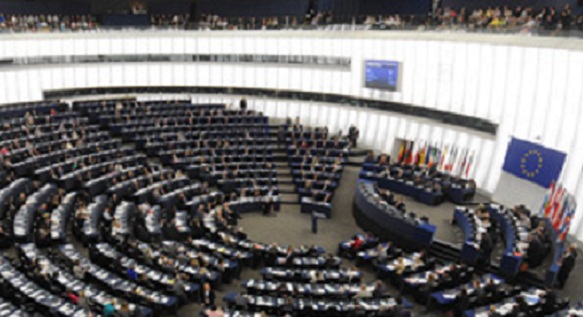
View all my reviews

Posted in Uncategorized | Tagged , , , , , , , , , , , , , , , , , , , , , , , , , , , , , , , , , , , , , , , , , , , , , , , , , , , , , , , , , , , , , , , , , , , , , , , , | Leave a comment

Crisis in Syria: Humanitarian Intervention in Syria in International Law, Moral Responsibility & the Distortions of Geopolitical and Technological Moral Hazard

Crisis in Syria:  Humanitarian Intervention in Syria in  International Law,  Moral Responsibility & the Distortions of Geopolitical and Technological Moral Hazard

American Aircraft Carrier Readies for Action

American Aircraft Carrier Readies for Action


#MoralHazard, #GeopoliticalMoralHazard, #SuperpowerMoralHazard,#IsraeliMoralHazard, #TechMoralHazard, #SyriaCrisis


By: Robert Sheppard,

Professor of International Law


The recent confrontational crisis in Syria sparked by the use of banned Chemical Weapons, most likely Sarin Nerve Gas upon civilian and paramilitary groups during the Syrian Civil War presents an entangled dilemma for all actors in the drama, most notably the United States as it contemplates punitive military action against the Syrian Assad regime. President Obama first announced an impending military strike against Syrian targets as a sanction against the use of chemical and nerve gas citing the doctrine of “humanitarian intervention,” then following the rejection of his proposed action by the British Parliament, delayed the impending action to allow for further investigation, discussion amoungst allies and opportunity for the US Congress to give prior authorization to the proposed punitive missile and air strikes. Consequently, this issue has become a matter of intense public debate to which every citizen has an obligation to contribute according to their ability, and thus this article is offered as part of this debate, to the best of the author’s ability as a concerned American citizen, Professor of International Law and as a “citizen of the world” as well as observer of international affairs.

In this regard I write in some respects with a sense of “deja vous” as in 2003 before the invasion of Iraq and during the UN proceedings on the matter of alleged “weapons of mass destruction” of the Saddam Hussein regime I wrote an open letter to then President Bush advising against the intervention on the grounds of its illegality under international law without authorization by the Security Council and on my estimate of the likely long-term quagmire, unsuccessful result in terms of either democracy or peace, predictable negative and risk-generative counter-reactions, and the likely misdirection and wastage of national resources in such an undertaking which was not closely related to America’s core national interests and most likely contemplated for the benefits of special interests, including the oil lobby, the Israel lobby and the “military-industrial complex” which President Eisenhower warned us against in his farewell address to the nation. In the light of history I believe fairly that I was proved right and President Bush wrong in that instance.

In the Iraq invasion of 2003 as well the contemplated action against the Assad regime, my reluctance to approve the precipitous military action did not and does not arise from any sympathy with the target regime. I detested the Saddam regime as a brutal and repressive dictatorship and enemy of its own people that any freedom-loving person would be happy to see removed, provided it could be replaced with something better. I have no better view of the Assad regime. In the case of Libya I both detested the Qadaffi regime and supported the efforts that resulted in its overthrow, on the differentiated ground of its United Nations authorization and a greater likelihood of a favorable outcome.  The world is both a dangerous and complex place, and I would neither endorse a knee-jerk automatic rejection of military or non-military action from a narrow-minded isolationist or “Anti-American” leftist perspective nor automatically endorse such action from a nationalist or patriotic perspective. I served in the American armed forces in a US Army Military Police Brigade in its legal Judge Advocate General section concerned with International Law in times of armed conflict, and am a father of three children whose future will be affected by these issues of war and peace.  I supported President Obama in his election and re-election. While I have been often critical of the misdirection of American foreign policy, often distorted by special interest groups and self-centered elites, I hope that it has been out of concern for the best interests of the American people and the peoples of the world and in light of the realities of the world rather than from unthinking ideological, prejudiced, simplistic or emotionalist reactions.

The Crisis in Syria cannot be seen only as a limited question of the wrongful use of Chemical Weapons and how the international community including America should respond in humanitarian concern to that occurrence, assuming its factuality, but must be seen and judged in its wider context, history, geopolitical implications and inextricably entwined long-term consequences. It is not a question of deciding on an appropriate response to a single harmful incident only, but rather of seeking a more enlightened broader policy that will better alter the overall context of that incident which set the stage for its coming about.  Before we attempt to decide the appropriate response to the assumed use of Chemical Weapons in Syria we need to step back and rethink the overall involvement of the American people and its military and political forces in the region as a whole and how any such action will affect that involvement. Furthermore, as repeatedly proven in innumerable Security Council Resolutions, the black letter of the resolution or Congressional authorization thereof is very often a “thin entering wedge” whose scope is very often expanded in accordance with the “hidden agendas” of the principal actors and special interest groups promoting them, of which the resolution itself proves a minimalist window-dressing, and therefore must be approached with caution.

I am not an isolationist, like some of the extreme Tea-Party activists or extreme left-isolationists, because I believe the world, its economy and its geopolitical balance of power is inextricably a globalized reality in which we must unavoidably live and survive. To the contrary, I am and remain a confirmed internationalist, and  a “Realpolitik Realist” though not to the exclusion of a measured dimension of the competing “Idealist” Foreign Policy School affirming the values of global democracy and human rights. To ignore the “Realpolitik” dimension of a necessary balance of power enforced through a necessary relative accumulation of force, availability of force, implied threat of force and if necessary measured and proportionate resort to force under appropriate circumstances, either through blind idealism or through willful isolationist blindness would be a mistake, as would also an unlimited and unrestrained resort to force amounting to a policy of quasi-colonial expansionism or “state terrorism.” The Middle-East is unavoidably bound up with the energy security not only of the West but the entire world as well and simply adopting the behaviour of the ostrich is not going to make that reality go away.  Accordingly, on the eve of taking an action in Syria which may release an unforseeable chain of consequences,  it cannot remain acceptable to unthinkingly affirm the status quo of our failed policies. Someone must ask and answer the question, is it really sustainable or in the interest of the American people to continue an ever-increasing involvement in the region which more and more necessitates the quasi-colonial surveillance, intervention and hostile alienation of potentially the entire Islamic world, necessitating the erection of a massive and invasive NSA-CIA-Military omnipresence which in light of the Snowden revelations can only be concluded as dangerously threatening, if not yet in realized fact then certainly in very real future potential for abuse in future changed circumstances, the undermining of the civil liberties not only of the American people but also of our allied-Western and non-Western peoples across the globe? Can we sustainably afford to continue this policy in view of the costs in our lost liberties, not to mention our shrinking relative financial resources drained by the World Economic Crisis and the challenge of new rising powers such as China and a resurgent Russia, the focus of the “Pivot to Asia” which further involvement in the Middle-East is already undermining?

If not then we need to re-formulate our Middle-Eastern policy around the securing of our true interests and to the exclusion of the false interests substituted by the special interest groups distorting our foreign policy and seriously depleting our limited strategic resources needed throughout the globe and draining resources in likely escalating entanglements not vital to American core interests.

  1. DISCUSSION OF THE CRISIS IN SYRIA AND PROPOSED AMERICAN MILITARY INTERVENTION

The purpose of this paper is to review in aid of the American people’s deliberation the principal considerations which must be taken into account in the pending consideration of the Syrian question by the US Congress, America’s NATO allies and the Executive Branch including: 1)  Is the proposed military action legal or illegal under International Law? 2)  Is the proposed military action supportable by the ascertainable facts, which may be incomplete? 3) What is the true purpose of the proposed military strike against Syria, including  not only its ostensible purpose as a punishment for the alleged illegal use of Chemical Weapons banned under international law, but also its “Realpolitik” underlying reasons and motivations with regard to the geopolitical national interests of the United States and the “international interests” of the international community? 4)  Will the proposed action likely attain either the ostensible purpose or the tacit “Realpolitik” objectives? 5)  What are the likely short-term and long-term consequences of the execution or non-execution of the planned military action?  6)  And finally, all things considered is the proposed action on the whole in the true interest of the American people and the international community of which it is a part and leader, and as such advisable or inadvisable?

As will be concluded below for the reasons elaborated in  this process of analysis, we counsel that the proposed action is inadvisable because: 1) It is illegal under International Law as a violation of the United Nations Charter; 2) It is unlikely to attain any substantial improvement in the humanitarian condition in Syria which it purports to support; 3) It contains large and incalculable risks for a widening of the conflict and involvement of other powers that may threaten escalation in a destabilizing chain reaction verging towards a threat of World War and  degrading the system of international law, balance of power and sustainable geopolitical stability; 4) Peaceful alternatives such as placing the Syrian Chemical Weapons Stockpile under international control under supervision of the UN Security Council alongside convening of a UN Comprehensive Middle-East Arms Control, Disarmament and Non-Proliferation Conference for the Phased Reduction of Chemical, Biological and Nuclear Weapons  of Mass Destruction  would be preferable; 5) It would be better to utilize UN authorized sanctions, even in a weaker form capable of being approved by the UN Security Council consensus than to by-pass the system of Security Council governance and undermine the order of International Law in an attempt to vindicate the humanitarian ends through the proposed action; 6)  That it pre-empts and prevents peaceful alternatives for resolution of the Chemical Weapons issue, including those proposed by Pope Francis, and other similar possible solutions such as prior demand for the surrender of those responsible to the International Criminal Court, or reference for alternative action by the Security Council including the possibility of region-wide UN-sponsored multi-lateral Weapons of Mass Destruction disarmament negotiations that might include reductions of Chemical Weapons stockpiles and commitments for dismantling of nuclear weapons programs by Iraq and Iran in return for phased reductions in the Israeli nuclear stockpile at Dimona  against which the Chemical Weapons are deployed, or alternative plans such as placing such Weapons of Mass Destruction in the Middle-East under international control as discussed by Putin and Kerry; 7) That it is not in America’s long-term interests to be used as a proxy for the attainment of local military dominance by Israel under its right-wing government through the influence of the AIPAC-related lobby on US foreign policy in the absence of a just settlement of the Palestine issue; 8)  That allowing itself to be used as a proxy for the achievement of local military dominance by Israel under its right-wing government will generate counter-reactions and hostility amoung Islamic and non-Islamic states that will invite retaliation and continuing animosity detrimental to America’s long-term core interests;    9) That allowing itself to be used as a proxy for Israeli military dominance creates a dangerous Moral Hazard in the Israeli right-wing government as well as its Arab-extremist counterparts  to further delay and obstruct a just and peaceful  Two-State solution to the Palestinian issue;  10) That its precedent may encourage other unilateral unauthorized military strikes by other nations in violation of the UN Charter leading to expanded war, as for example encouragement of an Israeli strike on Iran without UN authorization, with the likely consequence of Iranian invasion or destabilization of Shia-majority Iraq, sinking of oil tankers and acceleration of their remaining dispersed nuclear program in retaliation, all of which would likely draw the US into further and deeper “boots on the ground” entanglements again in Iraq or elsewhere; 11) That its consequence would lead to further involvement and diversion of resources from higher priorities, such embodied in the “Pivot to Asia” and other desirable realignments and would tend to cause divisions and  conflicts with America’s core NATO allies, such as Britain, which reject unilateral action not authorized by the UN;  12) That unilateral action by the United States alone would draw negative consequences to it alone which should be born by the international community as a whole after collective action under UN authorization, including Israel as the chief Realpolitik beneficiary of such action and for whose benefit it is substantially undertaken;  13) That it’s true motivation arises from a false conception of American national interest and international interest in which American foreign policy both in this instance and in its wider context has been distorted by special interests groups  for their own benefit and at the unjustifiable cost of the American people, resulting in a corrupting process of “geopolitical moral hazard” resulting in an irresponsible asymmetrical distribution of costs and benefits in foreign policy decisions which should be corrected in the true interests of the American people in the course of their exercise of democratic control and oversight of war powers and foreign policy, and: 14) That in its execution the proposed action is likely to be distorted and expanded in accordance with the hidden agendas of the sponsoring special interest groups backing it, divergent from the core interests of the American people.

1.  Is the proposed military action against Syria legal or illegal under International Law?


International Law on the Use of Force

Significantly, the proposed military action against Syria is contemplated as a unilateral action without the authorization of the Security Council of the United Nations, presumably because of an anticipated veto of the action in the Council by Russia. Such unauthorized action, prima facie illegal under International Law would threaten to undermine the framework of international law and global governance as well as dividing US core allies and deepening deleterious entanglements divergent from American core interests. The fundamental rules of international law on the legality of the recourse to war or force by states are contained in the United Nations Charter. The Charter as drafted in 1945 at the end of World War II and designed to prevent the recurrence of such world wars makes two contributions that are central to today’s international law of war and armed force:  it outlaws the use of force on the part of individual states, and instead it empowers the Security Council to make all decisions on collective measures that involve military force. Article 2(4) establishes the first element by requiring that states not use or threaten force against other states: “All members shall refrain in their international relations from the threat or use of force against the territorial integrity or political independence of any state, or in any other manner inconsistent with the Purposes of the United Nations.” This is a general prohibition, set in the section of the Charter that defines the common and primary obligations of UN membership and of the organization itself, and it is often cited as the primary contribution of the UN system to international order. It goes along with Article 2(3) which insists that UN members settle their interstate disputes by “peaceful means.” Article 2(3) takes away from states the legal right to use force, and Articles 24. 39, 42 and others then deliver this power to the Security Council on behalf of the international community. These sections of the Charter establish that the Council has the “primary responsibility for the maintenance of international peace and security” (Article 24) and that it can take what measures it deems necessary in that pursuit, including military action against states or other threats (Article 42). The goal of the framers of the Charter was to centralize the enforcement of international order in the hands of the international community of nations, led by the great powers given permanent seats on the Security Council, and to pacify the relations among other states by depriving them of independent legal channels to war. This was motivated by the understanding that the lesson of the two world wars was that state aggression must be forestalled with a forceful and collective response. Thus, any intervention that is authorized by the UN Security Council is unambiguously legal, including that for purposes of “humanitarian intervention” as long as it conforms to the Council’s authority over “threats to international peace and security” (Article 39″).

Under these constitutional principles of international law, the principal remaining legal justification for war or force by individual states not authorized by action of the Security Council is self-defense. States have long claimed that military force used in response to an attack by another constitutes a distinct category in law and in practice, and as a result the canon of international law generally recognizes such a right. The customary understanding of self-defense goes back as far as the field of public international law, which is to say that it was recognized by Grotius and others in seventeenth-century Europe as existing already. The concept is defined as a military response to an armed attack where the response is both necessary and proportionate to the attack. In the history of the concept, it is the precise definition of the  ideas of necessity and proportionality that generate controversy; the self-defense concept itself is not contested. Each application of the concept in practice has a productive effect as precedent that further elaborates its meaning, sometimes making it clearer and sometimes making it more complicated. For instance, Israel’s claim of acting in self-defense in its attack on Iraq in 1981 was widely rejected by scholars of international law and by the international community of nations, including by the Security Council, and thus it incidentally may have helped define the outer bounds of “necessity.”

The International Law Case of the Caroline affair, which arose from armed skirmishes between the United States and Britain in1838, provides a case in which a state’s justification for its behavior has become constitutive of the categories of lawful and unlawful uses of force. The British eventually apologized for their incursion into U.S. territory, and the Americans conceded that the idea of anticipatory self-defense might exist within

the concept of self-defense, but the most lasting effect of the incident was the definition of the legitimate scope of the right to self defense between nations under international law including strict limitations on claims of preemptive war:  thus, the threat must be “instant, overwhelming, and leaving no choice of means, and no moment for deliberation.” In the present instance the United States does not claim that its action is motivated by or justified as an act of self-defence or collective self-defense, nor do the circumstances reflect any immanent threat to the United States and therefore self-defense, generally the only legitimate form of non-Security Council authorized use of international force, is inapplicable as a legal justification of the proposed Syrian action.

Thus under the “black-letter law” of International Law defined in the United Nations Charter Article 2 (3) the proposed unilateral action would be clearly illegal under International Law and destructive of the rule of law and orderly international relations. However, International Law is more complex that merely the black letter of the constitutional treaties, as it also includes, like our Anglo-American Common Law, sources of law based on “Customary International Law” or the law derived from the ongoing “practice” of nations in their dealings with each other, supplemented by case law precedent derived from adjudications such as those of the International Court of Justice, or  “World Court” at the Hague.  Upon consideration of these additional elements, however, the judgment of most legal scholars would arrive at the same conclusion of the proposed unauthorized unilateral action being illegal under International Law as a whole.  Some might argue that the clear provisions of the Charter in Article 2 (3) have been subject to the evolution of “exceptions” or “desuetude” by the usage of nations, such as the US/NATO intervention in Kosovo or the 2003 Iraq invasion, which was also not authorized by the UN Security Council. Though we might be reluctant to accept that clear “statutory” rules of law could be undermined by their repeated violation, as if a law should be defined by its violators rather than its legislators, customary international law does operate to supplement the existing treaty law in many areas. Though there are many instances of “humanitarian intervention” and “absolute” interpretations of national sovereignty have been continuously qualified by such human rights treaties as the UN Convention on Civil and Political Rights, scholars and international jurists of the World Court would undoubtedly conclude that since 1945 and the UN Charter, the doctrine of “humanitarian intervention” though alive and well if authorized by the Security Council, remains subordinate to the overriding imperative of peaceful settlement of international disputes through seeking Security Council authorization for its use under Article 2 (3).

An additional issue, beyond that of Security Council authorization, in determining the legality of the proposed unilateral military strikes under international law is the substantive issue of whether Syria can be held to standards regarding Chemical Weapons under treaties of which it has not signed or joined. The great preponderance of the nations of the world have “outlawed” Chemical Weapons through the Chemical Weapons Convention (CWC) of 1993.  However Syria has never signed or joined this treaty and thus is not directly bound by its terms under international law. The reason it has not signed the treaty is simply because Israel has not signed or adhered to the Nuclear Non-Proliferation Treaty, and Syria has amassed its Chemical Weapons stockpile as its principal  means of defense against the Israeli nuclear stockpile at Dimona. Thus the US administration could not rely on this treaty as a basis for its attack. Alternatively, the US could refer to the Geneva Protocol on Chemical Weapons of 1925, of which Syria has joined, but again this treaty has major loopholes in it, such that it does not prohibit use of Chemical Weapons within a state’s borders in civil wars or conflicts, and does not, unlike the 1993 Convention, prohibit production or stockpiling of such weapons or their use in retaliation, as opposed to “first use.”  Thus, under the present facts, Syria’s use of the Chemical Weapons would violate the “black letter” treaty law of neither treaty. But as discussed above, international treaties are supplemented by “customary international law” in international law, and it may be legitimately though perhaps inconclusively argued that the Geneva Protocol has been expanded by customary practice of nations to include applicability to both non-signatories and to internal civil wars and conflicts as a matter of customary international law. Here the US would have a plausible though inclusive case that Syria actually violated international law in the leading incident, though this is less clearcut than is generally assumed by the lay public and press in discussons of the Syria Crisis.

2. Is the proposed military strike on Syria supported by the facts of the situation?


Here we can say the jury is still out, or has not yet deliberated in that the United Nations inspectors have not formulated their report, nor were they given a mandate if the use of Chemical Weapons were to be found, to determine the perpetrators and responsible parties. At the beginning of the crisis we were being “railroaded” or “hustled” in a vacuum of independently verifiable facts which was very reminiscent of the precipitous rush to action at the beginning of the 2003 Iraq War. In that case we discovered that we were grossly imposed upon with allegations of “weapons of mass destruction” which turned out to be blatantly false and which proved very likely to have been contrived by the intelligence agencies at the behest of their neo-conservative overseers to push the American people into a “rush to judgment” for a policy of war which had already been decided upon for completely other purposes and motivations. To President Obama’s credit he delayed this time-worn tactic of “strike first and then rally ‘em round the flag” to subject the question of war and peace in Syria to the democratic process of the Congress, which is constitutionally charged with the power and responsibility of deciding the declaration of “war,” which though  in modern times never referred to or “declared” as war but engaged in perpetually nonetheless.  As the European Union and NATO themselves have indicated, along with Germany and others, no action should be taken before an independent United Nations investigation is concluded and the facts have a chance of being known. We know that a dictatorship like Assad’s has no qualms about lying to its own people and the international community. Unfortunately, we have learned from bitter experience, along with some of the related Snowden, Manning, Iraq and Pentagon Papers revelations, that our own democratic governments resort to systematic lying, obfuscation and disinformation, hopefully on a lesser scale, but undeniably so. As such we should be cautious and skeptical in reviewing even the allegations of the American and British and allied governments when they push so feverishly towards war or forceful interventions of this kind, since the hidden truths, hidden agendas and real motivations are often later discovered beneath the “tip of the iceberg” of stated facts given to the media or the Congress  during the  “rush to action.”  Of course some true emergencies require immediate action and some operational details cannot be publicly disclosed for legitimate security reasons and we give the President the power to handle such emergencies in “real time” on trust, pending later review by the Congress and the people under such arrangements as the War Powers Act, but we have learned to view efforts to abuse such “emergencies” with just reservation of judgment.


3.  Is the proposed Military Strike against Syria likely to improve the humanitarian conditions of the Syrian people?

Here, we can only be guided by educated guesses and speculation with regards to an unforeseeable future, though the precedent of the American intervention in Iraq unauthorized by the Security Council and international law leaves considerable scope for skepticism. Already enmeshed in a vicious and deadly civil war the humanitarian condition of the Syrian people is already horrific and will likely continue so with or without the American strike. Most civilian deaths have resulted from conventional and paramilitary actions and not from Chemical Weapons, and would likely continue so even if the outcome of the strike was the termination of Chemical Weapons use. Undoubtedly the consequences of the strike would be shaped by its nature, targets, effectiveness and duration. It would no doubt have some deterrent value in preventing further use of Chemical Weapons against civilians in the abstract. One cannot rule out an irrational Syrian response in vindictiveness or in a pre-emptive “use it or lose it” attack against either the rebels in Syria or against Israel. Presumably the delay in the strike has given the Syrian regime opportunity to disperse and hide the Chemical Weapons in advance of the strike,  just as the long-threatened strike by Israel against Iran’s nuclear facilities has given years of opportunity to prepare dispersal and defense of those facilities, mitigating the potential effectiveness and drawing out any contemplated military action. An intensification of the civil war in Syria is a likely result, with further untold civilian suffering, not to speak of predictable “collateral damage” from the strikes themselves. If the Chemical Weapons strike were to later expand to the dimensions of a “regime change” action, as the initial intervention in Libya did, and a benign regime followed the fall of the Assad dictatorship perhaps a positive result might ensue. However the cases of Iraq, Afghanistan and the revolution and coup in Egypt   highlight the probably greater likelihood of an implosion resulting in internecine warfare, a failed state and further deterioration of the humanitarian condition of the Syrian people. Objectively, it is hard to foresee how the exercise in “teaching Assad a lesson” would improve the lot of the Syrian people caught up in the civil war.

3.  What is the purpose and goal of the proposed US unilateral strike on Syria, including not only its ostensible stated public purpose, but also its true or “Realpolitik” hidden agenda goals?


The announced and ostensible purpose of the military strikes on Syria are to punish and deter the use of Chemical Weapons by Syria, either on its own people in the civil war and potentially others. These official purposes reputedly exclude the ulterior purpose of bringing about “regime change,” but as in the case of Syria, Iraq and Libya we may fairly conclude that this is an unspoken purpose, unstated because it would violate the norms of national sovereignty as well as Article 2 of the United Nations Charter.  In terms of regime change, I would personally like to see nothing better than the removal of the Assad regime, a generally despicable one objectionable to anyone of moral and political principles, though the subsidiary question of the choice of means does necessitate the concern for international law as well as the real world consequences in terms of the likely successor of such a regime or the breakup or breakdown of the state, prospects  of which are none too promising in terms of ideals of human aspirations or Western interests. Such regime change has as its real objective the weakening of Syrian power to resist Israel and to install a regime more compliant to Israel’s interests, and less amenable to the influence of Russia and of Iran.

A further unstated purpose of the military strikes, however, is to remove the Chemical Weapons  as a deterrent and counter-weapon to Israel’s nuclear and conventional arsenal and consequent unrestrained regional domination. This was also the motive of Israel’s strike on the Osirak reactor in Iraq and of Israeli encouragement of America’s calamitous invasion of Iraq in 2003. It can be expected that as long as Israel possesses a nuclear arsenal all rational states in its vicinity will seek to acquire the means to deter its employment against their interests, and that there will be no cease in their attempts to acquire such capacity and attempts to quash such counter-balancing capacity will involve an endless and unlimited Sisyphusian effort necessitating a never-ending entanglement in the region, especially in the absence of a workable settlement of the Palestinian question through creation of a viable Palestinian State in accordance with United Nations resolutions of long standing.   Is it in America’s interests to expend its own resources unlimitedly to put down all such attempts to redress that imbalance of power? If the right-wing government of Israel insists on the maintenance of such an imbalance of power and terror with the entire Islamic world without a Palestinian settlement should it be at the cost of the American people or should they bear the cost in money, blood and technology themselves? If the right-wing government in Israel was the primary Realpolitik beneficiary of the invasion of Iraq to remove a potential challenge to their own power (along with the oil industry, the Military-Industrial-Surveillance Complex and their financial backers) should the American people pay the near trillion dollar cost and lost lives of that invasion or should they shoulder that burden themselves which is not related to America’s core interests and its government discuss with the Israeli people whether such cost is justified relative to the alternative of a just solution to the Palestinian question and a more sustainable balance of power with their potential adversaries still adequate to achieve their  real needs for strength and deterrence to guarantee their legitimate security interests? Can America afford to go on acting as a proxy for the suppression of any and all attempts of one billion Muslims to attain the natural desire for a counterbalance the hegemonic dominance the right-wing Israeli government when the non-settlement of the Palestinian question with a just two-state solution makes the perpetual resurgence of such efforts inevitable and endless when America is now challenged economically and perhaps militarily by the rise of new Asian and other newly industrialized powers on a global basis? Is it in America’s interest to take on the task of the surveillance, policing and continuous sporadic intervention and military suppression of one billion Muslims with whom they have no essential quarrel and which efforts naturally give rise to occasional efforts to strike back at America’s interventions in such incidents as 9-11? Such questions must be raised and answered as part of the debate of the much more limited question of the goals and purposes of the Syrian intervention, both stated and tacit, which are but one part of this larger picture.  If I raise these questions am I being anti-Semitic or biased against Israel? I would hope not and I know the same questions are raised in Israel and in the Jewish community and amoung the Israeli people to determine their own enlightened self-interest and in reasonable critique of their own government by their own people. Anyone is free to form their own opinion about me in this regard, and I can relate in passing that my sister is married to a freethinking man of Jewish heritage and I have Jewish friends that are much more critical of the rightist Israeli government than I am.  I can also state that  I hope any debate of this and related matters takes into account the legitimate security interests of Israel in a very difficult situation in the region as to guaranteeing their own survival, especially in the light of the historical horrors of the Holocaust and the chronic insecurities of Jewish history.

4)  Will the proposed action likely attain either the ostensible purpose or the tacit “Realpolitik” objectives?

As discussed above, it is highly dubious and unlikely that the military strikes will attain the humanitarian objective of relieving the Syrian people of the oppression and atrocities attendant on the ongoing civil war. If the Chemical Weapons stockpiles are completely destroyed it may relieve them of further chemical attacks, but the likely unintended consequence would be the intensification of the oppression and atrocities by non-chemical means. The attacks should weaken the Syrian regime but not enough to either cause its collapse or bring any end to the civil war. The civil war may indeed be prolonged as the intervention generates counter-interventions by other powers and players such as Iran and Russia. Should regime change eventually occur the likely successors look equally grim and oppressive, and the implosion of the state or deterioration into a failed state and internecine factional and sectarian warfare abetted by outside powers is a distinct possibility.

5)  What are the likely short-term and long-term consequences of the execution or non-execution of the planned military action?


From the above, we may guess but can never know, that the proposed military strike would most likely lead in the short-term to a further deterioration and intensification of  the civil war in Syria. In the longer term, once having intervened it is unlikely that the US will be able to avoid further entanglement in the chronic and ongoing situation. It will prove impossible to stride the aircraft carriers and glibly declare “mission accomplished” and “human rights vindicated” and pressure will intensify for further commitments to precipitate regime change, or should the regime prove victorious, to prevent loss of face and further humanitarian debacles. Iranian supported retaliatory attacks on Israel and American interests in the Middle-East, possibly indirectly supported by increased Russian aid are forseeable, including a possible Iranian attempt to take over Iraq or destabilize Egypt, further threatening Israel and drawing demands for further American protective intervention and entanglement. Deterioration towards World War, potentially drawing together the Russians, Iranians and Chinese arrayed against a splintering Western alliance and interventionist USA and Israel is not to be excluded, including disruption of global oil supplies and precipitation of a new phase of the World Economic Crisis. Should America follow the British example and abort the intervention, substituting alternative weaker Security Council approved action, some of these consequences may be avoided.

II.  THE CONCEPT OF MORAL HAZARD AND ITS APPLICABILITY TO GEOPOLITICAL ACTION, THE MIDDLE-EAST, MILITARY TECHNOLOGY & SURVEILLANCE TECHNOLOGY

What is “Moral Hazard?”  Moral Hazard arises where a party in a situation will have a tendency to take risks and actions because the costs, losses and consequences that could occur will not be borne by the party taking the risk. In other words, it is a tendency to be more willing to take a risk, knowing that the potential costs or burdens of taking such risk will be borne, in whole or in part, by others. Thus, a moral hazard may occur where the consequences of the actions of one party may change to the detriment of another party after action has taken place. The concept is most often used in financial transactions, as in the case of the Subprime Mortgage crisis in which predatory financial institutions deliberately generated unsustainable and highly risky mortgage loans because they knew the loans could be packaged and sold off to mortgage-backed securities investors or to guarantee agencies such as Fannie Mae, and therefore the generators of the sub-prime loans would never incur any possible future losses themselves, which would instead be successfully fobbed off on third-parties.

Unfortunately the irresponsibility and predatory behaviour connected with “moral hazard” is by no means confined to the financial arena and the employment of capital, but raises its ugly head consistently in the precipitation of war in the geopolitical arena and in the abuse of technology whenever actors from a sense of impunity from the consequences of the use of their power can take actions which shift the costs of their undertakings onto others, especially the public and the relatively powerless. Through human history the almost constant series of wars have occurred in very substantial part because the elites and interest groups—aristocracies, party bosses and wealth holders—-that have made decisions of war and peace and not coincidentally derived the lion’s share of the benefits of war, having the ability to shift the costs in blood and treasure onto the public, disempowered lower classes and foreign peoples, perpetuating an endemic and chronic Political Moral Hazard of ruling elites and elite special interest groups capable of dominating and distorting national decision making processes.

But even where political leaders are less blatantly exploitative or believe themselves to be acting in some conception of the national or international public interest moral hazard nevertheless consistently and dangerously continues to arise because  individuals, institutions or even nations do not bear the full consequences and responsibilities of their actions, and therefore have a pernicious tendency to act more irresponsibly than they otherwise would, leaving other parties to hold the liabilities and losses arising from the inevitably consequences of those actions.

Moral Hazard has played several unfortunate roles in defining American foreign policy in the Middle-East and Islamic world in the last three decades. Specifically the American people have felt themselves repeatedly dismayed, confused and betrayed by a Middle-East policy undertaken in their name and purportedly in their interest, including the Iraq and Afghanistan Wars, but leaving them with trillions of dollars of costs, the spilt blood of their children, deeper and deeper entanglement in endless and escalating conflicts unrelated to their core interests and little beneficial result either for their own nation or for the purported foreign beneficiaries of those actions.  The test of “Qui Bono?” or “Who Benefits?” has always remained a key analytical tool in sorting out which actions of elites and special interest groups have harmed the interests of the people, and very often leads directly to objective identification of the cause of the mismanagement of their affairs. If we utilize this test with respect to the failed Iraqi intervention and its Afghanistani successor, as well as the incipient involvement in Syria we can identify three major beneficiaries of the failed American policies, amoungst others, namely the oil industry and its financial backers, the “Military-Industrial Complex” against which President Eisenhower warned the American people on retiring from the presidency and his former command of the allied forces in World War II,  to which  the “War on Terror” has further compounded into a “Military-Industrial-Surveillance Complex,”   and the rightist-Israeli leadership groups and lobby support who have, alongside  their Islamic-extremist counterparts, chronically forestalled any meaningful settlement of the Palestinian question, depriving both the Israeli people and the Palestinian people of any meaningful prospect of sustainable peace and security.  Though such a characterization is unavoidably over-simplistic, when we seek the main causes of the failed policies for purposes of their rectification, it is not unfair and supported by ample evidence to conclude that the largely-failed Iraq invasion and US over-involvement in the region resulted from the distortion of American foreign policy through the deleterious substitution of the interests of these three special interest groups for the greater interests of the American people in whose name and at whose cost that failed policy was carried out. The presence of hundreds of AIPAC lobbyists urging a vote for the presently proposed unilateral intervention in Syria is also strong evidence of the power of special interest groups to distort American foreign policy away from its own core national interests towards a proxy role. The distorting presence of the money of the same three and allied interest groups and their PAC’s in the electoral process in electing the national leadership and threatening the withdrawal of that money in future re-election campaigns reinforces the corruption of the decision-making process and the further distortion of its results away from the national interest.

When the United States through this corrupting and distorting process allows itself it be used as a proxy for narrow oil, financial, military-industrial-surveillance and right-wing Israeli government interests the result is to confer the benefits of US actions on these narrow interest groups while placing the burdens and costs in money, blood and depletion of power on the American and allied peoples. The result is a pernicious creation of Moral Hazard in these groups which redouble their efforts to further distort the decision making process to undertake even more adventurous risks and the future redoubling the future costs, ad infinitum in the Middle-East and elsewhere. Thus  the right-wing Israeli government has repeatedly used the United States as a proxy in quashing potential adversaries such as Iraq, Iran,  the condoning of the coup in Egypt, and now Syria. By helping to induce the American government to invade Iraq in 2003 it eliminated a very troublesome potential adversary, as evidenced by its prior strike against the Osirak reactor. Had the right-wing Israeli government had to bear the costs of that invasion itself in blood and treasure it very well might have been more cautious and adopted alternative means of co-existence, including concluding the Road Map leading to a just and equitable Two-State solution in Palestine. Because it could achieve its result with impunity by proxy Moral Hazard further induced it to undertake further and further risks and punitive actions against the Palestinians and the contemplated strike against the Iranian nuclear facilities under an artificial impression of impunity. Although the right-wing government of Israel is touted as an “ally” and there are undoubtedly substantial areas where Israeli interests and true American interests coincide, it is notable that in almost all of the proxy wars in which America acted on behalf of the right-wing Israeli government interests Israel itself was very careful not to equally share the burdens of those proxy efforts. Where was the Israeli army in the first Iraqi war to liberate Kuwait, the 2003 Bush coalition invasion of Iraq, the invasion of Afghanistan and other actions in the Islamic world provoked in substantial part by their own failure to contribute to a just and equitable Two-State settlement of the Palestinian question? Indeed, the Moral Hazard of the right-wing Israeli government is doubly compounded by the practice in every instance of conflict of applying for military “Foreign Aid” from the American Congress, further indemnifying them against the intransigent feed-back effects of their own risk-creating behaviour, and depleting resources for humanitarian and developmental foreign aid to the needy. Thus the proxy invasion of Iraq provoked the natural counter-reaction of the Scud missile attacks on Israel and the demand for further military “Foreign Aid” leading to the subsidy of the “Iron Dome” defenses, a further technological contributor to the sense of impunity further compounding the Moral Hazard of agitation for further aggressive action such as the proposed Syrian and Iraqi air strikes. In the meantime immense profits are reaped by the “Military-Industrial-Surveillance Complex” and its sub-contractors and financiers at the expense of bloating the American national deficit and inducing the World Economic Crisis crippling the American economy. What is clear is that this process is ultimately as self-expanding as it is unsustainable for the American people, especially in the context of the rise of newer and greater global challenges throughout the world outside the Middle-East from newly arising powers, as exemplified by the now seemingly suspended “Pivot to Asia,” underlining the dangerous stretching-thin of even Americas strategic resources.

The role of technology has a curious and morally corrupting influence in compounding the dangers of Moral Hazard in its military applications. One of the key selling points of the proposed Syria intervention by its advocates proceeds from the use of  “remote control” military hardware, such as Tomahawk cruise missiles, high-altitude bombing, pervasive Snowden-Era Onmipresent Surveillance,  and Remote-controlled Drone attacks. The argument is made that we can act with God-like impunity wholly free of consequences because there will be no “boots on the ground,” meaning no blood of our children on the ground, due to the antiseptic virtue of our precision-controlled “surgical strikes.” The right-wing Israeli government touts also that its policies can be enjoyed with impunity in family living rooms conveniently protected behind Chinese-style national walls happily shutting out the Bantustans of Gaza and the West Bank, policed and patrolled by the “game consoles” of remote controlled missile-firing drones. Thus advanced technology itself becomes morally corrupting in morally blinding, anesthetizing and seemingly insulating its users from the moral consequences of their violent actions, also producing a self-reinforcing spiral of Moral Hazard, as well as furthering a spiraling technological arms race of asymmnetrical terrorist countermeasures in its trail. This process of progressive moral degeneration on all sides leads to demonization and dehumanization of mutual adversaries and ultimately to temptations to reduce adversary populations to permanent oppression, occupation, remote-controlled brutalization with the object of “breaking the will” of entire populations to accept their lot as permanent underlings, or even to look towards a “final solution” resurrecting the spectre of the Holocaust.  It is natural that such an attitude generates justifiable outrage in those whose own children’s boots are covered in blood “on the ground” while the fashionable footwear of the children of those handling the “Joysticks” of the remote controls are employed at disco dancing and figure-enhancing health workouts.  Accordingly it is likely that the result of such “surgical strikes” will ultimately include the “karmic comeuppance” of the creation of a Frankenstein monster of the radicalization and acts of desperation of those massive populations so experimented upon, in the nature of further “9-11” style incidents if not the catastrophic feedback effects under the “Law of Unintended Consequences” of driving powerful potential adversaries such as Iran, Russia and potentially China into a counter-alliances precipitating an uncontrollable World War III and threatened nuclear Armageddon, in the longer-run  necessitating the global relocation of ever more privileged feet from the disco floor into those “boots on the ground.”  If unreversed, such processes must lead to the destruction of the futures of the children of the populations on both the controlling and receiving ends of the Joysticks.

CONCLUSION

O Where, O Where has the American Dream gone, and wherefore is the world so turned to nightmare? Blake turned from the “Songs of Innocence” to the “Songs of Experience,” the sword of Camelot ended in a lake of tears and St. Paul awakened to the ways of  this world invoked to us: “When I was a child, I spoke as a child, I understood as a child, I thought as a child; but when I became a man, I put away childish things. For now we see in a mirror, darkly, but then face to face.” (1 Corinthians 13).  Henry Kissinger, recipient of the Nobel Peace Prize at the ending of the Vietnam War famously lamented of American formulation of  foreign policy: “Americans have no sense of tragedy.” Oedipus discovered late the “Law of Unintended Consequences” and one’s own capacity for self-delusion and self-undoing. St. Paul also lamented: “For the good that I would I do not: but the evil which I would not, that I do.” (Romans 7:19). Thus it is time for the American people to heed the lessons of experience and put away the childish illusions of the past and embark upon a more mature worldview in its foreign policy.

Writing in The Children of Light and the Children of Darkness  the theologian Reinhold Niebuhr observed:

“Man’s capacity for justice makes democracy possible; but man’s inclination to injustice makes democracy necessary.”

Thus it is well that President Obama, an admirer of Niebuhr,  has paused in the rush to precipitous action in the wake of the defeat of the proposed strike in the British House of Commons, to allow its consideration by the US Congress and the American people in accordance with the democratic process framed in the US Constitution and the War Powers Act.

One of Niebuhr’s major contributions was his view of sin as a social event — as pride — with selfish self-centeredness, individual and collective, as the root of evil. The sin of pride was apparent not just in criminals, but more dangerously in people who felt good about their deeds. The human tendency to corrupt the good was the great insight he saw manifested in governments, business, democracies, utopian societies, communist and capitalist political parties, sectarian religions and churches. Like the influence of Tolkien’s “One Ring to Rule Them All” he helped explain how even good men, beginning in good faith and with good intentions were drawn, almost involuntarily if not intentionally, to actions resulting in evil. This position is laid out profoundly in one of his most influential books, Moral Man and Immoral Society. He was a debunker of hypocrisy and pretense and made the avoidance of self-righteous illusions the center of his thoughts.

Who is not dismayed by the spectacle of the beheadings of bound and helpless victims on Internet videos being beheaded to the shouts of “Allahu Akbar!” Who would not have felt revulsion at the command of Moses in Numbers 31:13 to the army of the Israelites with respect to the captive women and children of the Caananites they had just  forcefully driven from their homes: “Now therefore kill every male amoung the little ones, and kill every woman that hath known a man by lying with him; but all the women-children that have not known a man by lying with him, keep alive for yourselves.” Down through history the self-righteous delusions of Muslims, Christians, Jews, Hindus, Buddhists and every sect known to man that they alone are holy and speak and act for God as His chosen people has been unmasked as the hypocritical and self-blinded worship of the golden calf of self, tribe, and ethnic totem—a perverted love of self and the inflated masks of self-centered and self-serving power and as far away from any true relationship with any universal loving God as may be imagined.  Religious, sectarian and ethnic war is a tragedy and travesty of the human capacity to conceive of the ideals of God, justice, universal harmony and love and a source of universal shame to humanity and its ideals,  yet like the poor, seems to be always with us and ever entangling others in its folly.

Niebuhr was concerned with two forms of American idealism which have persisted over the last century and continue prominently in the debate over Syria.  American idealism, he believed, comes in two forms: the idealism of the antiwar non-interventionists, who are embarrassed by power; and the idealism of pro-war civilizational-imperialists, who disguise and dissemble power as d virtue. He said the non-interventionists seek to preserve the subjective purity of their own souls, either by denouncing military actions or by demanding that every action taken be unequivocally virtuous. They exaggerate the sins committed by their own country, excuse the malevolence of its enemies and inevitably blame America first. Niebuhr argued this approach was a pious fraud and hypocritical means of escape and evasion of real-world responsibilities in a complex and imperfect world, a kind of hypocrisy more concerned with self-righteously feeling good about oneself than doing  real good for real people living in the real and imperfectable world. The second type of American idealism was that of the prideful interventionists, who see American virtues of freedom and democracy and liberal ideals as a license to  impose their own sublimated power upon the rest of the world, a spreading of “civilization” amoung the barbarians, valid up to a point, that point being when liberal and reformist leaders in their self-love begin to confuse their own power, projects and status with virtue and good, blinding themselves to the possibility that their own good intentions have been perverted by the seductions of power and self-righteousness or corrupted by the political processes of which they have become a part.

It is this second kind of distortion of American idealism which he would council his student Mr. Obama to look into the mirror for. These kind of administration idealists would tell us: sure we have the capacity to read every e-mail and monitor every phone call you make and to lob Tomahawk missiles to any point on the globe with impunity as to the consequences, but Hey!—trust us!—-we’re the good people—the good guys remember!—-we’re going to make sure all this power is used for good, right?—-Wrong, or at least not necessarily. History teaches that the road to Hell is paved with good intentions, inter-tiled with self-love and the self-delusions of the self-righteous, as arranged and manipulated by the opportunistically hypocritical and predatorily vicious.  For this reason the Constitution sets in place the system of checks and balances and democratic feedback, not trusting to the self-definitions of virtue by power holders.

Niebuhr counseled that idealism had to be balanced with realism if we are to live morally in any real sense in the real world. Part of such realism is the horribly difficult process of recognizing one’s own capacity for slipping into wrongfulness, as well as the limits of one’s own power in order to avert tragedy.

It is also significant that President Obama praiseworthily submitted the question of war and peace in Syria to the US Congress and the American people for consideration within the democratic process, as under the US Constitution the ultimate power to declare war rests with the Congress, and is derived from the people. It was said by Clemanceau that “war is too important to be left to the generals.” This illustrates a universal problem of a generalized “democratic deficit” in foreign policy generally. Though many such matters require technical knowledge and expertise and unified policy-making and execution and are thus entrusted to the President or executive head of government, it is important that as in the American War Powers Act that Congress and the people have ultimate long-term control and veto power over the acts of the executive.

In the international sphere, the United Nations system also suffers from a “democratic deficit” in its operations regarding global governance and war and peace. We may also paraphrase Clemanceau and state that “war is too important to be left to the nation-state or governments alone.” Thus many activists including former United Nations Secretary-General Boutros Boutros-Ghali have called for the creation of a United Nations Parliamentary Assembly, a sort of globalized version of the EU European Parliament,  as a third chamber of the United Nations in addition to the General Assembly of nation-states and the Security Council, for the purposes of making the United Nations more democratically accountable. Important question of war and peace such as the Syria crisis which potentially threaten World War III need the input not only of the great-power and elected Permanent Members of the Security Council and of all nation-states in the General Assembly, but should also require the additional democratic voice of the representatives of the peoples of the world  independent of their governments in power, as occurs in the European Parliament. The Syria crisis underlines the need for correcting the democratic deficit in the United Nations with a United Nations Parliamentary Assembly, and also possibly through Security Council reform, perhaps including alteration of the veto power so that a single permanent member of the Security Council cannot completely paralyze the body in crisis. Perhaps a requirement of two veto votes or other supermajority might be substituted for the single veto which can often prevent the Security Council from taking any meaningful action in serious crises of war and peace.  In this regard,  I have been active as a Senior Associate  in the Campaign for a United Nations Parliamentary Assembly, spearheaded by former UN Secretary-General Boutros Boutros-Ghali and invite everone to join in this effort. See: http://en.unpacampaign.org/index.php

In the case of the administration’s project for Syrian military intervention without Security Council authorization, in violation of international law, without a clear probability of a successful outcome in bringing about a better humanitarian future for its intended beneficiaries, and fraught with the risks of uncontrollable further escalations and entanglements not related to the core interests of the nation, for the reasons argued above the American people and its Congress should for the moment follow the example and reasoning of the British Parliament and reject the proposed initiative as it stands as either a misplaced exercise in an unrealistic idealism on the part of some, or as a willful distortion of the foreign policy process on the part of special interests which are inconsistent with the true interests of the American people, and refer the matter back to the administration to search for better alternative lines of action.


Posted in Uncategorized | Tagged , , , , , , , , , , , , , , , , , , , , , , , , , , , , , , , , , , , , , , , , , , , , , , , , , , , , , , , , , , , , , , , , , , , , , , , , , , , , , , , , , , , , , , , , , , , , , , , , , , , , , , , , , , , , , , , , , , , , , , , , , , , , , | 1 Comment

FOLKTALES AND FABLES IN WORLD LITERATURE–THE PANCHATANTRA, THE INDIAN AESOP, LA FONTAINE’S FABLES, THE PALI JATAKAS, THE BROTHERS GRIMM, CHARLES PERRAULT’S MOTHER GOOSE, THE CHINESE MONKEY KING, JOEL CHANDLER HARRIS’ TAR-BABY & THE AMERINDIAN COYOTE AND TRICKSTER TALES —-FROM THE WORLD LITERATURE FORUM RECOMMENDED CLASSICS AND MASTERPIECES SERIES VIA GOODREADS—-ROBERT SHEPPARD, EDITOR-IN-CHIEF

Panchatantra: The Complete VersionPanchatantra: The Complete Version by Vishnu Sharma

My rating: 5 of 5 stars

FOLKTALES AND FABLES IN WORLD LITERATURE–THE PANCHATANTRA, THE INDIAN AESOP, LA FONTAINE’S FABLES, THE PALI JATAKAS, THE BROTHERS GRIMM, CHARLES PERRAULT’S MOTHER GOOSE, THE CHINESE MONKEY KING, JOEL CHANDLER HARRIS’ TAR-BABY & THE AMERINDIAN COYOTE AND TRICKSTER TALES —-FROM THE WORLD LITERATURE FORUM RECOMMENDED CLASSICS AND MASTERPIECES SERIES VIA GOODREADS—-ROBERT SHEPPARD, EDITOR-IN-CHIEF


Folk tales, folk song, folk legend and and folk lore have been with us since time immemorial and incorporate the primal archetypes of the collective unconscious and the folk wisdom of the human race. Very often these were passed down for millennia in oral form around primal campfires or tribal conclaves as “orature” before the invention of writing and the consequent evolution of “literature,” later to be recorded or reworked in such immortal collections as “Aesop’s Fables” of the 6th Century BC. In the 1700-1800’s a new interest in folk tales arose in the wake of the Romantic Movement which idealized the natural wisdom of the common people, inducing the systematic efforts of scholars and writers to collect and preserve this heritage, as exemplified in such works as Sir Walter Scott’s “Minstrelsy of the Scottish Border,” (1802) Goethe’s friend Johann Gottfried Herder’s “Folksongs,” (1779) and the “German Folktales” (1815) of “The Brothers Grimm”—Jacob and Wilhelm.

With the evolution of World Literature in our globalized modern world these enduring folk tales remain a continuing source of wisdom and delight. We encounter them as children in our storybooks and we gain the enhanced perspectives of maturity on them as we introduce them to our own children and grandchildren. Additionally, we have the opportunity to learn of the folk wisdom and genius of other peoples and civilizations which add to our own heritage as the common inheritance of mankind.

Thus World Literature Forum is happy to introduce such masterpieces of the genre as the “Panchatantra” of ancient India, similar to the animal fables of our own Western Aesop, the “Pali Jatakas,” or fabled-accounts of the incarnations of Buddha on the path of Enlightenment, folk-tales of the Chinese Monkey-King Sun Wu Kong and his Indian prototype Hanuman from the Ramayana, and the Amerincian Coyote and Trickster Tales. Also presented is some of the history and evolution of the classics of our own Western heritage, whose origins may have slipped from memory, such as Charles Perrault’s “Mother Goose” tales, La Fontaine’s “Fables,” and American Southern raconteur Joel Chandler Harris’s “Tar Baby,” derived from the African tales of the black slaves,and perhaps of earlier Indian origin.


AESOP—FATHER OF THE FOLK AND ANIMAL FABLE


Aesop's Fables: The Fox and the Crow

Aesop’s Fables: The Fox and the Crow

Aesop’s “Fables” (500 BC) were very popular in ancient Athens. Little is known of Aesop himself, though legends have it that he was very ugly and that the citizens of Athens purportedly threw him off a cliff for non-payment of a charity, after which they were punished by a plague. Most Europeans came to know the Fables through a translation into Latin by a Greek slave Phaedrus in Rome, which collected ninety-seven short fables became a children’s primer as well as a model text for learning Latin for the next two millennia throughout Europe. An example is:

The Fox and the Crow

A Fox once saw a crow fly off with a piece of cheese in its beak and settle on a branch of a tree. “That’s for me, as I am a Fox,” said Master Reynard, and he walked up to the foot of the tree. “Good-day, Mistress Crow,” he cried. “How well you are looking today: how glossy your feathers; how bright your eye. I feel sure your voice must surpass that of all other birds, just as your figure does; let me hear but one song from you that I may greet you as the Queen of Birds.” The Crow lifted up her head and began to caw her best, but the moment she opened her mouth the piece of cheese fell to the ground, only to be snapped up by Master Fox. “That will do,” said he. “That was all I wanted. In exchange for your cheese I’ll give you a piece of advice for the future: ‘Do not trust flatterers.'”


THE PANCHATANTRA—THE INDIAN AESOP


Panchatantra: The Turtle and the Geese/La Fontaine's Fables: The Turtle and the Ducks

Panchatantra: The Turtle and the Geese/La Fontaine’s Fables: The Turtle and the Ducks

Sometime around 600 AD the enlightened King of Persia Nushirvan sent a delegation to India headed by the renown scholar Barzoye to obtain a copy of a book reputed to be replete with political wisdom. Barzoye visited the court of the most powerful king in India and at last obtained copies of not only that book but of many others. Fearful that the Indian king would take back the books, he quickly made copies and translated the works into Persian, or Pahlavi. On returning to the royal court in Persia Barzoya recited the works aloud to the King and court, who were so delighted they became Persian classics. Thus began the travels of the Panchatantra, which would be brought to Paris in the 1600’s translated from the Persian into French, and from thence into all the modern European languages.

The Panchatantra, or “The Five Principles,” is ascribed in India to a legendary figure, Vishnusharma, and is the most celebrated book of social wisdom in South Asian history. It is framed as a series of discourses for the education of royal princes, though like the Fables of the Greek Aesop, it utilizes the odd motif of talking animals–animal fables. Thus the core ethical problems of human existence such as the nature of trust and the limits of risk are entrusted to the wisdom of the beasts.

One of the most famous of the Aesopian animal fables of the Panchatantra is that of “The Turtle and the Geese.” In the story two geese are close friends with a turtle in a pond named Kambugriva, but the pond is quickly drying up threatening all three with death. The geese resolve to fly away to a large lake and come to say good-bye to Kambugriva. He replies:

“Why are you saying good-bye to me? If you love me, you should rescue me from the jaws of death. For you when the lake dries up you will only suffer some loss of food, but for me it means death. What is worse, loss of food or loss of life?”

“What you say is true, good friend. We will take you with us: but don’t be stupid enough to say anything on the way.” The geese said.
“I won’t” Kambugriva promised.

So the geese brought a long stick and said to the turtle: “Now, hold onto the middle of this stick firmly with your teeth. We will then hold the two ends in our beaks and fly you through the air to a large beautiful lake far away.”

So the two geese stretched out their wings and flew with the stick in their mouths, the turtle hanging on by his teeth over the hills and forests until they flew over a town just near the lake. Looking up the townspeople saw the two birds flying, carrying the hanging turtle and exclaimed: “What is that pair of birds carrying through the air? It looks ridiculous, like a large cartwheel!”

“Who are you laughing at?” shouted the turtle with indignation, but as soon as he had opened his mouth to chastise them he fell from the stick and landed amoungst the townfolk, who proceeded to shell and cut him up for meat in their soup.

Moral:

“When a man does not heed the words of friends
Who only wish him well,
He will perish like the foolish turtle
Who fell down from the stick.”


LA FONTAINE’S FABLES–AN INDIAN TALE TRAVELS ROUND THE WORLD TO EUROPE


Jean de la Fontaine, Author of the Fables

Jean de la Fontaine, Author of the Fables

One way in which folk tales travel about the world is through the process of conscious adoption and adaptation by authors in other nations. La Fontaine (1621-1695) was a literary courtier in the court of Louis XIV of France. The raciness, dangerous ambiguity and rampant wit of some of his tales led sometimes to the disfavour of Louis, but the purity and grace of his style led to his election to the Academie Francaise. His first edition of verse “Fables” was modeled on Aesop, but in later editions he turned to oriental sources, of which a French translation by Pilpay of the Indian “Panchatantra” from the Persian and Arabic was one. Its moral had survival value in the treacherous world of the French court at Versailles, particularly in its invocation to keep one’s wits about you in a crowd and learn how to hold one’s tongue:

The Tortoise and the Two Ducks

A light-brain’d tortoise, anciently,

Tired of her hole, the world would see.

Prone are all such, self-banish’d, to roam —

Prone are all cripples to abhor their home.

Two ducks, to whom the gossip told

The secret of her purpose bold,

Profess’d to have the means whereby

They could her wishes gratify.

‘Our boundless road,’ said they, ‘behold!

It is the open air;

And through it we will bear

You safe o’er land and ocean.

Republics, kingdoms, you will view,

And famous cities, old and new;

And get of customs, laws, a notion, —

Of various wisdom various pieces,

As did, indeed, the sage Ulysses.’

The eager tortoise waited not

To question what Ulysses got,

But closed the bargain on the spot.

A nice machine the birds devise

To bear their pilgrim through the skies. —

Athwart her mouth a stick they throw:

‘Now bite it hard, and don’t let go,’

They say, and seize each duck an end,

And, swiftly flying, upward tend.

It made the people gape and stare

Beyond the expressive power of words,

To see a tortoise cut the air,

Exactly poised between two birds.

‘A miracle,’ they cried, ‘is seen!

There goes the flying tortoise queen!’

‘The queen!’ (’twas thus the tortoise spoke;)

‘I’m truly that, without a joke.’

Much better had she held her tongue

For, opening that whereby she clung,

Before the gazing crowd she fell,

And dash’d to bits her brittle shell.

Imprudence, vanity, and babble,

And idle curiosity,

An ever-undivided rabble,

Have all the same paternity.


THE PALI JATAKAS–TALES OF THE PREVIOUS INCARNATIONS OF THE BUDDHA ON THE PATH TO ENLIGHTENMENT


The Pali Jatakas: Buddha Discoursing on His Previous Incarnations on the Path to Enlightenment

The Pali Jatakas: Buddha Discoursing on His Previous Incarnations on the Path to Enlightenment

The Pali Jatakas are preserved in the “Pali Canon of Buddhist Scripture” which was compiled about the same time as the Christian Bible, in the first centuries AD. Each story purports to tell of a previous life of the Buddha in which he learned some critical lesson or acheived some moral attainment of the “Middle Path” in the course of the vast cycle of transmigration and reincarnation that led to his Buddhahood. The story of “Prince Five Weapons” represents one such prior life of the Buddha. The core of the story is the account of a battle against an adversary upon whose tacky and sticky body all weapons stick, a symbolical case study of a nemesis of the Buddhist virtue of “detachment.”

In the opening frame tale of “Prince Five Weapons” the Buddha counsels an errant monk: “Are you a backslider?” he questioned. “Yes, Blessed One.” confesses the monk, who had given up discipline. Then Buddha tells the story of his past life: A Prince was born to a great king. The Queen, seeking a name for him asked of 800 Brahmins for a name. Then she learned that the King would soon die and the baby Prince would become a great king, conquering with the aid of the Five Weapons. Sent to Afghanistan for martial arts training in the Five Weapons, on his return he encounters a great demon named “Hairy Grip” with an adhesive hide to which all weapons stick fast. the Prince uses his poison arrows, but they only stick to his hairy-sticky hide. He uses his sword, spear, and club but all stick uselessly. Then he uses his two fists, his two feet and finally butts him with his head, all of which stick uselessly to the hide. Finally, hopelessly stuck to the the monster, the demon asks if he is afraid to die. The Prince answers that he has a fifth weapon, that of Knowledge which he bears within him, and that if the monster devours him the monster will be punished in future lives and the Prince himself will attain future glories. The monster is taken aback by the spirit of the Prince and, becoming a convert to Buddhism releases him, after which the Prince fulfills his destiny of becoming a great King, and in a later life, the Buddha. Thereby, the backslider is counseled to persevere and end his backsliding, with the moral: “With no attachment, all things are possible.”


“THE TAR BABY”—FROM THE AFRICAN SLAVE TALES OF UNCLE REMUS—(BRER FOX AND BRER RABBIT)–BY JOEL CHANDLER HARRIS—A FOLK STORY CIRCUMNAVIGATES THE WORLD


The Tar Baby, from Joel Chandler Harris' Uncle Remus Tales

The Tar Baby, from Joel Chandler Harris’ Uncle Remus Tales

Joel Chandler Harris (1848-1908) was born in Ante-Bellum Georgia, worked as a reporter and writer and like the Brothers Grimm and Scott collected folk tales by talking with the African slaves working on the Southern plantations, publishing them most famously as the “Uncle Remus” tales of Brer Fox and Brer Rabbit, told by an old and wise slave to the young son of the master of the plantation. Like the Amerindian “Trickster” tales or the cartoon series the “Roadrunner and the Coyote,” or “Bugs Bunny” they often focus on how the smart and wily Brer Rabbit outthinks and tricks Brer Fox who constantly seeks to catch and eat him. The most famous of these stories is that of “The Tar Baby” in which Brer Fox covers a life-like manniquin in sticky tar and puts it in Brer Rabbit’s path. The rabbit becomes angry that the Tar Baby will not answer his questions and losing his temper strikes him, causing his hand to stick fast. Then in turn he hits, kicks and head butts him until his whole body is stuck fast to the “Tar Baby.” The secret of how Brer Rabbit escapes is deferred by the sagacious storyteller Uncle Remus “until the next episode.”

Scholars, discovering the similarity of the “Tar Baby” story with the Pali Jataka story of “Prince Five Weapons” debated whether the story had travelled across the world and centuries in the most astonishing way or was simply independently invented in two places. These two competing theories, “Monogenesis and Diffusion” vs “Polygenesis” remain competing explanations. Further research documented how the Pali Jataka had, like the “Panchatantra” been translated into Persian, then Arabic, then into African dialects in Muslim-influenced West Africa, where many American slaves hailed from. Polygenesis Theory also gained some competing support from C.G. Jung’s theory of “Archetypes” and the “Universal Collective Unconscious” which would provide a psychological force and source for the continuous regeneration of similar stories and dreams throughout the world. The two theories continue to compete and complement each other as explanations of cultural diffusion and similiarity.


CHARLES PERRAULT’S “MOTHER GOOSE” TALES–ROYAL COURTS AND THE FOLK


Charles Perrault, Author of the Mother Goose Tales

Charles Perrault, Author of the Mother Goose Tales

Charles Perrault (1628-1703) was a contemporary of La Fontaine at the court of France’s Louis XIV, with whom he was elected to the Academie Francaise. He won the King’s favor and retired on a generous pension from the finance minister Colbert. He was associated with the argument between two literary factions which became known in England as “The Battle of the Books” after Swift, and which focused on the question of whether the modern writers or the ancients were the greater. Perrault argued in favor of the moderns, but Louis XIV intervened in the proceedings of the Academie and found in favor of the ancients. Perrault persisted,however, in trying to outdo Aesop in his “Mother Goose” collection of folk and children’s tales. One of the most famous was that of “Donkey Skin,” a kind of variation on the better-known Cinderella theme, in which a Princess, fearful of the attempt of her own father to an incestuous marriage, flees, disguising herself as a crude peasant-girl clothed in a donkey-skin. Arriving at the neighboring kingdom she works as a scullery maid until the Prince observes her in secret dressed in her most beautiful royal gown. Falling in love with her the Prince is unable to establish her true identity but finds a ring from her finger and declares he will marry the girl whose finger fits the ring. As in the case of Cinderella’s glass slipper, all the girls of the kingdom attempt but fail to put on the ring, until the very last, Donkey-Skin succeeds. At the marriage it is discovered that she is really a Princess and she is reconciled with her father, who has abandoned his incestuous inclinations. The story is partially a satire on Louis XIV, who himself took as a mistress Louise de la Valliere, a simple girl with a lame foot while surrounded by the most elegant beauties of Paris.

Donkey Skin: From the Mother Goose Tales of Charles Perrault

Donkey Skin: From the Mother Goose Tales of Charles Perrault


THE CHINESE MONKEY KING AND HANUMAN FROM THE INDIAN RAMAYANA


The Chinese Monkey King Sun Wu Kong---Derived from Hanuman in the Ramayana of Valmiki of India

The Chinese Monkey King Sun Wu Kong—Derived from Hanuman in the Ramayana of Valmiki of India


Another remarkable instance of the diffusion of a story or character is that of the character of the Monkey King Sun Wu Kong in the immortal Chinese classic “Journey to the West” or “Xi You Ji.” In this instance the character of the Monkey King originated in India as the Hanuman of the Ramayana, a half-man, half-monkey with magical superpowers who aids Rama in recovering his wife Sita from the evil sorcerer Ravanna. This tale was embodied in Indian lore which passed into China with the coming of Buddhism and was later incorporated into the classic novel by Wu ChengEn. Other Indian tales travelled through Persia into the Abbasid Caliphate to become part of the “One Thousand and One Nights.”


THE AMERINDIAN COYOTE AND TRICKSTER TALES


Amerindian Trickster Coyote Figure

The indiginous peoples of the Americas had rich narrative oral traditions ranging from tales of hunting and adventure to the creation myth of the Navajo “Story of the Emergence” and the Mayan “Popul Vuh.” These tales circulated around the two continents and were most commonly associated with the “Trickster” tales—a devious, self-seeking, yet powerful and even sacred character, often embodied, like the Aesopian tradition, in animal form. In Southwest North America this often took the form of the Coyote. who constantly seeks to get his way by trickery, amorality and double-dealing, and who sometimes is successful but sometimes brings about his own ruin through his own deceit,insatiable appetites or curiosity. In the lustful tale “The Coyote as Medicine Man” the trickster gets all he desires. The Coyote walking along a lake sees an old man with a penis so long he must coil it around his body many times like a rope. Then he sees a group of naked girls jumping and playing in the water. He asks the old man if he can borrow his penis, which the old man lends him. Then the Coyote sticks the enormous penis onto his own and enters the water, at which the enormous penis slithers like an eel into the vagina of one of the girls, who cut it off with a knife, but with one part remaining inside, making her sick. Later the Coyote transforms himself into a Medicine Man shaman to whom the girls go to cure their sick friend. He uses this opportunity and trickery to sexually fondle all the girls as well as curing the sick one by an additional act of copulation, which fuses the two segments of the severed penis again into one, allowing him to extract the whole from her.

World Literature Forum invites you to check out the great Folk Tales and Fables of World Literature, and also the contemporary epic novel Spiritus Mundi, by Robert Sheppard. For a fuller discussion of the concept of World Literature you are invited to look into the extended discussion in the new book Spiritus Mundi, by Robert Sheppard, one of the principal themes of which is the emergence and evolution of World Literature:

For Discussions on World Literature and n Literary Criticism in Spiritus Mundi: http://worldliteratureandliterarycrit…

Robert Sheppard

Editor-in-Chief
World Literature Forum
Author, Spiritus Mundi Novel
Author’s Blog: http://robertalexandersheppard.wordpr…
Spiritus Mundi on Goodreads:
http://www.goodreads.com/book/show/17…
Spiritus Mundi on Amazon, Book I: http://www.amazon.com/dp/B00CIGJFGO
Spiritus Mundi, Book II: The Romance http://www.amazon.com/dp/B00CGM8BZG

Copyright Robert Sheppard 2013 All Rights Reserved

View all my reviews

Posted in Uncategorized | Tagged , , , , , , , , , , , , , , , , , , , , , , , , , , , , , , , , , , , , , , , , , , , , | 2 Comments

WHAT EVERY EDUCATED CITIZEN OF THE WORLD NEEDS TO KNOW IN THE 21ST CENTURY: INTRODUCTION TO LATIN-AMERICAN LITERATURE—GABRIEL GARCIA MARQUEZ, JORGE LUIS BORGES, OCTAVIO PAZ, PABLO NERUDA, MARIO VARGAS LLOSA —-FROM THE WORLD LITERATURE FORUM RECOMMENDED CLASSICS AND MASTERPIECES SERIES VIA GOODREADS—-ROBERT SHEPPARD, EDITOR-IN-CHIEF

One Hundred Years of SolitudeOne Hundred Years of Solitude by Gabriel Garcí­a Márquez

My rating: 5 of 5 stars

WHAT EVERY EDUCATED CITIZEN OF THE WORLD NEEDS TO KNOW IN THE 21ST CENTURY: INTRODUCTION TO LATIN-AMERICAN LITERATURE—GABRIEL GARCIA MARQUEZ, JORGE LUIS BORGES, OCTAVIO PAZ, PABLO NERUDA, MARIO VARGAS LLOSA —-FROM THE WORLD LITERATURE FORUM RECOMMENDED CLASSICS AND MASTERPIECES SERIES VIA GOODREADS—-ROBERT SHEPPARD, EDITOR-IN-CHIEF


Latin American writers have always been a hybrid and cosmopolitan lot—-on the one hand part of the Western world and drawing their heritage, like all Western writers from the legacy of Classical Greece and the Latin masters of Rome, the Biblical and Christian heritage, and the heritage in particular of Spanish and Portuguese literature, of Cervantes and Camoes; the classical joke of ‘Modernismo” being that Latin American literature had evolved beyond its national and colonial origins to embrace a true regional culture, and that the cultural capital of this “Latin America” was Paris!—the place where almost every Latin American writer, artist, thinker or revolutionary would make pilgrimage to take part in the currents of the Western world.


On the other hand, they have by necessity been rooted in the history, geography and milieu of “The New World,” with reference to their Pre-Columbian heritage and the various sub-cultures of their peoples, despite the fact that many or most of them, just like North Americans, are immigrants or descendents from Europe itself—not only from colonial Spain and Portugal, but from Italy, Ireland, Britain, Germany—even Japan and the Middle-East and really, like the USA to the north, and increasingly from all of the countries of the world to a greater or lesser extent. Recall the joke of Borges—that the typical Argentine was an Italian, speaking Spanish, who thinks he is an Englishman! So in fact Latin American literature, just like ‘American’ or North American literature, has always been a part of both Western Literature and of World Literature, consciously or unconsciously.


If we ask who are the Latin American “Greats” who have made a global impact and contribution to World Literature as a whole beyond the local milieu of their origins, then many of the names are quite obvious and familiar: Above all Borges, whose “Ficciones” and philosophical, bizarre and perplexing stories and exploratory non-linear modes of narrative are modernist classics the world over, such as “The Garden of the Forking Paths.” Then of course, there are the Nobel Prize winners, including many of the “El Boom” period with its “Lo real Maravilloso”—Magical Realism—-of which Gabriel Garcia Marquez’s “Cien anos de soledad”–“The Hundred Years of Solitude” is foremost. The Nobel Prize, and perhaps the Neustadt, are prima facie evidence of global contribution and thus we would have to include the great lyric poet Pablo Neruda of Chile, Octavio Paz of Mexico, Asturias of Guatemala, and Gabriela Mistral of Chile. Overall I would have to say the indisputable “Big Three” who have had a global impact as part of World Literature over the last century would be Borges, Neruda, and Garcia Marquez.


THE HISTORICAL DEVELOPMENT OF LATIN-AMERICAN LITERATURE


Map of Latin-America


PRE-COLUMBIAN ORATURE AND LITERATURE

Yet obviously it would be a travesty to think of Latin America’s contribution to world literature only in terms of a hagiographic handful of beatified ‘Greats.’ The major contributors to world culture from Latin America go far beyond them. Of the Pre-Columbian heritage, we are hampered by the fact that many of the Indian or American peoples had no written language and much of their rich oral language and traditions have been lost or deliberately suppressed. Yet some important works, such as the Mayan classic, the “Popul Vuh,” or “Council Book,” a kind of Mayan Bible recording their myths of origin, classical tales of mythic heroes such as the Celestial Twins Hunahpu and Xbalanque, and a kind of tribal history like the tribal history of the Old Testament, have come down to us, like the Iliad and the Odyssey, originally oral epics memorized by classical singers, then later transcribed into alphabetical script and recorded.

As in the case of the heritage of many African tribes, whose oral works and traditions are excluded from the definition of ‘Literature’ by the fact that they were composed orally rather than scripturally, we should keep an open mind and be ready to welcome “Orature” alongside “Literature” where the works are of significant quality and contribution, Other Pre-Columbian contributions might include the “Cantos Mexicanos,” or “Songs of the Aztec Nobles,” composed orally in Nahuatl and then later transcribed into Romanized script, Other borderline works of historical-cultural cum literary interest would include the Letters of Columbus to the King, and accounts of the conquest, such as Bernard Diaz del Castillo’s “True History of the Conquest of New Spain,” and the related historical works of Bartholome de las Casas, “Apostle of the Indians.”

Once again, we get into a theoretical point—-“What is Literature?”—-are these works of historical interest only or are they of wider interest to the whole of humanity because of their universal quality? Sometimes it is hard to say at the borderline—-because a work that is perhaps of only local historical interest may become ‘foundational’ to a whole culture. i.e.,may become a cultural ‘touchstone’ in ignorance of which one can never hope to understand the culture as a whole and the potentially universal ideas which grow out of it—–Perhaps the Old Testament being an example, originally only a self-centered tribalistic totem of a civilizationally marginal people, yet evolving to become the common ethical-religious and spiritual root of the Judeo-Christian-Islamic monotheistic culture dominant in the world today. Yet certainly many parts of it also rise in their literary and artistic high quality to be undeniable parts of literature.
In the colonial period there are many worthy candidates for at least secondary status in the global canon: Juan Ruiz de Alarcon—playwright, and Sor Juana Inez de la Cruz, a remarkable woman and Mexican nun, proto-feminist, and intellectual, noted for her plays, poetry and prose.


REVOLUTIONARY AND NATIONALISTIC LITERATURE OF THE EARLY 19TH CENTURY


From there we then reach the revolutionary period of the Post-Napoleonic rise of nationalisms and new Latin American nations attaining independency from Spain and Portugal, and going on to develop national literatures and cultures, all the while part of Western culture and literature and of a Pan-American Latin American culture and literature. Simon Bolivar, “El Liberator” was also a prolific writer, historical essayist and narrator of his military exploits. Similarly the Mexican Lizardi was an ardent propagandist and pamphleteer—a kind of Latin American Tom Paine, and also author of the supposed first Latin American novel, “The Itching Parrot.” Jose Juaquim Olmedo celebrated the victories of Bolivar in his “La Victoria de Junin: Canto a Bolivar.” As with Goethe, we have the coexistence of Classicism and Romanticism in such works as “En el teocalli de Cholula,” (In the Temple Pyramid of Cholula) of the Cuban Jose Maria Heredia, probably the first appearance of the Romantic poem in Latin America. Preeminent at this time was probably Sarmiento of Argentina, notably his Romantic views in his Life in the Argentine Republic in the Days of the Tyrants, a topic and theme to become widespread, even down to the time of Garcia Marques in his “Hundred Years of Solitude.” Romanticism and nationalism were as common in Latin America as they were in Europe.


THE RISE OF “MODERNISMO” OR LATIN-AMERICAN MODERNISM


With the ending of the 19th Century brought on the period of “Modernismo,” which generally saw a break with the nationalistic expression of the prior generation, and writers immersed themselves in a world of artifice and imagination. These were the “Modernistas”, who believed, so it is commonly said, in the French Parnassian ideal of “l’art pour l’art—Art for art’s sake.” They wrote on rare and exotic themes and experimented with language and meter and symbolism. The literature became comparatively more Pan-Latin-American and less national-focused, as well as becoming more globalized. These included Najera, Silva, del Casal and Jose Marti but is generally accepted to have reached its peak with Nicaragua’s Ruben Dario.

Then coming down to the early 20th Century, Latin America, together with the rest of the Western world was taken up with a myriad of movements and literary trends. Three women poets distinguished themselves, Alfonsina Storni, Juana de Ibarborou, and notably the Nobel Prize winner Gabriela Mistral, known for their impassioned lyrics. The avant-garde in poetry included, Vincente Hudobro of Chile, Cesar Vallejo of Peru, Nobel winner Jorge Luis Borges of Argentina and Chile’s Pablo Neruda, also a Nobel Prize winner. The Mexican Revolution of 1910 also produced a flurry of revolutionary historical novels, such as “El Aguila y la Serpiente”—The Eagle and the Serpent—by Guzman, and “The Underdogs,” by Azuela.

Around this time there was also a movement to represent the particular experience of the Indian or Native peoples, raised to the level of awareness of a protracted social problem, called the “indigenista” literature, with such writers as the Bolivian Alcides Arguedas, with his “Raza de bronce”—The Bronze Race, and “El Mundo es ancho y ajeno”—Broad and Alien is the World, by the Peruvian Ciro Alegria.


“EL BOOM” AND THE ASCENT OF MAGICAL REALISM & LATIN-AMERICAN LITERATURE ONTO THE WORLD STAGE FROM THE 1960’s


Of course coming down to the second half of the 20th Century again we have the great period of “El Boom” in which Latin American literature really is put on the map of globalized World Literature. The Boom reflected the economic development of Latin America and the assimilation of many of the global Modernist influences in form and technique, multiple points-of-view, stream of consciousness and internal monologue, non-linear innovative narrative styles, and other techniques, pioneered earlier in the century by Faulkner, Joyce, James and Woolf. We have Guatemala’s Nobel Prize winner Miguel Angel Asturias, who combined mythological and social themes in such works as “El Presidente,” and “The Bejewelled Boy.” Then we have Cuba’s Alejo Carpentier who captured the world of magic and superstition in “The Lost Steps” and other works, and who is generally credited with coining the term “Magic Realism.” Similarly, writers of the older generation carried their work to higher powers, with Borges, Ficciones, that like many of the Boom writers to follow, combined he real with the fantastic, exploring the outer borders and limits of human reason and reality. Borges younger Argentine comrade, Julio Cortazar, made history with his formalistic experimentation in non-linear narration, embodied in such works as “Rayuela”—Hopscotch. Mexican Carlos Fuentes, rose to global renown with his “La Muerte de Artemio Cruz”—The Death of Artemio Cruz, accompanied by other Latin American brothers in letters, such as Mario Vargas Llosa of Peru,–“La casa verde”–The Green House, and of course the now immortal Nobel laureate Garcia Marquez with his Hundred Years of Solitude.


POST-BOOM LATIN AMERICAN LITERATURE


Of course everything under the sun has its day, and The Boom gradually receded. In the Post-Boom period, as is ever the case when we draw near the present things are more complicated and confused, and the broad lines are yet to be recognized. There seems to be a turn towards irony and popular genres, such as in the works of Manuel Puig. We even get “Anti-Boom Literature” such as Alberto Fuguet’s “McOndo” satirizing and puncturing the Magic Realism tradition which had now fallen to become an overworked cliché, every book seemingly mandatorily leading to the Latin American jungle where the real and the fantastic are effortlessly and seamlessly evoked, and the spectre of the fantastic and supernatural more and more idiotically is intruded into an unrelated reality, unmotivated by the narrative, themes and characters. We have the modern “Best Sellers” of Paolo Coelho and Elizabeth Allende, and post-Boom pastiches of Magic Realism, such as “Como agua para chocolate,” by Laura Esquivel. Historical explorations such as Fernando Vallejo’s account of the violence surrounding the Medellin Cartel appeared, along with the “subaltern’’ and “Testimonio” wave, characterized by such figures as Rigoberta Menchu. In recent years Post-Boom literature has been led by the strong figure of Roberto Balano of Chile, with his treatment of the theme of exile, a common Latin-American fate, as exemplified by his own experience following the Pinochet overthrowal of the socialist Allende government of Chile.


GABRIEL GARCIA MARQUEZ–FATHER OF MAGICAL REALISM & “EL BOOM”—1982 NOBEL LAUREATE


Nobel Prize Laureate Gabriel Garcia Marquez

Nobel Prize Laureate Gabriel Garcia Marquez


Gabriel José de la Concordia García Márquez (b.1928) is a Colombian novelist, short-story writer, screenwriter and journalist, known affectionately as “Gabo” throughout Latin America. Considered one of the most significant authors of the 20th century, he was awarded the 1972 Neustadt International Prize for Literature and the 1982 Nobel Prize in Literature. He is best known for his novels, “One Hundred Years of Solitude” (1967), “Autumn of the Patriarch” (1975) and “Love in the Time of Cholera” (1985) most of them expressing the theme of solitude.His works have achieved significant critical acclaim and widespread commercial success, most notably for popularizing a literary style labeled as magic realism, which uses magical elements and events in otherwise ordinary and realistic situations.


JORGE LUIS BORGES—ARGENTINIAN LTERARY GRANDFATHER OF MAGICAL REALISM AND THE PHILOSOPHICAL FANTASY GENRE


Argentinian Author Jorge Luis Borges

Argentinian Author Jorge Luis Borges


Jorge Francisco Isidoro Luis Borges (1899-1986), known as Jorge Luis Borges was an Argentine short-story writer, essayist, poet and translator who was born in Buenos Aires. His work embraces the “character of unreality in all literature”. His most famous books, Ficciones (1944) and The Aleph (El Aleph in Spanish) (1949), are compilations of short stories interconnected by common themes such as dreams, labyrinths, libraries, mirrors, animals, fictional writers, philosophy, religion and God. Borges’ works have contributed to philosophical literature and also to both the fantasy and magical realism genres. The genre of magical realism reacted against the dominant realism and naturalism of the nineteenth century. Scholars have also suggested that Borges’s progressive blindness helped him to create innovative literary symbols through imagination. Nobel Laureate J. M. Coetzee said of him: “He, more than anyone, renovated the language of fiction and thus opened the way to a remarkable generation of Spanish American novelists.”


PABLO NERUDA–CHILEAN MASTER OF LATIN-AMERICAN LYRICAL POETRY AND 1971 NOBEL LAUREATE


Nobel Prize Winning Poet Pablo Neruda

Nobel Prize Winning Poet Pablo Neruda


Pablo Neruda (1904-1973) was the renown Chilean lyric poet, author erotically-charged love poems such as the 1924 collection “Twenty Love Poems” and the “Song of Despair,” and the 1971 winner of the Nobel Prize for Literature. Neruda was a close advisor to socialist President Salvador Allende, a diplomat and Senator of the Communist Party. Colombian novelist Gabriel García Márquez once called him “the greatest poet of the 20th century in any language.”


OCTAVIO PAZ–MEXICAN NOBEL LAUREATE


Nobel Prize Winning Mexican Author Octavio Paz

Nobel Prize Winning Mexican Author Octavio Paz


Octavio Paz Lozano (1914-1998) was a Mexican writer, poet, and diplomat, and the winner of the 1982 Neustadt International Prize for Literature and the 1990 Nobel Prize for Literature. In addition to writing, in 1962 he was named Mexico’s ambassador to India.
In 1965, he resigned from the diplomatic corps in protest of the Mexican government’s massacre of student demonstrators in the Plaza de las Tres Culturas. He won the 1977 Jerusalem Prize for literature on the theme of individual freedom. In 1980, he was awarded an honorary doctorate from Harvard, and in 1982, he won the Neustadt Prize. His early poetry was influenced by Marxism, surrealism, and existentialism, as well as religions such as Buddhism and Hinduism. His poem, “Piedra de sol” (“Sunstone”), was praised as a “magnificent” example of surrealist poetry in the presentation speech of his Nobel Prize. His book-length essay, The Labyrinth of Solitude (El laberinto de la soledad), delves into the minds of his countrymen of Mexico, describing them as hidden behind masks of solitude. Due to their history, their identity is lost between a pre-Columbian and a Spanish culture, negating either.


MARIO VARGAS LLOSA–PERUVIAN NOBEL LAUREATE: FROM MODERNISM TO POST-MODERNISM


Nobel Prize Laureate Mario Vargas Llosa

Nobel Prize Laureate Mario Vargas Llosa


Mario Vargas Llosa (b.1936) is a Peruvian-Spanish writer, politician, journalist, essayist, and recipient of the 2010 Nobel Prize in Literature. Some critics consider him to have had a larger international impact and worldwide audience than any other writer of the Latin American Boom. Upon announcing the 2010 Nobel Prize in Literature, the Swedish Academy said it had been given to Vargas Llosa “for his cartography of structures of power and his trenchant images of the individual’s resistance, revolt, and defeat.” His novels include comedies, murder mysteries, historical novels, and political thrillers. Several, such as “Captain Pantoja and the Special Service” (1973/1978) and “Aunt Julia and the Scriptwriter” (1977/1982), have been adapted as feature films. In his essays, Vargas Llosa has made many criticisms of nationalism in different parts of the world, among others in Bosnia, Croatia and Serbia. Another change over the course of his career has been a shift from a style and approach associated with literary modernism, to a sometimes playful postmodernism.


SPIRITUS MUNDI AND LATIN-AMERICAN LITERATURE


Spiritus Mundi, Novel by Robert Sheppard

Spiritus Mundi, Novel by Robert Sheppard


Latin-American Literature has deeply influenced my own work, particularly the contemporary and futurist modern epic Spiritus Mundi. The chapters “The Volcano’s Underground” and “Teatro Magico” take place in Mexico City and feature the protagonist Robert Sartorius’ surreal alcohol, drug and sex induced experiences as he contemplates suicide on his fiftieth birthday, which is also the Mexican Day of the Dead, including encounters with mythical figures from the Mayan Popul Vuh. It contains an extended embedded dialogue on the contributions of Latin-American Literature to World Literature. Spiritus Mundi also chronicles the Bono-Geldof-style “People Power” crusade to establish a United Nations Parliamentary Assembly as a globalized version of the European Parliament for global democracy, a theme of challenging the existing structures of power through reform or revolution common to Latin-American writing.

World Literature Forum invites you to check out the great Latin-American masterpieces of World Literature, and also the contemporary epic novel Spiritus Mundi, by Robert Sheppard. For a fuller discussion of the concept of World Literature you are invited to look into the extended discussion in the new book Spiritus Mundi, by Robert Sheppard, one of the principal themes of which is the emergence and evolution of World Literature:

For Discussions on World Literature and n Literary Criticism in Spiritus Mundi: http://worldliteratureandliterarycrit…

Robert Sheppard

Editor-in-Chief
World Literature Forum
Author, Spiritus Mundi Novel
Author’s Blog: http://robertalexandersheppard.wordpr…
Spiritus Mundi on Goodreads:
http://www.goodreads.com/book/show/17…
Spiritus Mundi on Amazon, Book I: http://www.amazon.com/dp/B00CIGJFGO
Spiritus Mundi, Book II: The Romance http://www.amazon.com/dp/B00CGM8BZG

Copyright Robert Sheppard 2013 All Rights Reserved
View all my reviews

Posted in Uncategorized | Tagged , , , , , , , , , , , , , , , , , , , , , , , , , , , , , , , , , , , , , , , , , , , , , , , , | Leave a comment

WHAT EVERY EDUCATED CITIZEN OF THE WORLD NEEDS TO KNOW IN THE 21ST CENTURY: INTRODUCTION TO AFRICAN LITERATURE—CHINUA ACHEBE’S “THINGS FALL APART.” WOLE SOYINKA’S “DEATH AND THE KING’S HORSEMAN,” J.M. COETZEE, LEOPOLD SENGHOR, NADINE GORDIMER & NAGUIB MAFOUZ —-FROM THE WORLD LITERATURE FORUM RECOMMENDED CLASSICS AND MASTERPIECES SERIES VIA GOODREADS—-ROBERT SHEPPARD, EDITOR-IN-CHIEF

Things Fall Apart (The African Trilogy, #1)Things Fall Apart by Chinua Achebe

My rating: 5 of 5 stars

WHAT EVERY EDUCATED CITIZEN OF THE WORLD NEEDS TO KNOW IN THE 21ST CENTURY: INTRODUCTION TO AFRICAN LITERATURE—CHINUA ACHEBE’S “THINGS FALL APART.” WOLE SOYINKA’S “DEATH AND THE KING’S HORSEMAN,” J.M. COETZEE, LEOPOLD SENGHOR, NADINE GORDIMER & NAGUIB MAFOUZ —-FROM THE WORLD LITERATURE FORUM RECOMMENDED CLASSICS AND MASTERPIECES SERIES VIA GOODREADS—-ROBERT SHEPPARD, EDITOR-IN-CHIEF


When we think of African Literature that has universal impact and importance for all people inside and outside of Africa such as to constitute part of World Literature, there are many instantly recognizable “names” in the global public imagination, including of course the Nobel Prize winners such as Wole Soyinka of Nigeria, author of “Death and the King’s Horseman,” Nadine Gordimer and J.M. Coetzee of South Africa, and the North African-Arabic contingent such as Naguib Mahfouz and perhaps Camus, as well as many African writers who have attained considerable global currency such as the late Chinua Achebe, the author of “Things Fall Apart,” Alan Paton, Ben Okri, Leopold Senghor, and many, many others.


Map of Africa


WHAT IS AFRICAN LITERATURE?


When we go beyong these obvious “greats” and seek to identify the greater context and canon, we have a difficult threshold question to answer: “What is African Literature?” Presumably, we would want the most inclusive definition possible, but this is not easy. First of all, it is inescapable to recognize that Africa in an incredibly diverse continent, with thousands of tribes and languages, each with their own culture and history, not to speak of the many modern nation-states, with somewhat the heritage of European colonialism superimposed upon them. Here we get into the complexities that bedevil African literature as a concept that are not so problematic to many European literatures, focusing on more compact peoples united in language, geographical territory and political or ethnic unity, though even there we often encounter many of the same problems if we scratch but a little beneath the surface.


Should we include or exclude, for instance, white or colonial writers writing in or about Africa?—Arabic writers?—Writers of African hereditary, racial, and cultural origin, but displaced to other geographical regions such as Derek Walcott or Toni Morrison?—-African Writers in English or French or other non-African languages? Non-African writers writing of or about Africa—such as Conrad in the “Heart of Darkness” or Rider Hagard, or Isaak Dinisen? Afrikaans writers such as Ernst van Heerden? All these are threshold problems of large proportions.


At the base of these questions lies a deeper question: What is “Africa?” It is a large chunk of land, of course, a continent—but is “Africa” also a particular people, a particular race or a particular culture, one or more “civilization?” or a “world,”——or is it a chaos of disconnected tribes—a primordial wilderness jungle of human and pre-human heritage—an absence of civilization as some might imagine in derogation?—does it have any particular source of indigenous cohesion exclusive of its external influences from other civilizations? Is the unity of Africa only an alien illusion imposed upon it by alien cartographers looking at it from the outside, or is it a psychic unity somehow present in all its inhabitants ready to be rediscovered for the looking? Is Africa black? —or is it also white, and Khoisan, and Pygmy and Arab?—and going back to its roots from the ‘Out of Africa Theory” did Africa include all the races in their origins, even to include the whites and Asians, some remaining in part and others departing in part, some returning but all of the same mother?


But if we assume that Mother Africa would not disown any of her children that sought her, and seek for a definition that would be most inclusive we might find African Literature would include at least four broad divisions:

1) The Westerner or other non-African writer who utilizes the subject matter of Africa in a language not native to the African continent—-E.g. Conrad, Greene; and Castro Soromenho.

2) The African writer, black or white, who utilizes the subject matter of Africa, or other subject matter, in a language native to the African continent—Eg. Mofolo and Thiong’o;

3) The African writer who utilizes the subject matter of Africa, but who writes in a non-African language that has, by custom, become part of the African means of communication—-English, French, Arabic—-Achebe, Soyinka, Mahfouz, Senghor, Ba, Gordimer;

4) The Non-African writer of significant African heritage writing in any language incorporating major elements of that heritage or the subject matter of Africa—Walcott, Morrison, Aimee Cesaire, etc.


AFRICAN LITERATURE AND AFRICAN ORATURE


In addition to these categorical problems, we also have the complication of the interface and relationship of the signal forms of language itself—namely the relationship of written Literature to, what we might term Oral Literature or, for want of a better term, “Orature.” For here the special problem of Africa, really a universal problem rather than a merely African problem, however, raises its head——namely, how can we take account of “Literature” amoung the thousands of African languages which had no writing or system of writing prior to colonization, and if, as we assume, their cultural genius and wisdom in the absence of a written language was transmitted by oral forms in an oral cultural tradition, then how do we integrate that reality into our concept of “World Literature,” whatever that brave new concept might prove to be? We might think of this as a special African problem, but it is really a universal one, since, by anthropological conjecture, all branches of the human family were without writing during most of their evolution and history, minimally for at least sixty-four or five of the last seventy-thousand years, and almost assuredly such works as the Iliad and Odyssey, the Chinese Book of Songs and parts of the Bible began as oral compositions before being recorded in written form in later centuries.


EAST AND CENTRAL AFRICAN LITERATURE


But if we set aside those deeper questions for a short moment, and just take a panoramic tour-de-horizon around the continent of the recent era to get a broad overview of some of the strong writers who, either now or in the oncoming generation may rise to the level of global interest then we could say, first, in the broad area of East and Central African Literature we have strong candidates in Ngugi wa Thiong’o of Kenya, novelist, short-story and essayist—author of such works as “Weep Not, Child,” and “A Grain of Wheat;” then we could include Nuruddin Farah of Somalia, Okot p’Bitek of Uganda, Shaaban Robert of Tanzania,and Tchicaya u Tam’si of the Congo.


SOUTHERN AFRICAN LITERATURE


Then if we survey Southern African Literature, we would need to include Thomas Mofolo of Basutoland, novelist and author of “Chaka the Zulu,” and of course the greats Nadine Gordimer and J.M. Coetzee, plus many others such as Alan Paton, Peter Abrahams, Solomon T Plaatze, Ezekiel Mphahlele. Other important South African writers are A.C. Jordan, H.I.E. Dhlomo, B.W. Vilakazi, Alex la Guma, Bloke Modisane, Lewis Nkosi and Noni Jabavu—a woman writer of the Xhosha people, as well as Dennis Brutus and Alfred Hutchinson.


WEST AFRICAN LITERATURE


If we then turn to West African Literature, we have a rich offering led off by the Nigerian greats Wole Soyinka, author of “Death and the King’s Horseman,” “The Swamp Dwellers” and “Mandela’s Earth,” and Chinua Achebe with “Things Fall Apart.” We are also blessed with a host of near-great and to-be-great such as Amos Tutola of Nigeria, Cyprian Ekwensi, Flora Nwapa, Elechi Amadi, Buchi Emecheta, and Ben Okri and some of the younger writers: Okigbo, Aig-Imoukhuede, Ekwere, and Echeruo.

Outside Nigeria there would also be Lenrie Peters of Gambia, George Awoonor-Willians, Efua Theodora Sutherland, Kweel Brew and Ellis Ayftey Komey, William Conton, Syl-Cheney Coker of Sierra Leone, Kofi Anyidoho of Ghana, and Mariama Ba, Ousame Sembene and Cheik Allou Ndao of Senegal.


NORTH AFRICAN LITERATURE


Stramgely enough, North African Literature is, by one of those inexplicable sleights of hand of the historical human misimagination, not considered to be “African,” but is usually included under the head of “Arabic & Islamic Literature,” just as “Europe” is somewhat artificially segregated into a separate “continent” apart from the Eurasia. Were it to reclaim its rightful place in Africa, this literature would undoubtedly include such great writers as Naguib Mafouz, the Nobel Prize laureate from Egypt, as well as his fellow Nobel laureate Albert Camus, of Algerian origin, amoungst many others.


SCOPE AND DEVELOPMENT OF AFRICAN LITERATURE


In the widest definition, African Literature would include works in the most diverse languages: in English—Achebe, Soyinka, etc; French—Birago Diop, Gide, Kessel, Malonga, Oyono; in German—Kurt Heuser; in Danish—Buchholz and Dinesen; multiple African native languages—Mofolo and Thiong’o; in the English of South Africans—Gordimer, Paton; and in Afrikaans—Nuthall Fula and Ernst van Heerden.

Looking back historically, we have also the rediscovery of some of the oral epics dating back over the last thousand years, such as the Mali “Legend of Sundiata,” “The Ozidi” and “The Mwindo.” The oral tradition has been strongly present in modern literature—as in the Kikuyu songs incorporated in the Kenyan plays of Ngugi wa Thiong’o, the Acholi oral poem structure incorporated in the “Song of Iowino,” by p’Bitek and in the speech and oral proverbs present in Achebe’s great novel, “Things Fall Apart.”

After decolonization, the growth of African national literatures, as well as a Pan-African literature began to take shape, led by figures such as Soyinka, Achebe, Sembene, Okri, Thiong’o, p’Bitek, and Jacques Rabemannanjara. Important contributions were made by such writers as Duro Lapido, Yambo Oulougem with “Le Devoir de Violence,” and Ayi Kwie. They were largely writing in the global colonial languages and on themes such as the clash of the colonial and indigenous cultures, condemnation of racialism and imperial subjugation, pride in African heritage and hope for the future under independence and social transformation.

In the apartheid era, a strong literature reflected the trials and contradictions of life under that regime with the rise of writers such as Gordimer, Coetzee, Paton, Brutus, Bessie Head and Miriam Tlali, all addressing, along with universal themes, the problems of life across the racial divide.


CHINUA ACHEBE AND “THINGS FALL APART”


Chinua Achebe, Author of "Things Fall Apart"

Chinua Achebe, Author of “Things Fall Apart”


The late Chinua Achebe (1930-2013) Nigerian poet, novelist and professor, was perhaps the first African writer to win global recognition and acclaim, particularly through his novel “Things Fall Apart,” published in 1958,recognized as one of the first substantial novels to present the world of traditional African tribal society to the world through African eyes and sensibilities. It is the tragic story of a Nigerian yam farmer and tribal leader Okonkwo, who, ashamed of his weak and unsuccessful father sets out to prove himself strong, successful and respected in his tribe. Several disasters, however, undo his acheivement. First, out of fear of showing weakness, he participates in the ritual murder of a captive boy whom he had raised as a son, a misdeed that causes his banishment for several years. Next, upon his return to his villiage he finds the white men and their religion Christianity have made inroads into the ancient tribal traditions and he acts rashly with inflexible reactionary excess, killing an official of the white government to defend tribal tradition. Having don so, he calls for all-out war against the intruders, buts finds that the people have changed their mindset and are not willing to fight. After his arrest he kills himself, an act which tragically erases all the honor he has strived for. “Things Fall Apart” thus depicts the collision of colonial and Christian culture and traditional tribal culture. Implicitly, in significant part it is the inflexible rigidity of Okonkwo and the tribal tradition and their inability to adapt to change dooms them to tragedy.

Achebe later would serve as a professor in newly independent Nigeria until being caught up in the Nigerian-Biafran civil war in which his own tribe, the Igbo, suffered defeat in their attempt to secede. He then alternated between periods of exile due to his criticism of the corruption of the Nigerian government, and periods of return to Nigeria until his death this year.


WOLE SOYINKA, AFRICA’S FIRST NOBEL LAUREATE AND AUTHOR OF “DEATH AND THE KING’S HORSEMAN”


Nobel Prize Winner Wole Soyinka of Nigeria

Nobel Prize Winner Wole Soyinka of Nigeria


Wole Soyinka (born 1934) is a Nigerian writer and poet, notable especially as a playwright and the author of the play “Death and the King’s Horseman.” He was awarded the 1986 Nobel Prize in Literature, the first person in Africa to be so honoured. Soyinka has strongly criticised many Nigerian military dictators, especially late General Sanni Abacha, as well as other political tyrannies, including the Mugabe regime in Zimbabwe. Much of his writing has been concerned with “the oppressive boot and the irrelevance of the colour of the foot that wears it.” He criticised Leopold Senghor’s Négritude movement as a nostalgic and indiscriminate glorification of the black African past that ignores the potential benefits of modernisation. “A tiger does not shout its tigritude,” he declared, “it acts.”

Evading a death sentence proclaimed by the dictator Abacha and living abroad, mainly in the United States, he was a professor first at Cornell,then at Emory. With civilian rule restored to Nigeria in 1999, Soyinka returned to his nation. He has also taught at the universities of Oxford, Harvard and Yale.

“Death and The King’s Horseman” builds upon a true story to focus on the character of Elesin, the King’s Horseman of the title. According to a Yoruba tradition, the death of a chief must be followed by the ritual suicide of the chief’s horseman, because the horseman’s spirit is essential to helping the chief’s spirit ascend to the afterlife. Otherwise, the chief’s spirit will wander the earth and bring harm to the Yoruba people.

The first half of the play documents the process of this ritual, with the potent, life-loving figure Elesin living out his final day in celebration before the ritual process begins. At the last minute the local British colonial ruler, Simon Pilkings, intervenes, the suicide being viewed as barbaric and illegal by the British authorities. The result for the community is catastrophic, as the breaking of the ritual means the disruption of the cosmic order of the universe and thus the well-being and future of the collectivity is in doubt. As the action unfolds, the community blames Elesin as much as Pilkings, accusing him of being too attached to the earth to fulfill his spiritual obligations.

Events lead to tragedy when Elesin’s son, Olunde, who has returned to Nigeria from studying medicine in Europe, takes on the responsibility of his father and commits ritual suicide in his place so as to restore the honour of his family and the order of the universe. Consequently, Elesin kills himself, condemning his soul to a degraded existence in the next world. In addition, the dialogue of the natives suggests that this may have been insufficient and that the world is now “adrift in the void.”


J.M. COETZEE—2003 SOUTH AFRICAN NOBEL PRIZE WINNER


Nobel Prize Winning Author J.M. Coetzee of South Africa

Nobel Prize Winning Author J.M. Coetzee of South Africa


J. M. Coetzee (b.1940) is a South African-Afrikaaner novelist, essayist, linguist, translator and recipient of the 2003 Nobel Prize in Literature in which the Swedish Academy stated that Coetzee “in innumerable guises portrays the surprising involvement of the outsider. Coetzee has been described as “inarguably the most celebrated and decorated” living writer in the Anglosphere, and was an active anti-apartheid spokesman. His most famous works include “Waiting for the Barbarians” and “In the Heart of the Country.


NADINE GORDIMER—SOUTH AFRICAN NOBEL PRIZE WINNER


Nobel Prize Winning Author Nadine Gordimer of South Africa

Nobel Prize Winning Author Nadine Gordimer of South Africa


Nadine Gordimer (b.1923) is a South African writer, political activist and recipient of the 1991 Nobel Prize in Literature, for which she was cited as a woman “who through her magnificent epic writing has – in the words of Alfred Nobel – been of very great benefit to humanity”.
Gordimer’s writing has long dealt with moral and racial issues, particularly apartheid in South Africa. Under apartheid, works such as “July’s People” were banned. She was active in the anti-apartheid movement, joining the African National Congress during the days when the organization was banned, and in HIV/AIDS causes.


NAGUIB MAFOUZ—EGYPTIAN NOBEL PRIZE WINNER


Nobel Prize Winning Author Naguib Mahfouz of Egypt

Nobel Prize Winning Author Naguib Mahfouz of Egypt


Naguib Mahfouz (1911-2006) was the celebrated Egyptian writer who won the 1988 Nobel Prize for Literature. He is regarded as one of the foremost contemporary writers of Arabic and African literature, to explore themes of existentialism. He published 34 novels, over 350 short stories, dozens of movie scripts, and five plays over a 70-year career, many of which have been made into Egyptian and foreign films.

Like many Egyptian writers and intellectuals, Mahfouz was on an Islamic fundamentalist “death list.” He defended Salman Rushdie after Ayatollah Khomeini’s fatwah condemned Rushdie to death in 1989, supporting his freedom of expression but also criticizing his “Satanic Verses” as “insulting” to Islam. His most celebrated work is “The Cairo Trilogy” of the 1950’s consisting of “Palace Walk,” “Palace of Desire,” and “Sugar Street,” set the parts of Cairo where he grew up,depicting the life of the patriarch el-Sayyed Ahmed Abdel Gawad and his family over three generations.


SPIRITUS MUNDI AND AFRICAN LITERATURE


My own work, “Spiritus Mundi” the contemporary epic of social activism depicting the lives and loves of global activists for a United Nations Parliamentary Assembly for global democracy, draws heavily on themes and sources from African Literature. In Book II, the Yoruba mythical hero Ogun is one of those, along with protagonist Sartorius, Goethe and the Chinese Monkey King, to embark on a mythic Quest to avert WWIII and avoid destrution of the planet in nuclear Aramegeddon. A fictional African writer Wole Obatala discourses on the nature of African Literature and several chapters focus on the honeymoon trip of Sartorius and his wife Eva from Kenya to Johannisburg. The protagonists travel to Midrand, South Africa to advocate creation of the United Nations Parliamentary Assembly before the Pan-African Parliament, which in real life has endorsed the program.

World Literature Forum invites you to check out the great African masterpieces of World Literature, and also the contemporary epic novel Spiritus Mundi, by Robert Sheppard. For a fuller discussion of the concept of World Literature you are invited to look into the extended discussion in the new book Spiritus Mundi, by Robert Sheppard, one of the principal themes of which is the emergence and evolution of World Literature:

For Discussions on World Literature and n Literary Criticism in Spiritus Mundi: http://worldliteratureandliterarycrit…

Robert Sheppard

Editor-in-Chief
World Literature Forum
Author, Spiritus Mundi Novel
Author’s Blog: http://robertalexandersheppard.wordpr…
Spiritus Mundi on Goodreads:
http://www.goodreads.com/book/show/17…
Spiritus Mundi on Amazon, Book I: http://www.amazon.com/dp/B00CIGJFGO
Spiritus Mundi, Book II: The Romance http://www.amazon.com/dp/B00CGM8BZG

Copyright Robert Sheppard 2013 All Rights Reserved

View all my reviews

Posted in Uncategorized | Tagged , , , , , , , , , , , , , , , , , , , , , , , , , , , , , , , , , , , , , , , , | Leave a comment